wayground logo

Free Printable Worksheets

Font size

S
M
L
XL
Worksheets

Energy Unit

Total questions: 49

Worksheet time: 2hrs 38mins

Name
Class
Date
1.

Energy due to motion

a)

Thermal energy

b)

Potential energy

c)

Nuclear energy

d)

Kinetic Energy

2.

Energy due to position

a)

Thermal energy

b)

Potential energy

c)

Nuclear energy

d)

Kinetic Energy

3.

Kinetic energy increases with what two factors.

a)

Speed

b)

Mass

c)

Direction

4.

Material that reduces energy transfer

a)

Insulator

b)

Friction

c)

Temperature

d)

Heat

e)

Conductor

5.

Material that Increases energy transfer

a)

Insulator

b)

Friction

c)

Temperature

d)

Heat

e)

Conductor

6.

Average thermal energy

a)

Insulator

b)

Friction

c)

Temperature

d)

Heat

e)

Conductor

7.

Can energy be created or destroyed?

a)

Yes

b)

No

c)

Sometimes

8.

What is energy?

a)

moving energy

b)

stored energy

c)

renewable energy

d)

The ability to do work.

9.

What is potential energy?

a)

moving energy

b)

stored energy

c)

renewable energy

d)

non renewable energy

10.

What is kinetic energy?

a)

moving energy

b)

potential energy

c)

stored energy

d)

renewable energy

11.
What is the definition of CONDUCTION?
a)
When heat is transferred from objects like rays of light or electromagnetically.
b)
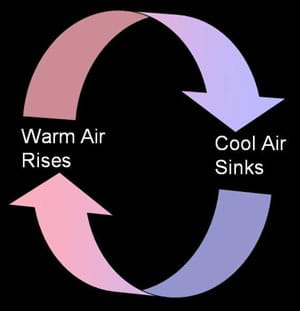
a  hot liquid or air that  expands, becomes less dense, and rises or becomes more dense, and sinks.
c)
When heat transfers from objects that are touching.
d)
When heat transfers through the heater or AC in your house.
12.
What is the definition of CONVECTION
a)
When heat transfers through waves.
b)
When heat transfers from objects that are touching.
c)
a  hot liquid or air that  expands, becomes less dense, and rises or becomes more dense, and sinks.
d)
Heat traveling from the sun
13.
The baby chickens are kept warm from the heat lamps demonstrates this type of heat transfer. 
a)
conduction
b)
convection
c)
radiation
14.

Near the ceiling of a room the air is warmer. The warm air rises because of

a)

conduction

b)

convection

c)

radiation

15.

In heat transfer, heat always flows from the _______________ substance to the _______________ substance.

a)

Hotter to colder

b)

Colder to hotter

c)

Hotter to hotter

d)

Colder to colder

16.

The handle of a metal spoon warms up when it is placed in a hot bowl of soup because of

a)

Convection

b)

Conduction

c)

Radiation

d)

insulation.

17.
Mechanical energy
a)
energy built up before being in motion
b)
energy released in a chemical reaction
c)
energy of motion
d)
sum of kinetic and potential energy
18.
Solar Energy is transferred to _____ Energy.
a)
Mechanical
b)
Solar
c)
Sound
d)
Electrical
19.
Electrical Energy is transferred to _____ Energy.
a)
Thermal
b)
Solar
c)
Electrical
d)
None
20.
The faster an object moves, the ________ kinetic energy it has. 
a)
more
b)
less
c)
none of the above
d)
all of the above 
21.
Gravitational potential energy depends on the ________ and ________ of the object. 
a)
Height and mass
b)
Friction and movement
c)
Mass and Movement
d)
Height and Friction 
22.
What kind of energy is in a rock at the edge of a cliff?
a)
Potential
b)
Kinetic
23.
What kind of energy is in a moving skateboard?
a)
Potential
b)
Kinetic
24.
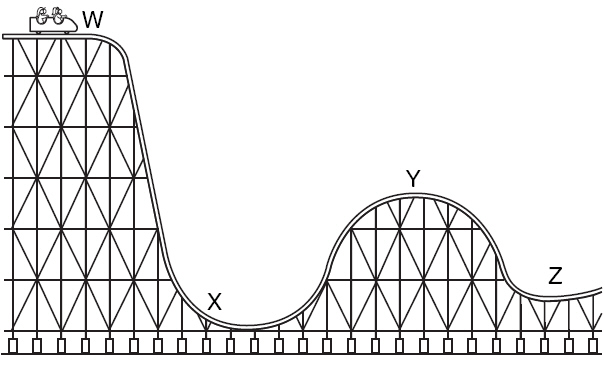
At which point is potential energy greatest?
a)
W
b)
X
c)
Y
d)
Z
25.
Energy can be _____________ or changed from one type to another.
a)
destroyed
b)
transferred
c)
created
d)
ignored
26.
What would have the greatest kinetic energy?
a)
A car driving down a hill.
b)
A person running down a hill. 
c)
A ball rolling down a hill. 
27.
As the thermal energy of a substance increases, its particles spread out and the substance expands.
a)
True
b)
False
28.
The particles of a gas move ____than the particles of the same substance in the liquid or solid state.
a)
faster
b)
slower
c)
same speed
29.
The change of state from a solid to a liquid is called ______.
a)
Freezing
b)
Boiling
c)
Melting
30.
What is the freezing point on the celsius scale?
a)
0
b)
32
c)
100
d)
-100
31.
Thermal energy and temperature are the same.
a)
True
b)
False
32.
_________ is the amount of energy required to raise the temperature of 1 kilogram of a substance by 1 kelvin.
a)
thermal energy
b)
specific heat
c)
thermostat
d)
temperature
33.
A barefoot student steps on a hot concrete surface. Most of the heat transferred to the student’s skin by this contact is by the process of—
a)
convection
b)
conduction
c)
vaporization
d)
radiation
34.

Which model is demonstrating what molecules in a solid look like.

a)
b)
c)
35.

The average kinetic energy of the atomes or molecules within a substance.

a)

thermal energy

b)

kinetic energy

c)

temperature

d)

gas

36.
What is the equation to measure change in Thermal Energy?
a)
Q=mc∆t
b)
Q=mc
c)
Q= ∆mct
d)
m=QC
37.
What is the symbol for Thermal Energy in the specific heat formula?
a)
Q
b)
t
c)
m
d)
C
38.
There are four cups of hot cocoa. The cup sizes are shown. The temperature of the cocoa in each cup is 25 degrees celsius. Which cup has the MOST thermal energy?
a)
Large cup (Trenta)
b)
Small cup (Tall)
c)
Medium cup (Venti)
d)
All three are the same temperature so they have the same thermal energy
39.
What unit do you use to measure Thermal Energy?
a)
J/Kg ºC
b)
Kg
c)
ºC
d)
J
40.
Copper, Stainless Steel, Carbon Steel, and Zinc were all heated using 10,000 JOULES of thermal energy.  What material would be have the LARGEST change in temperature?
a)
Copper
b)
Carbon Steel
c)
Zinc
d)
Stainless Steel
41.
A high specific heat means...
a)
It requires less energy to change temperature
b)
It requires more energy to change temperature
c)
It heats up very quickly
42.
When a  piece of aluminum foil is taken out of the oven and cools from 100° C to 50°C, What is the change in temperature?
a)
50°
b)
c)
100°
d)
150°
43.
Copper, Stainless Steel, Carbon Steel, and Zinc were all heated using 10,000 JOULES of thermal energy.  Based on the chart, which material would be have the SMALLEST change in temperature?
a)
Copper
b)
Carbon Steel
c)
Zinc
d)
Stainless Steel
44.
The specific heat of aluminum is 0.21 cal/g°C.  How much heat(Q) is released when a 10 g piece of aluminum foil is taken out of the oven and cools from 100° to 50°?
a)
105 J
b)
10.5 J
c)
1.05 J
d)
50 J
45.
If 200 grams of water is to be heated from 24.0° C to  100.0° C to make a cup of tea, what is the mass and what is the change in temperature?
a)
m=100g,  ∆t= 224 C
b)
m=200g,  ∆t=124 C
c)
m=100g,  ∆t=24 C
d)
m=200g,  ∆t=76 C
46.
There are 2 pans of water, one has 100 mL in it and one has 1000mL. You add 4000 joules of energy,  which one has the bigger change in temperature?
a)
100 mL
b)
1000 mL
c)
They the same material so they both heat to the same temperature
d)
They both will cool down.
47.
20 g of water. specific heat of water is 4.18 J/g°C.  temperature changes from 25° C to 20° Chow much heat energy (Q) moves from the water to the surroundings?
a)
418 Joules
b)
209 J
c)
83 J
d)
4.18 J
48.
lowest possible temperature on the Kelvin scale
a)
boiling point
b)
insulation
c)
absolute zero
d)
heat
49.
Which of the following would be the best insulator?
a)
air
b)
aluminum
c)
copper
d)
silver