Wayground logo

Free Printable Worksheets

Font size

S
M
L
XL
Worksheets

Adv Bio-Ch 25

Total questions: 82

Worksheet time: 3hrs 9mins

Name
Class
Date
1.

What phylum do flatworms belong too?

a)

Annelida

b)

Platyhelminthes

c)

Nematoda

2.

Flatworms have what kind of body cavity?

a)

Acoelomate

b)

Pseudocoelomate

c)

Coelomate

3.

What kind of symmetry do flatworms have?

a)

They are asymmetrical

b)

Radial symmetry

c)

Bilateral Symmetry

4.

Flatworms do not have gills or lungs and rely of diffusion through the skin to breathe

a)

True

b)

False

5.

The structure that acts as a kidney in a planarian flatworm is called:

a)

pharynx

b)

ganglia

c)

flame cell

6.

The muscular tube near the mouth that aids in getting food is called the:

a)

Pharynx

b)

Gastrovascular Cavity

c)

Flame cell

7.

The planarian does not have a ganglia - small mass of nerves resembling a brain

a)

True

b)

False

8.

The structure that detects light in the planarian flatworm is the

a)

pharynx

b)

flame cells

c)

Eyespots

9.

Planarians are free-living. They do not need a host to survive.

a)

True

b)

False

10.

The mesoderm germ layer refers to an animals:

a)

Lining of the digestive tract

b)

Muscular tissue

c)

Epidermis or Skin

11.

The ectoderm germ layers refers to

a)

The lining of the digestive tract

b)

Muscle Tissue

c)

The epidermis or skin

12.

The endoderm germ layer refers to

a)

The lining of the digestive tract

b)

Muscle tissues

c)

The epidermis or skin

13.

The planarian flatworm uses a process called regeneration to reproduce asexually

a)

True

b)

False

14.

The planarian flatworm has a complete digestive tract with a distinctive mouth and anus.

a)

True

b)

False

15.

Which structure is only found in parasitic flatworms

a)

Flame Cells

b)

Pharynx

c)

Scolex with hooks and suckers

d)

Eyespots

16.

What is the intermediate host of the Schistosoma blood fluke?

a)

Human

b)

Cat

c)

Snail

d)

Bat

17.

What is the primary host of the schistosoma blood fluke?

a)

Human

b)

Cat

c)

Snail

d)

Bat

18.

What is the benefit of flatworms being flat?

a)

Easier to hide from predators

b)

Helps food and oxygen reach all body parts

c)

Lowest energy form of movement

d)

Allows them to stick to the ocean floor

19.

Roundworms are officially known as...

a)

Nematoda

b)

Platyhelminthes

c)

Annelida

d)

Arthropoda

20.

How does the movement of Roundworms differ from that of Flatworms?

a)

Roundworms don't have cilia

b)

Flatworms use hydrostatic pressure

c)

Flatworms do a "spiral lashing" motion

d)

Roundworms have no muscles

21.

The pseudocoelom of roundworms is pumped full of water, creating a round shape, using __________________

a)

hydrostatic pressure

b)

aquaponics

c)

hydrodistribution

d)

corpus aquarius

22.

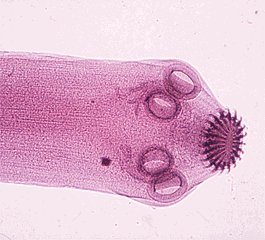
What class?

a)

Class Cestoidea

b)

Class Trematoda

c)

Class Turbellaria

d)

Class Monogenea

23.
This proglottid has both male and female sex organs. They are found in which class of worms?
a)
Cestoda
b)
Trematoda
c)
Turbellaria
d)
Monogenea
24.
Flat worms can reproduce 
a)
sexually 
b)
asexually
c)
both sexually and asexually
25.
Planaria are members of class
a)
Platyhelminthes
b)
Cestoidea
c)
Turbellaria
d)
Trematoda
26.
 Where does the tapeworm live while inside a host?
a)
Head 
b)
Gut 
c)
Foot 
d)
Chest 
27.
What is the function of the scolex of a tapeworm?
a)
To attach to the intestinal wall of the host 
b)
To reproduce
c)
To get rid of waste
d)
To carry the eggs
28.

Which worms belong to the class Trematoda?

a)

tapeworm

b)

planarians

c)

flukes

d)

roundworms

29.

Which of the 3 types of flatworms we talked about are not parasites?

a)

planarians

b)

flukes

c)

tapeworms

d)

monogeneans

30.

This parasitic worm produces a burning blister where it can exit the host.

a)

Hookworm

b)

Tapeworm

c)

Guinea worm

d)

Planarian

31.
which species of nematode is transferred to humans by eating infected pig meat
a)
trichonella
b)
pinworm
c)
diroflaria
d)
cestoda
32.

Roundworms have a false body cavity called

a)

pseudocoelom

b)

acoelom

c)

eucoelom

d)

coelom

33.

Roundworms exchange gases in circulation, respiration and excretion by

a)

diffusion

b)

osmosis

c)

regeneration

d)

heart, lungs, and bladder

34.
What is the radula used for?
a)
Locomotion
b)
Feeding
c)
Swimming
d)
Digging
35.
The protective membrane that surrounds the visceral mass on all mollusks is called...
a)
Radula
b)
Mantle
c)
Nephridia
d)
Visceral Shield 
36.

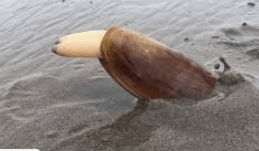
What TYPE of mollusk is this?

a)

Bivalve

b)

Gastropod

c)

Cephalopod

37.

What TYPE of mollusk is this?

a)

Bivalve

b)

Gastropod

c)

Cephalopod

38.

What TYPE of mollusk is this?

a)

Bivalve

b)

Gastropod

c)

Cephalopod

39.

What TYPE of mollusk is this?

a)

Bivalve

b)

Gastropod

c)

Cephalopod

40.

What TYPE of mollusk is this?

a)

Bivalve

b)

Gastropod

c)

Cephalopod

41.

Which TYPE of mollusk has two shells?

a)

Bivalve

b)

Gastropod

c)

Cephalopod

42.

Which TYPE of mollusk has ONE or NO shell?

a)

Bivalve

b)

Gastropod

c)

Cephalopod

43.
What does Cephalopod mean?
a)
means "2-shells"
b)
means "head-foot"
c)
means "stomach-foot"
44.
Which part of the Mollusk body is specialized for burrowing, feeding, and movement?
a)
trochophores
b)
visceral mass
c)
mantle
d)
foot
45.
Cephalopods move by
a)
using jet propulsion
b)
waving their tentacles back and forth.
c)
crawling along on a single muscular foot.
d)
clapping their shells together.
46.
Mollusks can be aquatic or terrestrial. 
a)
True
b)
False
47.
Mollusks are acoelomates. 
a)
True
b)
False
48.
The protective shell of a mollusk...
a)
is secreted by the mantle.
b)
Grows from the end of the mollusk foot. 
c)
Is constantly replaced by bigger shells as the mollusk grows. 
d)
forms when the mollusk reaches adulthood. 
49.
Which of the following is NOT a reason that some mollusks move slowly? 
a)
They have a heavy shell. 
b)
They have a closed circulatory system.
c)
They have an open circulatory system.
d)
Their muscular foot is not well adapted for speed. 
50.
Which of the following is not a potential organ that a mollusk could use for respiration? 
a)
Ctenidia
b)
Simple lung
c)
Mantle 
d)
Nephridia
51.
What is the function of the chromatophores on the mantle of squid, octopus, and cuttlefish? 
a)
Secreting the shell
b)
Stinging prey
c)
Camouflage 
d)
Move water over gills 
52.
Which of the following statements is not true?
a)
A squid has 8 arms and 2 tentacles.
b)
An octopus has 8 tentacles.
c)
A nautilus has 80-90 tentacles. 
d)
A cuttlefish has 8 arms and 2 tentacles.
53.

The internal shell of squid. They're used primarily to support squids muscular tissues and organs.

a)

PEN

b)

TENTACLE

c)

CHROMATOPHORE

d)

CUTTLEBONE

54.

Which part of the Mollusk body is specialized for burrowing, feeding, and movement?

a)

shell

b)

visceral mass

c)

mantle

d)

foot

55.

Organs that are in contact with blood supply and specialized for gas exchange.

a)

fin

b)

radula

c)

bivalve

d)

gills

56.

Which terms are true of bivalves such as oysters and clams? (Select ALL that apply)

a)

bilateral symmetry

b)

filter feeder

c)

highly intelligent

d)

invertebrate

e)

have tentacles

57.
What type of circulatory system do annelids have?
a)
Open Circulatory System
b)
Closed Circulatory System
c)
They don't need a circulatory system
d)
They have both types
58.
Which animals are the FIRST to have developed a true coelom?
a)
Nematodes & Platyhelminthes
b)
Mollusks & Annelids
c)
Cnidarians & Ctenophores
d)
Nematodes & Mollusks
59.
What type of cavity do mollusks have?
a)
Acoelomate
b)
Pseudocoelomate
c)
Coelomate
d)
It depends on the stage in the life cycle
60.
Which phylum do earthworms belong to?
a)
Molluska
b)
Annelida
c)
Nematoda
d)
Platyhelminthes
61.
A clitellum on an earthworm is associated with which system?
a)
Nervous
b)
Circulatory
c)
Reproductive
d)
Respriatory
62.
What do you call external bristles for movement in annelids?
a)
Parapodia
b)
Setae
c)
Foot
d)
Mantle
63.
Which annelids are known for living in marine environments?
a)
Oligochaetes
b)
Polychaetes
c)
Hirudinea
d)
Molluska
64.
Which class of Mollusks have the most advanced nervous system?
a)
Gastropods
b)
Bivalves
c)
Cephalopods
d)
arthropods
65.
Which of the following is the correct description of reproduction in Mollusks?
a)
Mostly asexual
b)
Budding
c)
Regeneration
d)
Mostly sexual
66.
What type of symmetry do Mollusks have?
a)
Asymmetrical
b)
Bilateral
c)
Radial
67.
What is the meaning of Gastropod?
a)
Soft-bodied
b)
Stomach foot
c)
Head-footed
d)
Two-shelled
68.
How do Gastropods obtain nutrients?
a)
Herbivore
b)
Carnivore
c)
Scavenger
d)
All
69.
What do earthworms eat?
a)
grass
b)
insects
c)
dirt
d)
organic matter in the soil
70.
Earthworms and leeches are
a)
dioecious
b)
hermaphroditic / monoecious
c)
asexual
71.

Earthworms are considered

a)

herbivorous pests in gardens

b)

detritivores / scavengers

c)

predators

d)

filter feeders

72.

How do earthworms breathe?

a)

with gills

b)

with lungs

c)

thru skin

d)

all of these

73.
If present, which type of skeleton is found in worms?
a)
Longitudinal
b)
Circular
c)
Exoskeleton
d)
Hydrostatic
74.
Which phylum of worms has a bilateral symmetry, one-way digestive system, respiration through skin, hydrostatic skeleton and segmented body?
a)
Annelida
b)
Platyhelminthes
c)
Nemotoda
d)
Nemertea
75.

What word means the "front" of the worm?

a)

dorsal

b)

ventral

76.
The tubes that contract to force blood through the worm (like a heart) are called ___
a)
clitellum
b)
gizzards
c)
aortic arches
d)
setea
77.
Which of the following is an example of a segmented worm?
a)
tapeworm
b)
roundworm
c)
Leech
d)
Planarian
78.
Which of these is NOT part of the earthworm digestive system? 
a)
pharynx
b)
crop
c)
clittelum
d)
gizzard
79.
The annelid digestive systems is ...
a)
incomplete
b)
complete
c)
closed
d)
opened
80.
Circulatory system of annelids is
a)
full
b)
complete
c)
incomplete
d)
closed
81.
Why are earthworms beneficial? 
a)
breakdown organic material in soil
b)
aerate soil
c)
castings (worm poo) rich in ammonia - used by plants
d)
all 3 are benefits that earthworms provide! 
82.

Segments are created by _____________.

a)

Parapodia

b)

Septa

c)

Setae

d)

Sesmoid Filaments