
 Worksheets
Unit 5 Review
Total questions: 80
Worksheet time: 2hrs 53mins
The moon orbiting the Earth at a constant speed.
balanced force
unbalanced force
Two ice skaters moving in a straight line at a constant speed.
balanced force
unbalanced force
A skier skiing through flags in a race down the mountain.
balanced force
unbalanced force
An object at rest needs an ______________________force in order to move.
balanced force
unbalanced force

Two forces are pushing on the cart with the SAME force. Which of the following best describes the forces and motion of the cart?
Balanced Forces
Balanced Equation
Net Force
25 N

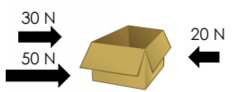
What is the net force?
30 N left
25 N right
5 N left
55 N right


An object at rest will remain at rest and an in motion will stay in motion until acted upon by an unbalanced force.
Gravity
Newton's First Law
Friction
Motion
The force of attraction acting between all matter
Motion
Gravity
Newton's First Law
Friction
A property of an object that resists changing its state of motion or state of rest.
Gravity
Acceleration
Inertia
Newton
The rate at which velocity changes with time
Gravity
Acceleration
Friction
Net Force
A force that resists the sliding or rolling of one solid object over another
Newton's First Law
Motion
Gravity
Friction
The unit of force in the international system of units
Newton
Meters
Friction
Motion
The sum of all forces that act upon an object
Balanced Force
Unbalanced Forces
Net Force
Motion
If a body is at rest or moving at a constant speed in a straight line, it will remain at rest or keep moving in a straight line at a constant speed unless it is acted upon by a force.
Gravity
Friction
Law of Inertia
Acceleration

In a Fall Trip, the 6th grade students drove to Austin, which is 180 miles away. It takes them 3 hours to get there. What was the bus's speed in miles per hour?
60 mph
50 mph
30 mph
55 mph

You need to get to science class in 90 seconds after leaving Ms. William's class, which is 45 meters away. In order not to be tardy, how fast do you need to travel to make it on time in meters per seconds? (HINT: double check your placement in the formula for this problem)
5 m/s
0.5 m/s
0.2 m/s
10 m/s

A comet travels 30,000 kilometers in 15 minutes. What is the speed of the comet in kilometers per minute?
2,200 km/m
1,000 km/m
2,000 km/m
1,800 km/m
speed × time
distance
total time
total speed
average speed
speeddistance
time
average speed
:)
timedistance
speed
total time
average distance
A cyclist covers a distance of 90 kilometers in 5 hours. Calculate the average speed.
15 km/h
18 km/h
20 km/h
22 km/h
Which of the following units can be used to express average speed?
km/h
m/s
mph
All of the above
If a runner completes a 10 km race in 50 minutes, what is their average speed in km/h?
10 km/h
11 km/h
12 km/h
13 km/h
A vehicle travels at an average speed of 80 km/h for 2.5 hours. How far does it travel?
180 km
200 km
210 km
220 km
A group of baby turtles have just hatched in Padre Islands. The baby have to complete a 80 meter dash to the shoreline before the seagulls have them for dinner. It takes the turtles 5 hours to make it to the ocean. What was their average speed?
12 m/hr
80 meters
3 hours
16 m/hr

In this graph, a bus is:
moving
standing still (stationary)
speeding up (accelerating)
slowing down (decelerating)

The speed of a bus in this graph is:
fast
slow
zero
the speed of light

This line is:
a curve
vertical
horizontal
a slope

It is TRUE that (more answers possible):
the graph shows a steep slope line.
the speed is steady in the graph.
a bus is moving forward.
a bus is returning back.

This line shows that:
the bus is at a bus stop
the bus is gradually slowing down (decelerating)
the bus moves in a steady speed
the bus is gradually speeding up (accelerating)

In this graph,
the bus is gradually speeding up (accelerating).
the line is curved.
the bus is gradually slowing down (decelerating).
none of the above.
Match the description to the graph:
"The car is coming back."


Segment A-B The bus is _________________.
at rest
returning (to original position)
moving forward

Describe the motion in the graph:
Constant Speed (positive slope)
Stopped (at rest)
Acceleration (increasing speed)
Return Home (negative slope)

Which is faster?
walking
skating
biking

WHAT WAS EDWARD'S AVERAGE SPEED? (HINT: IT TOOK EDWARD 5 HOURS TO GET TO HIS DESTINATION)
***Remember to use the formula
AVERAGE SPEED = TOTAL DISTANCE/TOTAL TIME
.0625 MILES PER HOUR
16 MILES/HOUR
6.15 MILES/HOUR
HOW LONG DID EDWARD STOP FOR?
1 HOUR AND 30 MINUTES
2 HOURS
2 HOURS AND 30 MINUTES

How far from Bristol is Anne at 08:00?
2O MILES
1O MILES
30 MILES
Describe what is happening between 09:00 and 09:30
(a)
Calculate Anneʼs speed for the first two hours of her journey
10 miles per hour
.20 miles per hour
40 miles per hour

How long does it take the cyclist to cover 800 meter distance?
60 seconds
80 seconds
120 seconds


Maria walked slowly to college along the road, she stopped to look at her watch, she realized she was going to be late for science lab, and she began running.


Carlos and Andrew decided to race each other home from school. The graph below shows the motion of the boys during the race. Which best describes the race?
Both boys reached the finish line at the same time.
Andrew won the race because he reached the finish line in a shorter amount of time.
Carlos won the race because he reached the finish line in a shorter
amount of time.
Andrew won the race because he reached the finish line in a longer amount of time.

Newton's first law is also called the Law of ...
Friction
Inertia
Unbalanced forces
Newtons
Newton's first law applies
to both moving and nonmoving objects
only to moving objects
only to objects that are not moving
Because of inertia, a moving object will keep ________ unless acted on by an unbalanced force.
at rest
moving
in one spot
inertia
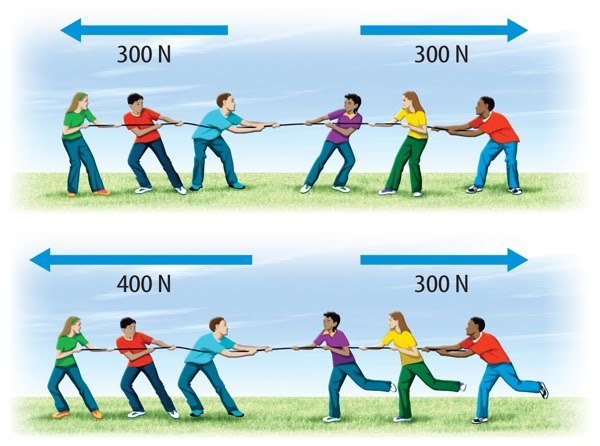
You and your friend, are playing tug of war. Your friend pulls with a force of 55 N to the right. You pull with a force of 65 N to the left. What is the net force on the rope?
10 N, to the left
20 N
10 N, to the lefts
10 N, to the right
What are you calculating when you divide the distance an object travelled by the amount of time it took for that object to travel that distance?
velocity
slope
motion
speed
The SI unit for speed is_______.
meters per second
miles per hour
miles per second
meters per hour
What two things do you need to know to calculate velocity?
direction and distance
speed and distance
speed and direction
Distance and time
A(n) _____ line on a distance-time graph shows a faster speed.
steeper
level
longer
shorter
The _____ of an object in motion can be shown on a distance-time graph.
speed
velocity
direction
displacement

If two objects moving at constant speed are represented on a distance-time graph, which object is moving faster?
the object represented by the steepest line
the object represented by the longest line
the object represented by the shortest line
the object with a horizontal line
A car travels 60 kilometers and makes two 30 minute stops along the way. The entire trip takes 2 hours. What is its average speed?
30 km/hr
60 km/hr
90 km/hr
120 km/hr

What are the axes on a distance-time graph?
the x-axis is time and the y-axis is distance
the x-axis is distance and the y-axis is time
the x-axis is time and the y-axis is speed
the x-axis is speed and the y-axis is time
Which best describes the velocity of a person on a merry-go-round moving at constant speed?
continuously changing
increasing
constant
zero

The two tennis players shown in the image walk to the net top shake hands at the end of the game. What is the displacement of player B
2m
4m
-2m
7m
What is velocity?
The speed of an object
The rate of change in an object's position
The distance traveled over time
The time taken to travel a distance
What additional component does velocity have compared to speed?
Magnitude
Distance
Direction
Time

How many feet did the object move? (numbers only)
(a)

How many inches is the displacement from the start to end position? (number only)
(a)

How many km did the object move during the 10 decades that were graphed? (number only)
(a)
How many km was the object displaced from the start to end position? (number only)
(a)
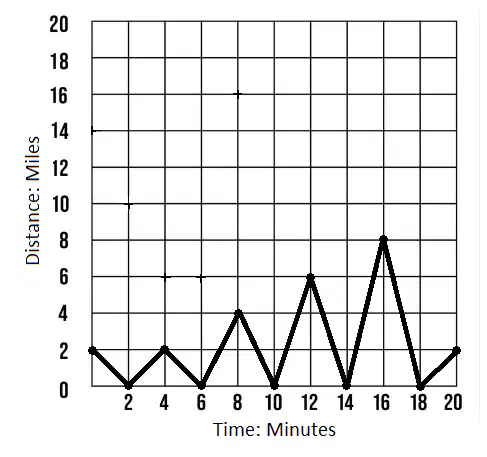
How many miles was the object displaced from the start to end position? (number only)
(a)

