
 Worksheets
Unit 4 test review
Total questions: 68
Worksheet time: 50mins


The variety of genes and alleles that exist in organisms
independent assortment
chromosomal abnormalities
genetic diversity
mutations
Any change in the sequence of DNA is a
recombination
mutation
chromatin
independent assortment
__________________ is when human breed plants or animals to get specific traits. ex. Dogs
artificial selection
natural selection
biological selection
_______________ is a form of an inherited characteristic. Ex. The shape of a chicken’s comb is an inherited trait.
trait
stimulus
response
Which is a group of organisms with similar characteristics and are able to interbreed to produce offspring
Variation
Species
Fitness
Gene
The probability of an organism surviving and reproducing
Variation
Species
Fitness
Gene
A length of DNA that codes for a specific characteristic
Variation
Species
Fitness
Gene
Differences in DNA between individuals or populations
Environmental Variation
Genetic Variation
Adaptive Feature
Genetic Engineering
Differences in DNA as a result of environmental factors
Environmental Variation
Genetic Variation
Adaptive Feature
Genetic Engineering
Taking a gene from one species and putting it in another
Environmental Variation
Genetic Variation
Adaptive Feature
Genetic Engineering
Process of humans breeding animals or plants with desired traits
Environmental Variation
Selective Breeding
Adaptive Feature
Genetic Engineering


What base does RNA have that DNA does not?
uracil
thymine
cytosine
guanine


If this pedigree shows a recessive disorder, what MUST the genotype of individual 4 be?
HH
Hh
hh
How many alleles does a child get from each parent for a trait?
1
2
3
4
Aa, DD, Bb, yy are all examples of ---
genotypes.
phenotypes.
What you see, or the physical appearance of an organism, is called the ---
genotype.
phenotype.
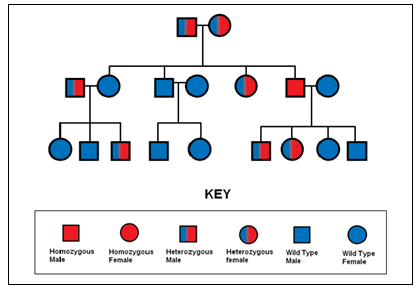
In a pedigree, which shape represents a male?
circle
square
Which gender has an X and a Y chromosome?
male
female

How many individuals are there in the 3rd generation?
1
2
4
6

On a pedigree, this symbol represents a ----
not affected male.
not affected female.
affected male.
affected female.

How are individuals III-2 and II-4 related?
Brother and sister
Dad and daughter
Uncle and niece
Grandfather and granddaughter

On this pedigree, the allele for curly hair is dominant. The couple labeled 2 both have curly hair, but have a daughter who does not have curly hair. Therefore, we can tell from the chart that for the couple labeled 2 -
the male is heterozygous and the female is heterozygous.
the male is homozygous recessive and the female is homozygous dominant.

What is the mode of inheritance shown here?
Recessive because it "skips" a generation
Dominant because it shows up in every generation
The physical transfer of a gene from the DNA of one organism into another organism in order to produce an organism with desired traits is called
Genetic engineering
Karyotype
Cloning
Selective breeding
The physical insertion of "good" copies of a gene into the cells of a person with a genetic disorder in an attempt to correct the disorder
Karyotype
Gene therapy
Selective breeding
Cloning
Selective breeding is...
a process to create an organism with desired traits from parents with those desired traits
natural method of producing offspring with desired traits
creating a new species
making organisms reproduce during times of stress
An example of selective breeding is
a dog breeder mating 2 dogs to make more dogs
a farmer grows bees to pollinate the plants on his farm
a person pollinates 2 white rose plants to only create white roses
One problem with selective breeding is
creating a new species
gene variety is lost
extinction of a species
Increasing helpful traits to an organism is one way a breeder may use selective breeding.
True
False
Which of these is the first step in selective breeding flowers?
Repeat the process only with the offspring with the desired traits
watch the seeds grow
Choose plants that have the desired trait to pollinate
chose which trait is desirable
Which of these is the second step in selective breeding flowers?
Choose which trait is desirable
Watch the seeds grow
Choose plants that have the desired trait to pollinate
Repeat the process only with the offspring with the desired traits.
Which of these is the third step in selective breeding flowers?
Choose which trait is desirable
Watch the seeds grow
Choose plants that have the desired trait to pollinate
Repeat the process only with the offspring with the desired traits.
In which ways can genetic engineering can improve crops?
Make them pest or drought resistant
Make them more nutritious
Make them larger
All options are correct


Advantages of genetically modified crops include(s)
insect resistance
drought/freeze resistance
higher yield
all of these are reasons for using GMOs
Why might people be against cloning?
It is a little creepy
It can cause unknown defects
It is detrimental to genetic diversity
All of the above
Cotton designed to resist pests and pesticides is an example of which of the following?
Genetic engineering
Cloning

