
NEW
Font size
 Worksheets
Ms. Ward's Mid Year Benchmark
Total questions: 27
Worksheet time: 7hrs 45mins
Which of the following is NOT part of an atom?
Electron
Element
Proton
Neutron
What is the basic unit of matter? (Hint: What is all matter made up of?) Cells Light Atoms Nucleus
Cells
Light
Atoms
Nucleus

What particle is X?
Proton
Neutron
Nucleus
Electron
What particle is Y?
Proton
Neutron
Nucleus
Electron
What particle is Z?
Proton
Neutron
Nucleus
Electron

What is the arrow pointing to?
Atom
Molecule
Chemical Bond
Element

What is circled in the picture?
Atom
Molecule
Chemical Bond
Element

What is circled in the picture?
Atom
Molecule
Chemical Bond
Element
The formula for hydrogen peroxide is H2O2. Which model represents hydrogen peroxide?


What are the three particles that make up an atom?
Protons, neutrons, electrinos
Protons, neutrons, electrons
Protons, quarks, neutrinos
Protons, neutrons, nucleus
How many total atoms are in this formula: 2C2H4
12
13
6
8
Is the following chemical equation balanced? 2H2+O2 ---> 2H2O
Yes
No

Changing a gas to a liquid is _______________.
condense
evaporate
sublime
deposit
Changing a liquid to a gas is _______________.
condense
evaporate
sublime
melt
Changing a solid to liquid is _______________.
deposit
evaporate
sublime
melting
Changing a liquid to a solid is _______________.
freezing
evaporate
sublime
melting

Solid
Liquid
Gas
We just experienced a heavy snow storm. After spending several hours making a huge snow fort, we decide to get some hand warmers to put in our gloves and go back outside. Explain how the hand warmers work.
Cold air changes into heat.
Heat blocks the cold air.
Heat travels from cold to warm areas.
Heat travels from warm to cold areas.
When thermal energy is added to a substance the temperature ________________ and the motion of the particles is _______________.
decreases and faster
decreases and slower
increases and slower
increases and faster
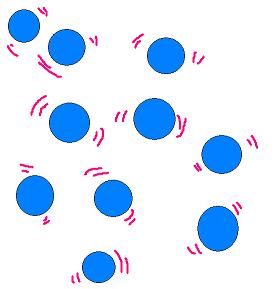
Which state of matter does this picture show?
Solid
Liquid
Gas

Solid
Liquid
Gas

The law of conservation of mass says substances can neither be _______ nor ___________.
Built; torn down
Blended together; separated
Created; destroyed
Condensed; extracted

Sodium and chlorine combine to form sodium chloride, or table salt. Sodium and chlorine are:
Producers
Products
Reactionaries
Reactants
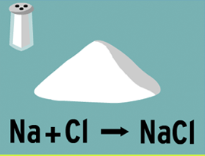
When sodium and chlorine combine to form sodium chloride, sodium chloride is the:
Originator
Reactant
Product
Produce
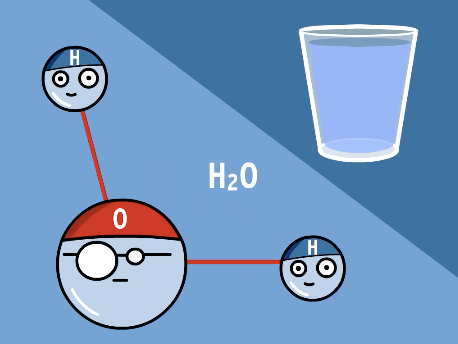
4 grams of hydrogen and 32 grams of oxygen will combine to form:
36 grams of water
28 grams of hydroxide
32 grams of oxygen
36 grams of deuterium
Which of the following IS NOT an example of matter?
Light waves
Chair
Table
Apple

