wayground logo

Free Printable Worksheets

Font size

S
M
L
XL
Worksheets

Ch. 10 & 11-1,2 Review

Total questions: 36

Worksheet time: 57mins
Name
Class
Date
1.
What does Boyle's law relate to?
a)
Temperature and Volume
b)
Volume and Pressure
c)
Temperature and Pressure
2.
When the temperature of matter increases the particles...
a)
speed up and move closer
b)
speed up and move farther apart
c)
slow down and move closer together
d)
slow down and move farther apart
3.
How do gas molecules move? 
a)
in an orderly fashion 
b)
constantly and randomly
c)
in straight line paths
d)
in a circular motion
4.
What type of relationship is Charles' Law?
a)
Inverse
b)
Direct
c)
Not enough information
d)
#goals
5.
True or False: Gases can be compressed. 
a)
True
b)
False
6.
What is the formula for Boyle's Law?
a)
P1V1=P2V2
b)
P1V1/P2V2
c)
P1V2=P2V1
d)
P1/V1=P2/V2
7.
When Pressure increases then the Volume must...
a)
Increase
b)
decrease
8.
When Volume increases then Pressure must...
a)
Increase
b)
Decrease
9.
What type of relationship to pressure and volume have?
a)
direct
b)
inverse
c)
no relationship
d)
I don't know
10.
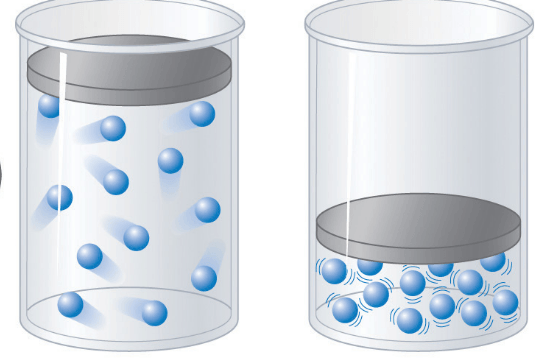
Which container will have a lower pressure?
a)
left
b)
right
c)
they both have the same pressure
d)
I don't know
11.
What causes pressure?
a)
The walls of the container
b)
The vacuum in the container
c)
The collisions of the particles
d)
Atmospheric pressure acting on the outside walls
12.
What type of relationship is Charles' Law?
a)
Inverse
b)
Direct
c)
Not enough information
d)
#goals
13.
If a balloon is cooled what will happen to the volume?
a)
Volume will increase
b)
Volume will decrease
c)
Volume will not change
d)
Balloon freezes to death
14.
You have a gas that has a pressure of 2 ATM and a volume of 10L.  What would be the new volume if the pressure was changed to 1 ATM?
a)
5 L
b)
20 L
c)
It would stay at 10L
d)
1 L
15.
In order to convert to Kelvin, you add ______ to the Celsius measurement.
a)
372
b)
273
c)
237
d)
732
16.
What is 50 °C in Kelvin?
a)
223
b)
323
c)
100
d)
50
17.
What is the device that measures atmospheric pressure?
a)
Aerometer
b)
Annemeter
c)
Barometer
d)
Humidity Detector
18.
If 200 mL of a gas at 27°C is cooled to -33°C at a constant pressure, the volume will be
a)
250 mL
b)
204 mL
c)
196 mL
d)
160 mL
19.
The following graph shows ____ relationship. 
a)
Direct
b)
Inverse
20.

Three gases are mixed together in a container with a total pressure of 4.8 atm. If two of the gases have pressures of 1.2 atm and 1.5 atm, what is the pressure of the third gas?

a)

2.5 atm

b)

1.8 atm

c)

2.1 atm

d)

1.3 atm

21.
If the temperature of a gas increase, the pressure...
a)
Decreases
b)
Increases
c)
Does not change
22.
What is standard temperature?
a)
0K
b)
0oC
c)
173 K
d)
173.15 K
23.
Which of the following is NOT a value for standard pressure?
a)
101.3 kPa
b)
760 mm Hg
c)
1 atm
d)
1 torr
24.
A gas of volume V is placed in a balloon.  Determine the new volume of the balloon if the pressure is tripled. The new volume will be ____ what it was originally.  
a)
1/3 of
b)
1/6 of
c)
1/9 of
d)
 9 times
25.
A gas of volume V is placed in a balloon. The absolute (Kelvin) temperature is tripled. The volume will be _____ what it was originally. 
a)
1/3
b)
1/6
c)
3 times
d)
6 times
26.
A gas of volume V is place in a balloon. The pressure is reduced to 1/5 of the original pressure. The volume will be _____ what it was originally.  
a)
the same as 
b)
1/5
c)
9 times
d)
5 times
27.

Temperature is the same as average kinetic energy.

a)

True

b)

False

28.

Determine the partial pressure of oxygen collected over water, if the temperature is 28℃ and the total pressure is 689.45 mmHg.  Water vapor pressure at 28℃ is 28.3 mmHg.

4 lines
29.

The force of attraction between molecules is ___.

a)

intermolecular forces

b)

bridge forces

c)

chemical bonds

30.

Collisions in which particles transfer all their kinetic energy to other particles are called ___.

a)

elastic

b)

inelastic

31.

A hypothetical gas that perfectly fits all the assumptions of the kinetic molecular theory is known as

a)

real gas

b)

ideal gas

c)

imaginary gas

d)

perfect gas

32.

Which of the following is not true about the volume of a gas?

a)

Most of the volume is empty space.

b)

The volume is occupied by particles in continuous, rapid, random motion.

c)

The volume is about 10 times greater than that occupied by an equal number of particles in the liquid or solid state.

d)

Generally, the volume can be easily changed

33.

Which of the following is an assumption of the kinetic-molecular theory of gases?

a)

Collisions between gas particles are inelastic.

b)

Gases consist of closely spaced particles.

c)

Gas particles move around in an orderly manner.

d)

The temperature of a gas depends on the average kinetic energy of the gas particles.

34.

If a gas has the same temperature throughout, which gas molecule has the highest average velocity?

a)

O2

b)

H2O

c)

H2

d)

Xe

35.

Which condition is necessary for most gases to behave nearly ideally?

a)

high pressure

b)

high temperature

c)

low compressibility

d)

low expansion

36.

Which gas deviates the most from ideal behavior?

a)

CH4

b)

H2O

c)

Cl2

d)

He