

Wayground logo

Free Printable Worksheets

Font size

S
M
L
XL
Worksheets

Neurons, Nervous, and Endocrine Systems.

Total questions: 56

Worksheet time: 1hrs 12mins
Name
Class
Date
1.
Which is the correct sequence in the transmission of a neural impulse?
a)
axon, dendrite, cell body, synapse
b)
dendrite, axon, cell body, synapse
c)
synapse, axon, dendrite, cell body
d)
dendrite, cell body, axon, synapse
2.
Multiple sclerosis is an autoimmune disease in which the body's own immune system destroys the _____________ of the nerve axons. 
a)
Myelin
b)
Dendrites
c)
Axon Terminal
d)
Nodes of Ranvier
3.
An axon conducts nerve impulses _________ the cell body.
a)
away from
b)
toward
c)
both toward and away
d)
around, bypassing
4.
The brain's supporting cells are called: 
a)
glial cells
b)
mitochondria
c)
neurons
d)
nuclei
5.
Neurons that travel toward the central nervous system are called
a)
afferent neurons
b)
efferent neurons
c)
exit neurons
d)
CNS neurons
6.
Impulses that travel down a myelinated neuron move faster than if it was unmyelinated.
a)
True
b)
False
c)
I'm not sure
7.
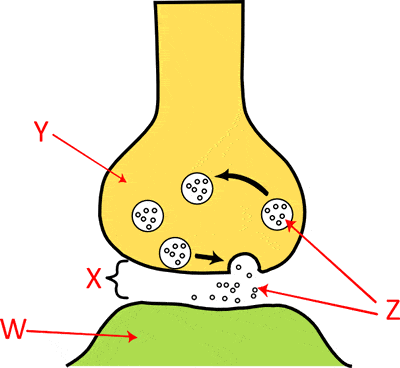
W
a)
Axon Terminal Button
b)
Neurotransmitters
c)
Dendrite
d)
Synapse
8.
_____ neurons carry messages to the central nervous system
a)
Motor
b)
Inter
c)
Sensory
d)
Fun
9.
The spaces between the covered parts of an axon are called:  
a)
synaptic clefts
b)
nodes of Ranvier
c)
Ventricles
d)
Vesicles
10.
______ send signals away from neurons whereas ______ receive signals from other neurons.  
a)
Axons; Dendrites
b)
Synapses; dendrites
c)
Dendrites; axons
d)
Axons; synapses
11.
A nerve cell can also be termed
a)
Neuron
b)
Cell Body
c)
Dendrite
d)
Axon
12.
X
a)
Axon Terminal Button
b)
Neurotransmitters
c)
Dendrite
d)
Synapse
13.
Z
a)
Dendrite
b)
Axon Terminal
c)
Neurotransmitters
d)
Synapse
14.
What is the nerve impulse in the axon called?
a)
action potential
b)
resting potential
c)
membrane potential
d)
synapse
15.
Y
a)
Axon 
b)
Neurotransmitters
c)
Dendrite
d)
Synapse
16.
Identify the part of the neuron
a)
axon
b)
axon terminal
c)
cell body 
d)
dendrite
17.
Identify the part of the neuron
a)
axon
b)
axon terminal
c)
dendrite
d)
Node of Ranvier
18.
Identify the part of the neuron
a)
axon
b)
axon terminal
c)
dendrite
d)
Node of Nazier
19.
What is being identified with the tiny arrows?
a)
calcium channels
b)
neurotransmitters
c)
receptors
d)
vesicles
20.
A chemical produced by neurons that carries messages to other neurons
a)
myelin sheath
b)
neurotransmitter
c)
axon
d)
axon terminal
21.
The tiny gap between neurons where nerve impulses are sent from one neuron to another.  It is where communication occurs between an axon and dendrite
a)
synapse
b)
axon terminal
c)
impulse
d)
myelin
22.

Sends impulses AWAY from CNS to muscle and glands.

a)

Motor Neuron

b)

Sensory Neuron

c)

Interneuron

23.
Which neurotransmitter is released in response to stress and trauma?
a)
Acetylcholine
b)
Endorphins
c)
Serotonin
d)
GABA
24.
Which neurotransmitter is involved in the "Fight or Flight" response?
a)
Acetylcholine
b)
Endorphins
c)
Norepinephrine
d)
Serotonin
25.
Serotonin is a neurotransmitter that helps regulate:
a)
learning and memory
b)
pain and pleasure
c)
muscle movements
d)
sleep, moods/emotions
26.
Nicotine can artificially stimulate receptor sites, making it an __________
a)
Acetylcholine
b)
Antagonist
c)
Agonist
d)
Axon
27.
The depletion of Acetylcholine is associated with the following:
a)
Schizophrenia
b)
Huntington's
c)
Depression
d)
Alzheimer's
28.
What is a neurotransmitter?
a)
fatty covering of the axon
b)
nerve cell
c)
chemical messenger
d)
gap between neurons
29.
When a neuron is not engaged in an impulse.
a)
Resting potential
b)
Action potential
c)
Neural potential
d)
Synaptic potential
30.
In order for a neuron to have an action potential, the neuron must receive more
a)
excitatory neurotransmitters
b)
inhibitory neurotransmitters
c)
agnostic neurotransmitters
d)
antagonistic neurotransmitters
31.

 Once the message is passed on, the neurotransmitters are either broken down by an enzyme or reabsorbed by the terminal buttons, in a process called

a)

receptor sites

b)

synapse

c)

reuptake

d)

axon

32.

_______ is primarily an inhibitory transmitter

a)

GABA

b)

Serotonin

c)

Norepinephrine

d)

Dopamine

33.

Prozac and similar antidepressant drugs predominately affect which circuit

a)

GABA

b)

Dopamine

c)

Serotonin

d)

Endorphins

34.

_________________ resemble/s opiate drugs in structure and effects

a)

Dopamine

b)

GABA

c)

Endorphins

d)

Serotonin

35.
A chemical that blocks a neurotransmitter from being absorbed, thus blocking its effects is a(n):
a)
Agonist
b)
Antagonist
c)
Endorphin
d)
L-Dopa
36.

Endocrine glands secrete _

a)

Hormones

b)

Neurotransmitters

c)

A wide range of chemical substances

37.

What is the main function of the endocrine system?

a)

It creates chemicals, or hormones, that are sent around the body to maintain homeostasis.

b)

It creates electrical messages that are sent around the body to maintain homeostasis.

c)

It maintains the correct level of oxygen in the body to maintain homeostasis.

d)

It releases waste from the body to maintain homeostasis.

38.
An organ that produces secretions called hormones is known as a :
a)
chemical
b)
gland
c)
hormone
d)
duct
39.
What is gland #3?
a)
Adrenal Gland
b)
Pancreas
c)
Ovaries
d)
Testes
40.
Letter H is pointing to
a)
Thymus
b)
Pancreas
c)
Pituitary
d)
Pineal
41.
Letter I is pointing to
a)
Testes
b)
Oviducts
c)
Ovaries
d)
Adrenals
42.

Letter J is pointing to

a)

Ovaries

b)

Pineal Gland

c)

Adrenal

d)

Testes

43.

The gland labeled 4 in the diagram is?

a)

the thymus gland

b)

the thyroid gland

c)

the parathyroid glands

d)

the adrenal glands

44.
What is the name of the structure that connects the pituitary gland to the brain/central nervous system?
a)
Hypophysis
b)
Hypothalamus
c)
Pancreas
d)
Adrenal glands
45.

How do hormones get to their target cells?

a)

nerve impulses

b)

floating in the blood stream

c)

electric and chemical signals

d)

respiration

46.

The "master gland" is known as the __________________.

a)

thyroid gland.

b)

adrenal gland.

c)

pancreas.

d)

pituitary gland.

47.

The response to stress is called

a)

Stay or Stray Response

b)

Fight or Stay Response

c)

Flee or Stray Response

d)

Fight or Flight Response

48.
The nervous system is composed of the ___, ___, and ___.
a)
heart, brain, kidneys
b)
lungs, liver, stomach
c)
brain, spinal cord, nerves
d)
eyes, pancreas, veins
49.

Which 2 are parts of the central nervous system?

a)

brain

b)

nose

c)

spinal cord

d)

left big toe

50.

What part of the nervous system is responsible for slowing down breathing and pulse?

a)

Spinal Nerves

b)

Sympathetic

c)

Parasympathetic

d)

Spinal Nerves

51.

The main function of the nervous system

a)

send messages to and from the brain and spinal cord to and from the body

b)

break down food to be used by the body

c)

remove wastes from the body

d)

all of these

52.

The two major parts of the nervous system are the

a)

brain and spinal cord

b)

central and somatic nervous systems

c)

sympathetic and parasympathetic systems.

d)

peripheral and central nervous systems

53.

Which of the following is regulated by the autonomic nervous system

a)

Breathing

b)

Kicking a soccer ball

c)

Balancing on one foot

d)

Raising your hand

54.

The two parts of the Peripheral Nervous System

a)

Brain and Spinal Cord

b)

Somatic and Autonomic

c)

Systematic and Brain

d)

Spinal cord and Autonomic

55.

Which part of the peripheral nervous system is controlled by you?

a)

Automatic

b)

Somatic

c)

Conscious

56.

Type of neuron located only in the brain and spinal cord that pass impulses from one neuron to another.

a)

Motor Neuron

b)

Interneuron

c)

Sensory Neuron
