
Font size
 Worksheets
4th Physics - Year to Date Mixed Quiz
Total questions: 197
Worksheet time: 4hrs 38mins


What needs to be done to this circuit so that the lamp lights up?
Close the switch
Add another lamp
Add a cell and close the switch

Which switch or switches must be closed to make the lamps light?
Only switch 1
Only switch 2
Switches 1 and 2

What component does this circuit symbol represent?
Voltmeter
Cell
Resistor

If lamp 1 is unscrewed from its holder, what will happen to lamp 2?
It will get brighter
It will go out
It will stay the same brightness

If lamp 1 is unscrewed from its holder, what will happen to lamp 2?
It will stay lit
It will go out
It will get dimmer

What is wrong with this circuit diagram?
There is only one cell
The ammeter should be connected in series
A ammeter should be connected in parallel

Which ammeter will have the biggest reading?
Ammeter 1
Ammeter 2
They will read the same
Which one is a parallel circuit?


What happens to the current in a parallel circuit?
The current stays the same
The current is added
The current is reduced
The current is split between the light bulbs
What happens to the voltage in a series circuit?
The voltage stays the same
The voltage is added
The voltage is reduced
The voltage is split between the light bulbs
What is the definition of current?
The rate of flow of charge
A measure of the difference in energy
How difficult it is for electrons to flow
What happens to the voltage in a parallel circuit?
The voltage stays the same in each branch
The voltage is added
The voltage is reduced
The voltage is split between the light bulbs
Which term can be used instead of voltage?
Resistance
Potential difference
Current

circuits with only one path for current to travel
circuits with more than one path for current to travel
circuits that do not allow electricity to travel through it
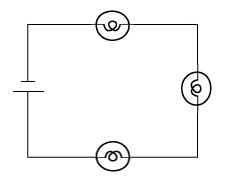

What is the current reading of ammeter A1 ?
10 A
6 A
3 A
4 A
A voltmeter should be placed ........... with the component you are checking.
Which is the unit for voltage?
Amps
Ohms
Volt
Multimeter
Which statement about electric current is correct?
It always flows clockwise
It gets used up as it goes around the circuit
It does not get used up as it goes around the circuit
It always flows anti-clockwise

What would the voltmeter read?
The resistors are all identical.

What is wrong with this plug?
Cable grip not securing cable
Outer plastic case damaged/cracked
Cable not secured properly under cable grip
Live/neutral incorrectly wired

What is wrong with this plug?
Cable grip not securing cable
Outer plastic case damaged/cracked
Cable not secured properly under cable grip
Live/neutral incorrectly wired
(I X R)
If the Voltage stays the same and Resistance is increased, Current will
Increase
Decrease
Stay the same
Double
Which ammeter will have the biggest reading?
Ammeter 1
Ammeter 2
They will read the same
What happens to the current in a parallel circuit?
The current stays the same
The current is added
The current is reduced
The current is split between the light bulbs
What happens to the voltage in a series circuit?
The voltage stays the same
The voltage is added
The voltage is reduced
The voltage is split between the light bulbs
What happens to the voltage in a parallel circuit?
The voltage stays the same in each branch
The voltage is added
The voltage is reduced
The voltage is split between the light bulbs
What would the voltmeter read?
The resistors are all identical.
What is the voltage of an appliance if it uses 200 J per second when supplied with a current of 5 A?
10 V
20 V
30 V
40 V

If lamp 2 is unscrewed from its holder, what will happen to lamp1?
It will stay lit
It will go out
It will get dimmer
It will dissapear
An electric current is defined as the flow of ? through a conductor.
electrons
protons
nuclei
ohms
The unit of electrical potential is the ? , which is represented by the letter ? .
ampere/A
resistance/R
volt/V
watt/W
What is the unit we use to measure electric current?
ampere (amp)
ohm
volt
newton

What is the power rating of a 240 volt, 6 amp device?
1.44
14.4
144
1440

Remember: I = P/V

(I X R)
Voltage divided by Resistance equals
(V / R)
Current
Power
Ohms
Watts
Voltage divided by Current equals
(V / I)
Current
Power
Resistance
Watts
If the Voltage stays the same and Resistance is increased, Current will
Increase
Decrease
Stay the same
Double


Refraction is the change in speed, wavelength and direction of a wave as it passes from one _________ into another.
glass
medium
area
boundary

What is the angle of incidence on a glass block with refractive index 1.52 if the angle of refraction is 32°?
52.6
20.7
32.0
74.3
Which of the following is true about a wave that has been refracted?
The speed and frequency changes, but the wavelength stays the same.
The speed and wavelength changes, but the frequency stays the same.
The wavelength and frequency changes, but the speed stays the same.
The speed and frequency changes, but the amplitude stays the same.


Light is travelling from air to water. Which path will the light most likely follow?
A
B
C
D
E
The higher the index of refraction, the faster light travels in that medium
True
False
Fiber optic cables work because of the principle of _____.
total internal refraction
incomplete internal refraction
total internal reflection
partial internal reflection

What is the angle of reflection (θr) in the image?
56o
90o
124o
34o
Refraction is the change in speed, wavelength and direction of a wave as it passes from one _________ into another.
glass
medium
area
boundary
What is the equation linking angle of incidence, angle of refraction and index of refraction?
n = sin(r)sin(i)
n = sin (i)sin (r)
n = ir
n = sin(i) ×sin(r)

State the name given to the change in direction of the signal at B
Total internal reflection
reflection
dispersion
refraction
Light at the boundary from plastic to air undergoes total internal reflection at an angle of incidence of 45 degrees. The refractive index of this plastic is...
1.4
1.3
1.1
1.0
The refractive index of a type of glass is 1.66.
What is the critical angle for this material?
53.2
48.8
37
no critical angle


The units of frequency are...
metres
seconds
Hertz
degrees
Sound is an example of a transverse wave
True
False
Which of the following statements describes the period of a wave?
Number of waves per second
Distance from crest to crest
Distance from resting position to top of the wave
Time taken to produce one wave
A microwave has a frequency of 300MHz. What is the wavelength of these waves?
1000 m
100 m
10 m
1 m
All waves can be reflected and refracted.
True
False
The period of a wave is 0.1 s. What is the frequency of this wave?
0.1 Hz
1 Hz
10 Hz
100 Hz

Sound waves travel faster through ________ media, like water or steel.
The loudness of a sound is directly related to the wave's _____.
wavelength
frequecy
rest position
amplitude
Human ear can detect frequency ranging from about 20Hz up to (a) Hz

What is the frequency of the wave?
2 Hz
4 Hz
1 Hz
0.5 Hz

What is the wavelength of the wave?
2 m
4 m
6 m
8 m
Assume that the speed of sound is 330m/s. A ship is 220 m from a large cliff when it sound its foghorn. When the echo is heard on the ship , how far has the sound travel?
(a)


Diagram shows the trace displayed on the screen of a C.R.O. with the time-base set to 10 ms/div. What is the frequency, f of the wave?
5 Hz
25 Hz
40 Hz
50 Hz

Diagram shows a waveform displayed on the screen of a C.R.O. If the controls on the C.R.O. are set at 0.5 V/div and 2 ms/div, find the peak voltage and the frequency of the input signal.
4 V, 2 Hz
5 V, 10 Hz
2 V, 100 Hz
4 V, 100 Hz
What state of matter is most tightly packed?
solid
What is specific heat capacity?
The power needed to raise the temperature of 1 kg of a substance by 1oC.
The energy needed to raise the temperature of 1 kg of a substance by 1oC.
The temperature increase of 1 kg of a substance when it is heated for 1 minute.
The mass of a substance whose temperature will increase by 1oC when heated for 1 minute.
What are the units for energy?
Joules (J)
Watts (W)
Kilograms (kg)
Seconds (s)
How do we say Δ in science and maths?
Alpha
Beta
Gamma
Delta
The specific heat capacity of a substance is 1000 J/kgoC. How much energy is required to raise 1 kg of it by 1oC?
10 J
100 J
1000 J
10,000 J
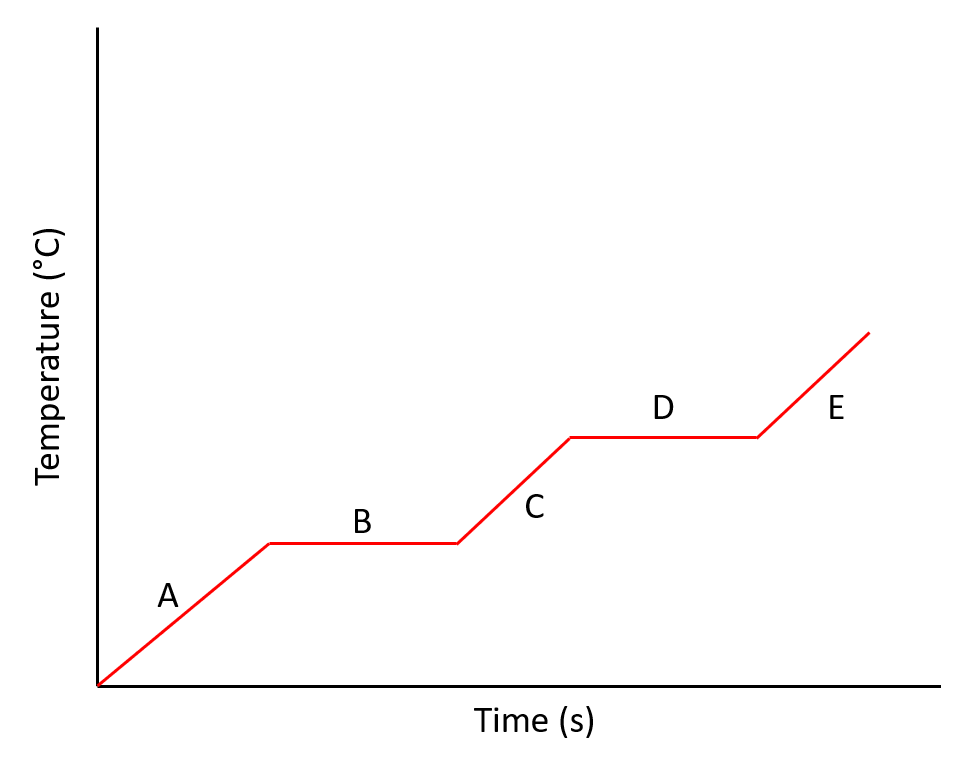
The diagram shows a heating curve for ice turning to steam. Which line represents the ice melting?
A
B
C
D
E
The diagram shows a heating curve for ice turning to steam. Why are lines B and D flat?
All of the thermal energy is used to break the bonds.
They stopped the stopwatch.
They stopped heating the ice.
The ice is freezing.
The diagram shows a heating curve for ice turning to steam. Which line represents the ice in a liquid state (water)?
A
B
C
D
E

The diagram shows a cooling curve for steam turning to ice. Which line represents the ice in a liquid state (water)?
A
B
C
D
E
The diagram shows a cooling curve for steam turning to ice. Which line represents the ice freezing?
A
B
C
D
E
The diagram shows a cooling curve for steam turning to ice. Which line represents the ice in a solid form?
A
B
C
D
E

Two satellites of equal mass are in circular orbit around a planet. Satellite b is twice as far out. Which feels a stronger gravitational force?
Satellite a
Satellite b
Both the same

The space shuttle is orbiting the Earth clockwise. Which arrow shows the direction of the gravitational force acting on the shuttle?
a
b
c
d

A satellite is launched into an orbit around the Earth. The time taken to complete an orbit is known.
What additional information do you need to calculate the orbital speed of the satellite?
The distance from the centre of the Earth
The acceleration of gravity at the surface
Earth's distance from the Sun
The satellite's size
When a satellite travels at constant speed, its orbit shape is approximated as a(n)
circle
ellipse.
oval that is almost elliptical
square
If the distance between a planet and the Sun increases, the strength of the gravitational force __________________.
increases
decreases
stays the same

You discover a new planet in our solar system. You measure it's orbital period to be 246 Earth years.
Where is this planet likely to be located based on this information?
Closer to the Sun than Mercury.
Located between Earth and Jupiter.
Located between Uranus and Neptune.
Located beyond Neptune.
The Moon has an orbital period of 27.3 days and is 384399 km from the Earth.
What is the orbital speed of the Moon?
0.5 km/s
1.0 km/s
2.0 km/s
5.0 km/s
A planet with a short orbit has...
a short day
a long day
a long year
a short year
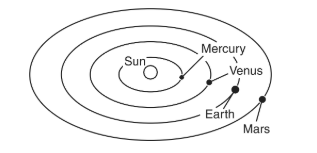
Which planet will take the least amount of time to revolve around the Sun?
Mercury
Venus
Earth
Mars
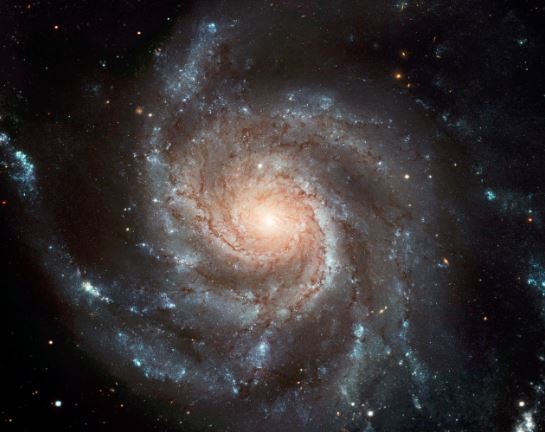
Without gravity, the stars, planets and all objects in the universe would _______.
continue to orbit each other
move in a random direction
move in a straight line
stop moving
What would happen to Earth if its forward motion stopped?
Earth would continue to orbit in our Solar System normally.
Earth would sit motionless and not moving.
Earth would drift off in space because nothing would hold it in the Solar System.
Earth would move toward the Sun and eventually crash into it.
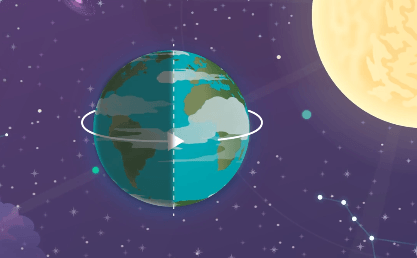

What orbits the Earth?
The Sun
The Moon
Jupiter
All The Planets
Convert 1 Earth year to Earth seconds.
8766 s
525960 s
31557600 s
1893456000 s
Deimos is a moon that orbits the planet Mars.
The radius of its orbit is 23500 km and its time period is 1.26 days.
Calculate the orbital speed of Deimos.
117000 km/day
11700 km/day
18700 km/day
1870 km/day
Mars is 1.5 times further away from the Sun that the Earth.
One Mars year is 1.88 Earth years long.
If the Earth travels at 30km/s. How fast is Mars travelling?
10.6 km/s
23.9 km/s
30 km/s
84.6 m/s
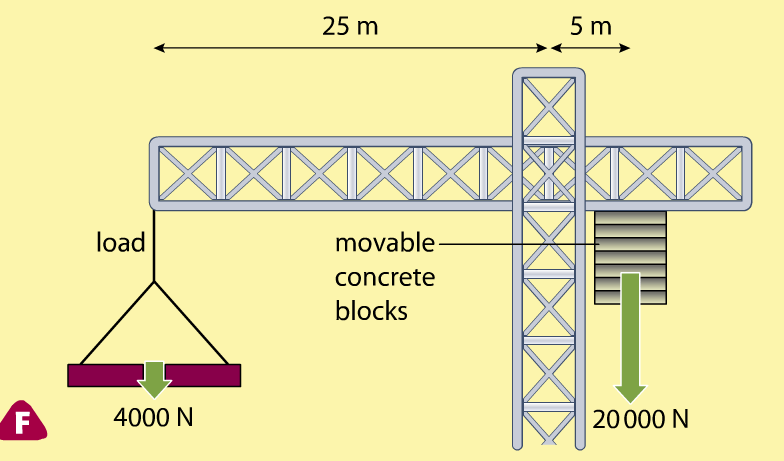


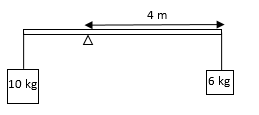
Two masses of mass 10.0 and 6.0 kg are hung from massless strings at the end of a light rod. The rod is virtually weightless. A pivot (fulcrum) is placed off center and the system is free to rotate. If the 6.0 kg mass is 4.0 m away from the pivot, how far away is the 10.0 kg mass if the system is not rotating?
0.42 m
2.4 m
4.8 m
4.2 m
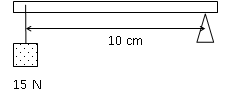
A nut can be loosened more easily with
a short spanner because a larger turning effect can be produced.
a long spanner because a larger turning effect can be produced.
a long spanner because a larger force can be produced.
a short spanner because a larger force can be produced.

The figure below shows a man lifting a heavy rock using a steel bar. He pushes downwards on the end of the bar with a force F.
Which pivot positions allows the force F to be as small as possible?
A
B
C
D
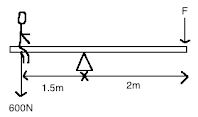
A boy of weight 600N sits on the see-saw as shown at a distance of 1.5m from the pivot. What is the force F required at the other end to balance the see-saw?
450 N
350 N
4.5 N
200 N

At what distance should a 2N load placed from the pivot so that the see saw won't move?
0.2m
0.5m
0.45m
0.42m
State the principle of moments.
When a system is in equilibrium, the sum of the total clockwise moment is equal to the sum of the total anti-clockwise moment about the same pivot.
When a system is in equilibrium, the sum of the total clockwise moment is greater the sum of the total anti-clockwise moment about the same pivot.
When a system is in equilibrium, the sum of the total clockwise moment is less than the sum of the total anti-clockwise moment about the same pivot.
When a system is in equilibrium, the sum of the total clockwise moment is equal to the sum of the total anti-clockwise moment about the different pivot.

What is the best description of the relationship shown in this graph?
In this graph, the relationship between force and extension is linear.
In this graph, the relationship between force and extension is non-linear.
In this graph, the relationship between force and extension is directly proportional.
In this graph, there is no relationship between force and extension.

The graph shows the relationship between force and extension as a spring is extended. What is another name for point A?
Point A is the elastic limit
Point A is the elastic summet
Point A is the plastic limit
Point A is the extension limit

In which side of the graph does the spring obey Hooke's law?
To the left of point A
To the right of point A
Which statement most accurately represents Hooke's Law?
a) The stretch of a spring is directly proportional to the force applied.
b) The stretch of a spring is proportional to the number of coils.
c) The stretch of a spring is inversely proportional to the force applied.
d) Thickness of a spring wire is proportional to the force applied.

An unstretched spring becomes longer when a force is applied to it. Which word describes the additional length of the spring gains?
Expansion
Extension
Stretched

Select a logical prediction for the investigation.
As the force applied to the spring increases, the extension of the spring will decrease.
As the force applied to the spring increases, the extension of the spring will stay the same
As the force applied to the spring increases, the extension of the spring will also increase.

An elastic material can change shape when ________ is exerted on it.
a force
a moment
an acceleration

A deformation is a change in _________.
Speed
shape
direction

In the diagram, a force is used to stretch a spring. The spring is temporarily deformed when the force is applied. When the force is removed, the spring . . .
returns to its original length.
stays the same length.

The _________ of an object is the increase in its length when it is stretched.
compression
extension

For this spring, as the force increases, the extension increases proportionally. What would you expect to happen to the extension if the force was doubled?
The extension would stay the same.
The extension would double
The extension would halve
Hooke's Law stops being relevant when a material goes past its:

