Wayground logo

Free Printable Worksheets

Font size

S
M
L
XL
Worksheets

Mid Chapter 4 Review

Total questions: 100

Worksheet time: 3hrs 24mins

Name
Class
Date
1.
Evaluate f(-2) if f(x) = x+3
a)
-1
b)
1
c)
5
d)
-5
2.
For the function {(0,1), (1,-3), (2,-4), (-4,1)}, write the domain and range.
a)
D: {1, -3, -4,}
R: {0, 1, 2, -4}
b)
D:{0, 1, 2, -4}
R:{1, -3, -4}
c)
D:{0, 1, 2, 3, 4}
R:{1, -3, -4}
3.
a)
Function
b)
Not a Function
4.
a)
Function
b)
Not a Function
5.
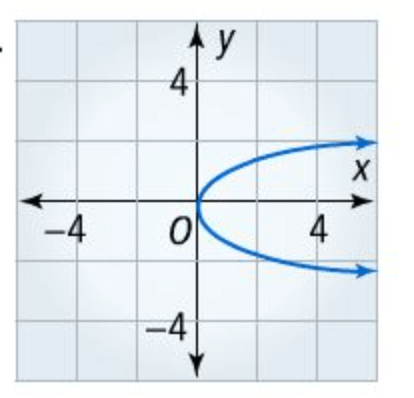
Which graph is not a function?
a)
Graph 1
b)
Graph 2
c)
Graph 3
d)
Graph 4
6.
All of the y values or outputs are called what?
a)
Domain
b)
Range
c)
Relation
d)
Function
7.
All of the x values or inputs are called what?
a)
Domain
b)
Range
c)
Relation
d)
Function
8.
a)
Function
b)
Not a Function
9.
a)
Function
b)
Not a Function
10.
f(x) = -3x + 3
find f(0)
a)
0
b)
-3
c)
3
d)
-1
11.
Solve for f(10):
f(10) = -x - 5
a)
15
b)
-5
c)
-15
d)
50
12.
What does f(-4) equal?
f(-4) = -2x - 8
a)
8
b)
-4
c)
-16
d)
0
13.
What does f(10) equal?
f(10) = -1.5X
a)
10
b)
-1.5
c)
-30
d)
-15
14.
Solve for f(5):
f(5) = -x + 4
a)
9 
b)
1
c)
-1
d)
-9
15.

Given the function
f(x)=x+3f\left(x\right)=x+3  

Evaluate: 


f(−2)f\left(-2\right)  

a)

f(−2)=−1f\left(-2\right)=-1  

b)

f(−2)=1f\left(-2\right)=1  

c)

f(−2)=5f\left(-2\right)=5  

d)

f(−2)=−5f\left(-2\right)=-5  

16.

Given 
  g(x)=4x−2g\left(x\right)=4x-2  


Evaluate: 

g(−7)g\left(-7\right)  

a)

g(−7)=−30g\left(-7\right)=-30  

b)

g(−7)=−26g\left(-7\right)=-26  

c)

g(−7)=−36g\left(-7\right)=-36  

d)

g(−7)=26g\left(-7\right)=26  

17.

Given:
w(x)=−10x−5w\left(x\right)=-10x-5  

Evaluate: 
w(1)w\left(1\right)  

a)

w(1)=−15w\left(1\right)=-15  

b)

w(1)=−5w\left(1\right)=-5  

c)

w(1)=5w\left(1\right)=5  

d)

w(1)=15w\left(1\right)=15  

18.

Given:
f(x)=6xf\left(x\right)=6x  


Find x when  f(x)=−24f\left(x\right)=-24  

a)

x=−4x=-4  

b)

x=4x=4  

c)

x=−144x=-144  

d)

x=−6x=-6  

19.

Evaluate f(-2) if f(x) = x2+ 3

a)

-1

b)

1

c)

7

d)

-7

20.
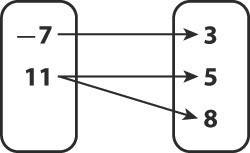
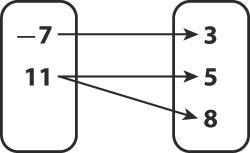
Is the relation a function? Why.
a)
Yes, because the x-value 11 has two y-values pair with it.
b)
Yes, because each x-value has only one y-value paired with it.
c)
No, because the x-value 11 has two y-values pair with it.
d)
No, because each x-value has only one y-value paired with it.
21.
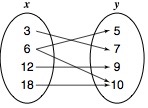
Is this mapping a function or not a function? 
a)
Function
b)
Not a Function
22.
Is this table a function or not a function? 
a)
Function
b)
Not a Function
23.
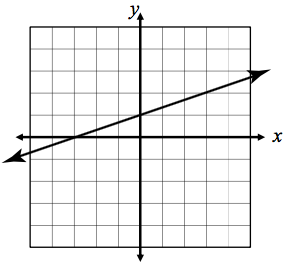
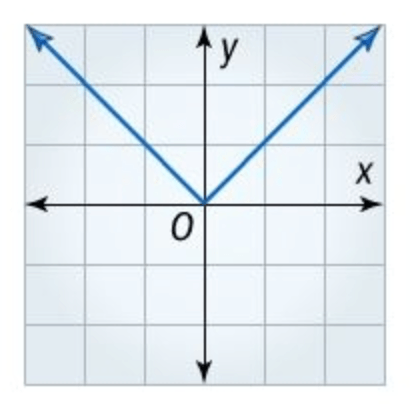
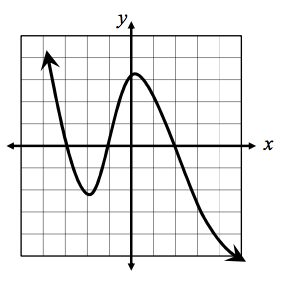
Is this graph a function or not a function? 
a)
Function
b)
Not a Function
24.
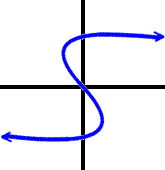
Is this graph a function or not a function? 
a)
Function
b)
Not a Function
25.
Is this graph a function or not a function? 
a)
Function
b)
Not a Function 
26.
What is the range of the following relation:
(9, -2) (4, 3)  ( 8, 10) ( -4, 8)
a)
-4, 4, 8, 9
b)
-2, 3, 8, 10
c)
(9, -2) ( 4, 3)
d)
(8, 10) (-4, 8)
27.
a)
Function
b)
Not a Function
28.
a)
Function
b)
Not a Function
29.
a)
Function
b)
Not a Function
30.
a)
Function
b)
Not a Function
31.
a)
Function
b)
Not a Function
32.
a)
Function
b)
Not a Function
33.
a)
Function
b)
Not a Function
34.
a)
Function
b)
Not a Function
35.
a)
Function
b)
Not a Function
36.
a)
Function
b)
Not a Function
37.
What is the definition of function?
a)
Has inputs and outputs
b)
Every input has only ONE output
c)
Inputs have different outputs every time
d)
x-values and y-values
38.
Is this mapping a function or not a function? 
a)
Function
b)
Not a Function
39.
Is this graph a function or not a function? 
a)
Function 
b)
Not a Function
40.
Is this set of ordered pairs a function or not a function? 
a)
Function
b)
Not a Function 
41.
Is this mapping a function or not a function? 
a)
Function
b)
Not a Function 
42.
Is the graph pictured a function?
a)
Yes
b)
No
43.
.
a)
Function
b)
Not a Function
44.
Is this set of ordered pairs a function or not a function? 
a)
Function
b)
Not a Function 
45.
Which graph does NOT pass the vertical line test?
a)
Graph 1
b)
Graph 2
c)
Graph 3
d)
Graph 4
46.
.
a)
Function
b)
Not a Function
47.
Which set of values is a function?
a)
(9,5) (10,5) (9,-5) (10,-5)
b)
(3,4) (4,-3) (7,4) (3, 8)
c)
(6,-5) (7, -3) (8, -1) (9, 1)
d)
(2, -2) (5, 9) (5, -7) (1, 4)
48.

a. E = {(3, 2) (2, 3) (3, 6) (2, 5)}

a)

FUNCTION

b)

NOT FUNCTION

49.

b. B = {(1, 1) (2, 2) (3, 3) (4, 4)}

a)

FUNCTION

b)

NOT FUNCTION

50.

c. C = {(1, 0) (0, 3) (0, -1) (-1, 5)}

a)

FUNCTION

b)

NOT FUNCTION

51.

d. A = {(1, 2) (2, 3) (3, 4) (4, 5)}

a)

FUNCTION

b)

NOT FUNCTION

52.

e. I = {(-2, 1), (-3, 2), (-4, 3), (-5, 4), (-6, 5)}

a)

FUNCTION

b)

NOT FUNCTION

53.
a)

FUNCTION

b)

NOT FUNCTION

54.
a)

FUNCTION

b)

NOT FUNCTION

55.
a)

FUNCTION

b)

NOT FUNCTION

56.
a)

FUNCTION

b)

NOT FUNCTION

57.
a)

FUNCTION

b)

NOT FUNCTION

58.
a)

FUNCTION

b)

NOT FUNCTION

59.
a)

FUNCTION

b)

NOT FUNCTION

60.
a)

FUNCTION

b)

NOT FUNCTION

61.
a)

FUNCTION

b)

NOT FUNCTION

62.
a)

FUNCTION

b)

NOT FUNCTION

63.

Is the relation a function?

a)

Yes

b)

No

64.
Is this set of ordered pairs a function and how can you tell?
a)
Yes its a function because no y values repeat
b)
No it's not a function because there are negative numbers
c)
No it isn't a function because an x value repeats but has different y values 
d)
No it isn't a function because an y value repeats but has different x values
65.
Is the relation a function?{(1,5),(1,7),(3,9),(4,11)}
a)
Yes
b)
No
66.

Look at the graph. Is the relation a function?

a)

yes

b)

no

67.
Is this mapping a function or not a function? 
a)
Function
b)
Not a Function 
68.

Is this table a function?

a)

Function

b)

Not a function

69.
a)
Function
b)
Not a Function
70.
a)

Function

b)

Not a Function

71.
a)

Function

b)

Not a Function

72.
a)
Function
b)
Not a Function
73.
a)
Function
b)
Not a Function
74.
If my function rule is x + 3, what is the OUTPUT if the input is 4?
a)
4
b)
3
c)
7
d)
10
75.
If my function rule is 4x, what is the OUTPUT if the input is 5?
a)
45
b)
54
c)
9
d)
20
76.
If my function rule is 2x + 1, what is the OUTPUT if the input is 2?
a)
5
b)
4
c)
22
d)
23
77.
If my function rule is x - 5, what is the OUTPUT if the input is 14?
a)
9
b)
19
c)
21
d)
1
78.

If my function rule is x÷3, what is the OUTPUT if the input is 12?

a)

9

b)

4

c)

3

d)

36

79.

What number should be in the ?

a)

5

b)

6

c)

7

d)

8

80.

What number should be in the ?

(a)  

81.

What number goes in the ?

(a)  

82.

What number goes in the ?

a)

12

b)

20

c)

10

d)

4

83.

What number belongs in the ?

a)

10

b)

9

c)

8

d)

7

84.

What number goes in the ?

a)

15

b)

10

c)

18

d)

3

85.

Look at the table. What is the rule?

a)

Subtract 2

b)

Add 2

c)

Add 3

d)

Subtract 4

86.

What is the rule in this table?

a)

Subtract 5

b)

Add 5

c)

Subtract 10

d)

Add 10

87.

What number should be in the ?

a)

10

b)

13

c)

14

d)

15

88.

y=x-6

What is the missing number?

a)

12

b)

10

c)

14

d)

13

89.

Level 3 Which equation matches the table?

a)

y = x + 5

b)

y = 5x

c)

y = x - 5

d)

x = y - 5

90.

Level 3 Which table of values can be defined by y=x+5?

a)

a

b)

b

c)

c

91.

Level 1 Find the missing OUTPUT value.

a)

8

b)

-2

c)

2

d)

-8

92.

Find the missing OUTPUT value.

a)

-2

b)

3

c)

9

d)

-7

93.

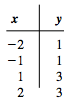
Is the relation a function? Explain.

a)

Yes, the x-value 11 has two y-values paired with it.

b)

Yes, each x-value has only one y-value paired with it.
c)

No, the x-value 11 has two y-values paired with it.

d)

No, each x-value has only one y-value paired with it.

94.

Does the table represent a function?

a)

Yes

b)

No

95.

Does the graph represent a function?

a)

Yes

b)

No

96.

Does the graph represent a function?

a)

Yes

b)

No

97.

For the function rule, y = -2x + 3: If the input is 4, what is the output?

a)

5

b)

11

c)

-5

d)

-11

98.
Which point is on the graph?
a)
(0,0)
b)
(-2, -2)
c)
(0, 2)
d)
(2, 0)
99.
What is the function of the table?
a)
y=3x+1
b)
y=4x-2
c)
y=x+1
d)
y=x+7
100.
What is the function of the table?
a)
y=x*2
b)
y=x+2
c)
y=x/2
d)
y=x-2