
 Worksheets
Unit 4: Economics
Total questions: 77
Worksheet time: 58mins
This is a tax on goods brought into a country...
Mercantilism
Feudalism
Tariff
Market
What was the goal of mercantilism?
To control trade and gain wealth
Make colonies wealthy
Import many goods from other nations
Share wealth with other nations
What is mercantilism?
System where a mother countries gains money and power from natural resources that come from its colonies.
Where colonies trade gold and silver with each other
wars that start over money
plantation colonies trading enslaved peoples for money
The impact of mercantilism was that...
the rate of slavery in the Americas went down
trade was limited in the Atlantic
the colonies grew wealthy
the Mother Country (Britain) grew wealthy
All of the following were major changes brought about by the Market Revolution EXCEPT:
People moving from farms to factories
Movement of homes in the country to home in the city
Electricity in people’s homes
Easier communication and transportation
The factory system made life easier because:
It streamlined the process of creating goods
It helped business owners speak directly with consumers
It helped transport goods faster and easier
It greatly reduced the number of hours individuals spent on farm labor
A canal is best explained as a
Natural river
Man-made river
Waterway from the mountains
Tunnel across states
The steamboat and the railroad made life easier because:
They streamlined the process of creating goods
They helped business owners speak directly with consumers
They helped transport goods faster and easier
They greatly reduced the number of hours individuals spent on farm labor
During the Market Revolution people’s lives became all of the following except:
Easier through new inventions
Faster from new transportation
Simpler from new modes of communication
Harder due to increasing prices
How did the US economy change after Reconstruction? (5-3.1)
Farmers produced more crops.
Trade was even more important to the US.
The US became a manufacturing and production country.
More people moved to the country because of overcrowding.
How did new methods of mass production contribute to the Industrial Revolution?
New products were all made by hand.
Businesses used sharecropping to increase the production of goods.
New products were made quickly and cheaply
Cities became ghost towns because machines replaced manual labor.
What happened as America shifted from an agrarian (farming) nation to an industrial nation?
New technologies helped farm work get done quicker and quicker.
It led to higher crop output.
Many people moved to the cities to make more money.
All of the above
Andrew Carnegie and John D. Rockefeller developed business practices that let them take total control of a specific industry. This practice was called ______________.
monopoly
technology
labor unions
urbanization
Growth of big business led to all EXCEPT which of the following:
People left cities and began to farm
By 1900, more Americans worked in factories than on farms
Big business created millions of jobs
The US became the world’s leading producer of manufactured goods
The Industrial Revolution
did not change life much for Americans.
saw an increase in urban population.
changed our government to a monarchy
moved people westward.
Why did production of goods transition away from the home?
Too many people moved to the city.
It was replaced by the factory system.
The need for textiles decreased.
Women who worked in cottage industries went on strike.
The Erie Canal promoted growth of cities and
decreased the cost of shipping goods in the Midwest
helped Disney cruises
increased trade in New Orleans
increased the cost of shipping goods
What statement about tenements was true during the Gilded Age?
The living conditions of tenements improved greatly
The number of people living in tenements declined
Many immigrants lived in crowded tenements
Tenements were torn down and rebuilt

An increase in political corruption, big business, immigration, and urbanization took place during the-
Progressive Era
Gilded Age
Roaring 20's
Great Depression
During the Gilded Age there was an increase in ____________________ and ___________________ as people moved to U.S. cities looking for economic opportunities.
Work and Infrastructure
Corruption and Laissez-Faire
Urbanization and Immigration
Monopolies and Political Bosses
Andrew Carnegie was an entrepreneur and a _____________ because he donated money to libraries and universities.
Person
Philanthropist
Nativist
Political Boss
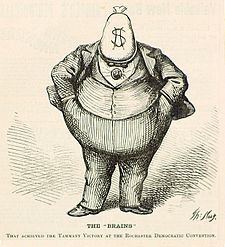
One of the most influential political machines was -
Upton Sinclair and the FDA
Samuel Gompers and the American Federation of Labor
W.E.B. DuBois and the NAACP
Boss Tweed and Tammany Hall
John D. Rockefeller had a monopoly over which in industry?
Steel
Railroads
Oil
Banking

What does this image say about the control of political bosses?
political bosses wanted to squish the opportunities in New York
political bosses control all of New York City
Political bosses were showing their approval with a "thumbs up" image
New Jersey did not have political bosses

From this image, who is in control of the US lawmakers.
Large monopolies
small private business
political machines
labor unions

Why does this image depict Rockefeller so large?
He was a political boss who tried to win governmental favors
He was a government inspector looking for corruption
He was a robber baron who used his money and power to influence government
He was looking to correct all of pollution cause by industrialization

What does this image say about the control of Stand Oil?
Standard Oil is a monster trying to control the entire USA
Standard Oil is trying to save government from political bosses
Standard Oil is trying to keep government on the right track to benefit laborers
Stand Oil had control over many aspects of government

What does this image say about the need for labor unions?
labor unions were desirable because the workers were being crushed by difficult living conditions and poor pay.
Labor unions decreased nativism
Labor unions helped big business keep control of the workers
Labor unions helped reduce the length of the work day
Between 1848 and 1920, suffragists protested for women to have the right to vote.
Which amendment guaranteed women this right in the United States?
16th
17th
18th
19th
The Jungle exposed unsanitary and unsafe practices in the meatpacking industry.
Which muckraker is responsible for exposing the conditions?
Jacob Riis
Lewis Hines
Ida Tarbell
Upton Sinclair

Prohibition banned the making, selling, buying, or drinking of alcohol. Which amendment made this possible?
17th Amendment
18th Amendment
19th Amendment
21st Amendment
Reporters, journalists, photographers, and authors who used the media to raise concerns about the negative effects of industrialization were known as
muckrakers
suffragists
immigrants
abolitionists
____________?____________
A period of time when social, economic and political problems caused by rapid industrialization were exposed and in some cases reformed.
What is the most likely title for this?
Industrialization
Progressive Era
Reconstruction
Prohibition
The purpose of the Sherman Anti-Trust Act was to
break up monopolies
give equal rights to women
help people living in poverty
end racism

The campaign to stop abuse in the homes by urging people and the government to stop alcoholism was called
Women Suffrage
Temperance Movement
Alcoholics Anonymous
Fair Weather Fan
What was the primary way flappers of the 1920s challenged the traditional role of women?
fought for increased job opportunities
pressured colleges and universities to accept female students
displayed fashions and behaviors that shocked mainstream society
helped female politicians win campaigns
What was a immediate effect of the radio?
help with finances
mobility for the working class
improved access to information
helped women get away from traditional roles
Environmental disaster that hit farmers on the great plains; Large dust storms made it impossible to farm:
Great Migration
1930s Wind Storms
Dust Bowl
Camps of homeless people in homemade shacks:
Hoovervilles
Homeless shelters
Soup kitchens
A series of programs aimed at providing relief, recovery, & reform during the Great Depression:
New Deal
League of Nations
Wilson's 14 Points
The term "Great Society" came to represent
the glamorous image fo the Kennedy Administration
the antion's anti-communist agenda
Michael Harrington's affluent society
the domestic programs of the Johnson Administration
What kind of society did President Johnson envision when he created the Great Society programs?
one the ensured access to justice, education, decent housing, and health care for all Americans
one that emphasized that all people are equal only in the eyes of God
one that sympathized with the less fortunate but strictly limited government's role in helping them
one that made separate schools for black and white children truly equal
Former CIA agents broke into Democratic headquarters. Nixon tried to cover up the burglary. He was forced by the Supreme Court to hand over his tapes of White House conversations. These showed that Nixon had lied about the cover-up. This was known as?
Lewinsky scandal
Watergate scandal
Iran-Contra Affair
Teapot Dome
Broad tax cuts, cuts to the federal budget, and increased military spending, Reagan believed all of these would promote economic expansion, these are examples of what policy:
Reaganomics
Strategic Defense Initiative
Containment
Fiscal Responsibility
During Reagan’s presidency, federal spending increased most for
defense and the military.
job training and school loans.
urban mass transit in major cities.
environmental protection.
Economic theory that tax cuts will increase jobs
and government revenues
Reaganomics
Deregulation
Supply-Side Economics
Strategic Defense Initiative

