
 Worksheets
Week 3 Homework_Term 1_2022
Total questions: 20
Worksheet time: 2hrs 40mins

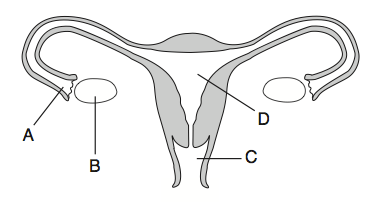
The function of part B is to _______.
produce eggs
produce sperms
allow fertilisation to take place
release the sperm
There are .......... chromosomes inside each gametes of a human and ......... chromosomes inside the zygote of a human.
23; 23
23; 46
46; 23
46; 46
The correct path travel by the sperm out of the human body is?
testes -> sperm duct -> urethra
testes -> spermatic cord -> urethra
testes -> spermatic cord -> ureter
testes -> sperm duct -> ureter
Length of menstrual cycle can be affected by
Stress
Malnutrition
Illness
Exercise
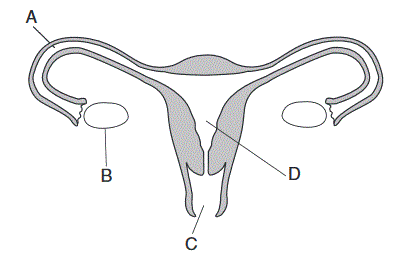
The diagram below represents structures found in the female reproductive system. If the areas labeled A were completely blocked on both sides, the most likely result would be that
egg production would stop
sperm production would stop
fertilization would not occur
an embryo would develop

Placenta
What is ovulation?
The release of a mature egg cell.
The loss of the lining of the uterus.
The joining of a male sex cell and a female sex cell.
The secretion of FSH from the pituitary gland
Which of these is a role of oestrogen?
It maintains the lining of the uterus during the middle part of the menstrual cycle.
It repairs the lining during menstruation.
It triggers ovulation.
Where does implantation take place?
cervix
uterus wall
ovary
oviduct
What name is given to mature sperm?
Spermatocyte
Spermatozoa
Spermatogonium
Spermatogonia
All cells in the human body are diploid.
true
false
Reproduction is essential for living organisms to order to
Keep the individual organism alive
Fulfill their energy requirement
Maintain growth
Continue the species generation after generation
Which hormone is responsible for the development of male secondary sexual characteristics?
LH.
Progesterone.
Testosterone.
Foetus is connected to the uterus by the structure called:
Umbilical cord
Placenta
Amniotic Cord
Zygotic cord
The lower part of uterus is known as :
Vagina
Fallopian tube
Accessory space
Cervix
A stage in woman's life when menstrual period stops permanently is called:
menstruation
menarche
menopause
none of the above

