wayground logo

Free Printable Worksheets

NEW

Font size

S
M
L
XL
Worksheets

REMEDIAL QUARTER 2

Total questions: 55

Worksheet time: 41mins

Name
Class
Date
1.

What unit is used to measure frequency?

a)

centimeters (cm)

b)

meters (m)

c)

hertz (Hz)

d)

miles per hour

2.
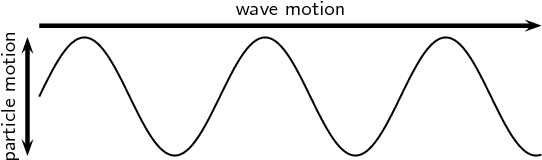
What kind of wave is pictured below?
a)
compressional wave
b)
transverse wave
c)
sound wave
d)
mechanical wave
3.
Amplitude reflects the amount of ____________________ in a wave.
a)
energy
b)
compression
c)
rarefaction
d)
speed
4.
The highest point on a wave is:
a)
the crest
b)
the trough
c)
the top
d)
the coast 
5.
The lowest point on a wave is the:
a)
Amplitude
b)
Crest
c)
Trough
d)
Wavelength
6.
The number of wavelengths that pass a point each per second is:
a)
frequency
b)
period
c)
longitudinal 
d)
transverse wave 
7.
The type of waves that require medium to pass:
a)
Mechanical Waves
b)
Electromagnetic Waves
8.
When the frequency of a wave increases, what happens to the wavelength?
a)
The wavelength is not directly affected by the frequency of a wave.
b)
The wavelength increases.
c)
The wavelength decreases.
d)
More specific information is needed to form a conclusion about the wavelength.
9.
A wave in which the particles of the medium vibrate parallel to the direction of the wave motion
a)
A. mechanical wave
b)
B. surface wave
c)
C. longitudinal wave
d)
D. wave
10.
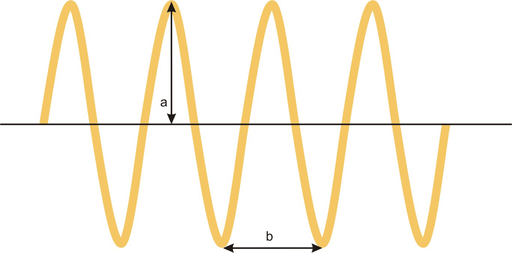
How many waves are in this wave chain?
a)
6
b)
3
c)
4
d)
5
11.

This is a _____ wave.

a)

surface

b)

longitudinal

c)

transverse

12.

The distance between two corresponding parts of a wave is the ____.

a)

crest

b)

trough

c)

amplitude

d)

wavelength

13.

Which of the following is NOT a mechanical wave?

a)

surface wave

b)

electromagnetic wave

c)

transverse wave

d)

longitudinal wave

14.

The part of a longitudinal wave where the particles are close together.

a)

amplitude

b)

compression

c)

frequency

d)

rarefaction

15.
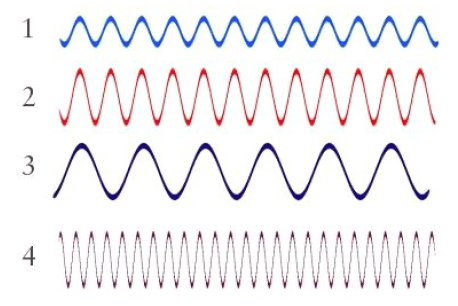
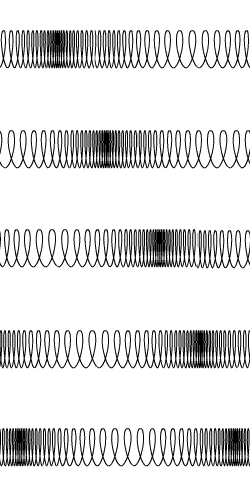
Which wave in the diagram has the greatest wavelength?
a)
1
b)
2
c)
3
d)
4
16.
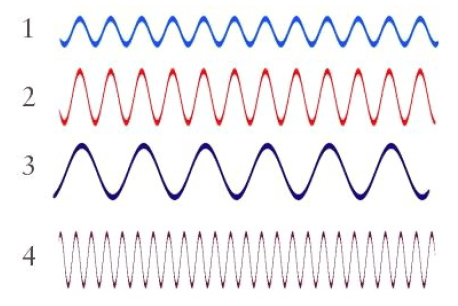
Which wave in the diagram has the greatest frequency?
a)
1
b)
2
c)
3
d)
4
17.
What type of wave is this?
a)
Longitudinal
b)
Transverse
18.
What is a vacuum? 
a)
A space with only air in it
b)
A space with NO matter at all present
c)
A machine you use to do your chores
19.
Frequency is a measure of...
a)
length of the wave
b)
height of the wave
c)
number of waves a second
d)
number of waves an hour
20.
Wave with the longest wavelength
a)
microwave
b)
radio
c)
gamma
d)
visible light
21.
The EM wave with frequency higher than infrared and lower than UV.
a)
radio
b)
visible light
c)
xray
d)
gamma
22.
4 is 
a)
radio
b)
UV 
c)
Visible Light
d)
X-ray
23.
7 is 
a)
Radio
b)
UV
c)
Infrared
d)
Gamma
24.
When the wavelength increases the frequency will
a)
increase
b)
decrease
25.
EM waves  
a)
Must travel through a vacuum
b)
Can travel through a medium or a vacuum
c)
Are the same type of wave as mechanical waves
d)
Can only travel through a vacuum
26.
Visible light is 
a)
radiation
b)
light
c)
a way to transfer energy
d)
all of these
27.
All EM waves travel at  
a)
different speeds
b)
the speed of sound
c)
the speed of light
d)
the speed of a vacuum
28.
Predict which EM wave could cause more damage 
a)
Radio wave
b)
UV wave
c)
X-ray
d)
Gamma ray
29.
Infrared rays are important for
a)
Warming the Earth
b)
Providing visible light for plants
c)
Taking X-rays
30.
Which of these lists the EM waves from Highest to lowest frequency?
a)
Radio -  Micro - Gamma - Visible light - UV - Xrays - Infrared - Xrays
b)
Radio - Micro - Infrared - Visible light - UV - X - Gamma waves
c)
Gamma - Xray - UV - Visible light - Infrared - Micro - radio
31.
Which of these lists the EM waves from Highest to lowest frequency?
a)
Radio -  Micro - Gamma - Visible light - UV - Xrays - Infrared - Xrays
b)
Radio - Micro - Infrared - Visible light - UV - X - Gamma waves
c)
Gamma - Xray - UV - Visible light - Infrared - Micro - radio
32.
Which has the LONGEST wavelength and, therefore, the lowest frequency/energy
a)
Gamma Rays
b)
Radio Waves
c)
Visible Light
d)
Infrared rays
33.
Which section of the spectrum is the ONLY one we can see?
a)
X-rays
b)
Visible Light
c)
Gamma Rays
d)
Ultraviolet Rays
34.
Put the visible light colors in order from longest wavelength to shortest wavelength
a)
Violet, Indigo, Blue, Green, Orange, Yellow, Red
b)
Red, Yellow, Green, Orange, Violet, Blue, Indigo
c)
Red, Orange, Yellow, Green, Blue, Indigo, Violet
35.

Law of Reflection states that the incident angle is ____ the reflected angle

a)

greater than

b)

less than

c)

equal to

36.

If Θ1 is 70 degrees what is Θ2?

a)

20

b)

40

c)

70

d)

90

37.

If the man is 4 m from the mirror, his image is how far from the mirror?

a)

2 m

b)

4 m

c)

8 m

38.

The man's image appears to be-

a)

upright

b)

inverted

c)

alive

d)

moving at a different rate

39.

The man's image appears to be-

a)

real

b)

virtual

c)

singing about who they are inside

d)

looking for a way out

40.

The man's image appears to be-

a)

larger

b)

smaller

c)

same size

d)

laughing at him

41.

Image behind the mirror is

a)

virtual

b)

real

c)

upside down

d)

upright

42.

image above the principal axis (PA) is

a)

virtual

b)

real

c)

upright

d)

upside down

43.

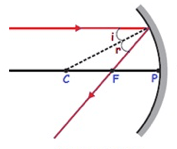
This ray diagram is for which mirror?

a)

concave

b)

convex

c)

plane

d)

window

44.

Name the mirror that curves inwards

a)

plane mirror

b)

convex mirror

c)

concave mirror

d)

spherical mirror

45.

The size of an object and its image are the same in this type of mirror...

a)

Plane

b)

Convex

c)

Concave

46.
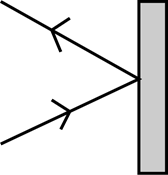
The illustration shows a light ray striking an object.
In the illustration, the light ray striking the object is-
a)
absorbed
b)
stopped
c)
reflected
d)
refracted
47.

What do you call a flat mirror?

a)

plane mirror

b)

convex mirror

c)

concave mirror

48.
___ is when light travels through a material and bends.
a)
Diffraction
b)
Dispersion
c)
Mirage
d)
Refraction
49.
Which describes a convex lens?
a)
triangular in shape
b)
more transparent in the middle
c)
thicker on the edges than in the middle
d)
thicker in the middle than on the edges
50.
Is a concave lens thicker or thinner in the middle? 
a)
Thicker 
b)
Thinner 
51.
This diagram best represents 
a)
reflection
b)
refraction
c)
absorption
d)
diffusion
52.
How does light travel
a)
It curves around corners
b)
Really slow
c)
In a straight line
d)
In circles
53.

A concave lens has an inward curved shape. It refracts light outward from the lens. They light rays spread apart as they exit the lens. Which represents a concave lens?

a)

A

b)

B

c)

A and B

d)

neither A or B

54.
A converging lens is also known as a ____ lens.
a)
convex
b)
concave
c)
double
d)
refracted
55.

What type of lens do you have in your eye?

a)

Concave

b)

Prismatic

c)

Objective

d)

Convex