Wayground logo

Free Printable Worksheets

Font size

S
M
L
XL
Worksheets

Evolution/Natural Selection

Total questions: 24

Worksheet time: 15mins

Name
Class
Date
1.

What are fossils?

a)

Are the remains or evidence of once-living organisms

b)

Is the change over time in populations of related organisms

c)

A chart that divides Earth’s history into different time units

d)

Occurs when the last individual organism of a species dies

2.

What is the fossil record?

a)

Are the remains or evidence of once-living organisms

b)

Is the change over time in populations of related organisms

c)

Is made up of all the fossils ever discovered on Earth

d)

Occurs when the last individual organism of a species dies

3.

What is extinction?

a)

A chart that divides Earth’s history into different time units

b)

Are the remains or evidence of once-living organisms

c)

Occurs when the last individual organism of a species dies

d)

The impression of an organism

4.

What is the geologic time scale?

a)

A chart that divides Earth’s history into different time units

b)

Is made up of all the fossils ever discovered on Earth

c)

The impression of an organism

d)

Is the change over time in populations of related organisms

5.

Variation

a)

A person who studies plants and animals by observing them.

b)

The resemblance of one species to another species.

c)

Is a slight difference in an inherited trait of individual members of a species.

d)

The breeding of organisms for desired characteristics.

6.

Natural Selection

a)

Is a slight difference in an inherited trait of individual members of a species.

b)

The breeding of organisms for desired characteristics.

c)

Is an inherited trait that increases the organism’s chance of surviving and reproducing in its environment.

d)

The process where organisms that are best suited to their environment survive and pass on their genetic traits.

7.

Adaptation

a)

Is a slight difference in an inherited trait of individual members of a species.

b)

Is an inherited trait that increases the organism’s chance of surviving and reproducing in its environment.

c)

A person who studies plants and animals by observing them.

d)

The resemblance of one species to another species.

8.

Camouflage

a)

The breeding of organisms for desired characteristics.

b)

The process where organisms that are best suited to their environment survive and pass on their genetic traits.

c)

Is an adaptation that enables a species to blend in with its environment.

d)

A person who studies plants and animals by observing them.

9.
A change in the inherited characteristics of an organism over time is ________
a)
evolution.
b)
development.
c)
growth.
d)
ancestry.
10.

Which scientist visited the Galapagos Islands and came up with the theory of natural selection?

a)

Theodor Schwann

b)

Gregor Mendel

c)

Charles Darwin

d)

Rudolf Virchow

11.
The similarities of the bones in the diagram provide evidence that---
a)
The organisms shown lived in the same natural envionrment
b)
The organisms shown may have developed from a common ancestor
c)
The organisms shown have the same genetic diseases
d)
All vertebrate species have identical forelimbs
12.
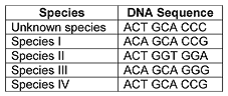
According to this data, the unknown bacterial species is most closely related to: 
a)
Species I
b)
Species II
c)
Species III
d)
Species IV
13.
The diagram shows fossils in different rock layers. Which of these statements about the age of these fossils is most likely correct?
a)
Fossil A and C are the same age
b)
Fossil B is older than fossil C
c)
Fossils A is older than fossil B
d)
Fossil D is older than fossil C
14.
What type of beak would help a bird pick insects off a plant?
a)
a large thick beak
b)
a long thin beak
c)
a small short beak
d)
a large hooked beak
15.
Which of following in NOT a critial part of the theory of evolution?
a)
overproduction
b)
consistent environment
c)
genetic variation
d)
struggle to survive
16.
What is the most important factor that contributes to a species evolving? 
a)
environmental change
b)
how old a species is
c)
what the ancestors look like
d)
what time of year a species reproduces.
17.
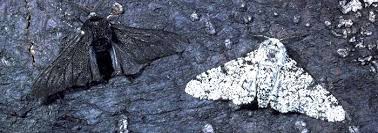
Predict which moth would increase in population
a)
light 
b)
dark
18.
What characteristic did Darwin observe about the finches on the Galapagos Islands?
a)
Their feathers 
b)
Genotypes 
c)
Their beaks
d)
Their body sizes
19.

Which IS NOT used as evidence for evolution?

a)

Fossils

b)

Natural Selection

c)

Body Structure/Anatomy

d)

DNA/Proteins

20.
What does evolution mean?
a)
To change something
b)
To change and adapt over time
c)
To lose some original features
d)

To improve something over time

21.
What animals did Charles Darwin study when at the Galapagos Islands?
a)
Giraffes
b)
Seagulls
c)
Seals
d)
Finches
22.
For Darwin, how have animals and plants survived?
a)
Through luck
b)
Through natural selection
c)
Through careful management
d)
Through choice
23.
What is survival of the fittest?
a)
It is where the fittest die out and therefore reproduce and pass on their genes
b)
It is where the fittest die out and therefore can't reproduce and pass on their genes
c)
It is where the fittest don't die out and therefore can't reproduce and pass on their genes
d)
It is where the fittest don't die out and therefore reproduce and pass on their genes
24.
What is natural selection?
a)
Your natural fate is decided from birth
b)
Nature actively chooses who surivives
c)

Those best suited to demands of environment survive

d)
The weakest of a species surivie