
Font size
 Worksheets
Polynomials Unit Exam
Total questions: 32
Worksheet time: 2hrs 56mins

1
-2

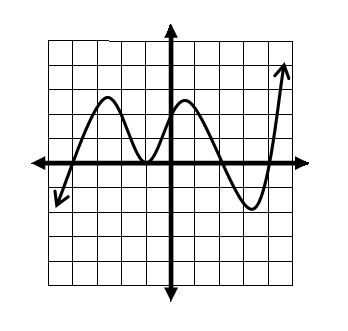
What could be the equation of the polynomial function shown in this graph?


y = x(x - 6)(x + 5)
y = (x + 2)(x - 7)3
The degree of a polynomial determines...
the maximum number of x-intercepts
the number of turning points
if the end behavior is up or down
the y-intercept


SELECT ALL OF THE FOLLOWING intervals over which this function is increasing.
(−∞; −1.6)
(−1.6; 0)
(0, 0.9)
(0.9; ∞)
(−8, 3.2)
f(x)=x3+x2−24x+36 has a minimum at which point
(2.5, -2.1)
(2.5, -3.1)
(3.1, -2.1)
(3.1, -2.5)

The given polynomial is decreasing over what interval?
(-3.2, 2.5)
(90.3, -2.1)
(2.5, -3.2)
(-2.1, 90.3)
f(x)=x4−19x2−6x+72 has what end behavior?
As x→∞, f(x)→∞
As x→−∞, f(x)→∞
As x→∞, f(x)→∞
As x→−∞, f(x)→−∞
As x→∞, f(x)→−∞
As x→−∞, f(x) →−∞
As x→∞, f(x)→−∞
As x→−∞, f(x)→∞
Graph the polynomial:
g(x)=x3−7x2+2x+13 . What are the interval(s) of increasing and decreasing?
Increasing: (- ∞ , 0.148),(4.519, ∞ )
Decreasing: (0.148, 4.519)
All real numbers
Increasing: (-1.146, 1.782)
Decreasing: (13.146, -28.627)
Increasing: (−∞, 13.146),(−28,627, ∞)
Decreasing: (13.146, -28.627)
Which of the following is one of the factors of the expression: 4x2−25?
(4x−5)
(2x+1)
(4x−1)
(2x−5)
What is the factored form of the expression? x2−16
(x−4)(x+4)
(x−8)(x+8)
(x−4)(x−4)
(x−8)(x−8)
What are the binomial factors of x2+7x−18
(Pick 2 answers)
(x−9)
(x+9)
(x−2)
(x+2)
4p³+8p²+3p+6
Complete the formula a³+b³=
Simplify this polynomial:
3x2 - x + 2 - 5x2 + 8x - 5
8x2 + 9x + 7
-2x2 + 7x - 3
2x2 + 7x - 3
5x2 - 3
What is the constant of this polynomial?
2x3 - 8x2 + 3x - 7
2
-8
3
-7
x3 -2x2 -17x + 1
for x = -2
4
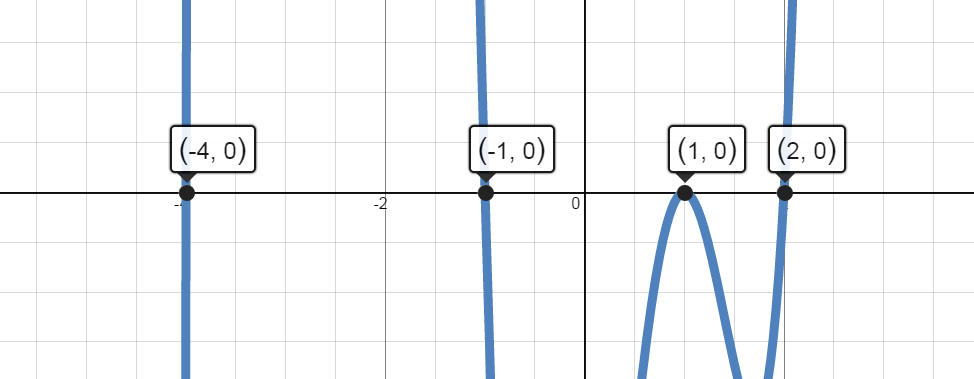
f(x) = (x+4)(x-1)2(x-2)(x+4)

Identify the degree of the polynomial and the sign of the leading coefficient
Degree - Even
Degree - Odd
Degree - Even
Degree - Odd

Identify the degree of the polynomial and the sign of the leading coefficient
Degree - Even
Degree - Odd
Degree - Even
Degree - Odd
What is the end behavior of a third degree polynomial with a positive leading coefficient?
As x approaches infinity, f(x) approaches infinity. As x approaches negative infinity, f(x) approaches infinity.
As x approaches infinity, f(x) approaches negative infinity. As x approaches negative infinity, f(x) approaches negative infinity.
As x approaches infinity, f(x) approaches negative infinity. As x approaches negative infinity, f(x) approaches infinity.
As x approaches infinity, f(x) approaches infinity. As x approaches negative infinity, f(x) approaches negative infinity.

