Wayground logo

Free Printable Worksheets

Font size

S
M
L
XL
Worksheets

Pre test quiz for Nika

Total questions: 25

Worksheet time: 23mins

Name
Class
Date
1.

One problem with selective breeding is

a)

creating a new species

b)

gene variety is lost

c)

new food sources

2.

Selective breeding is...

a)

a process to create an organism with desired traits from parents with those desired traits

b)

natural method of producing offspring with desired traits

c)

creating a new species

d)

making organisms reproduce during times of stress

3.
Evidence shows that the wolf is the ancestor to all of the breeds of dogs shown below. How did this variation arise in a relatively short period of time?
a)
A.  Genetic manipulation
b)
Natural selection
c)
Random chance
d)
Selective breeding
4.
In pea plants, the tall allele is dominant to the short allele. What key would demonstrate this?
a)
Tall = T
Short = S
b)
Tall = T
Short = t
c)
Tall = t
Short = T
d)
Tall = TT
Short = tt
5.

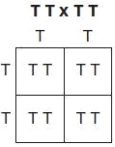
T - tall and t = short

In the Punnett square, what belongs in the missing square?

a)

tt

b)

Tt

c)

TT

6.

In plants, tall (T) is dominant to short (t). Perform the following cross: Tt x Tt. What is the probability of producing a short plant?

a)

0%

b)

25%

c)

50%

d)

75%

7.

Each one of the boxes on the Punnett square represents what probability of an offspring's genotype?

a)

25%

b)

1%

c)

10%

d)

0%

8.

What is ratio of the offspring from the cross shown will be homozygous recessive for the trait of tallness? T = tall t = short

a)

0 in 4

b)

1 in 4

c)

2 in 4

d)

4 in 4

9.
_____________________ carries information for inherited traits.
a)
DNA
b)
FBI
c)
RNA
d)
CBS
10.

How many chromosomes are found in each cell of your body?

a)

46

b)

23

c)

40

d)

45

11.

What is a short segment of a DNA strand that codes for our characteristics?

a)

chromosome

b)

DNA

c)

RNA

d)

gene

12.

Where is DNA found in a human cell?

a)

ribosome

b)

nucleus

c)

cell membrane

d)

cytoplasm

13.

From smallest to largest how would genetic information be organized?

a)

genes, cell, nucleus, chromosome, DNA

b)

chromosome, cell, gene, DNA, nucleus

c)

DNA/nucleotides, gene, chromosome, nucleus, cell

d)

nucleus, cell, gene, DNA, chromosome

14.

Which of the following is NOT a greenhouse gas?

a)

Carbon dioxide

b)

Methane

c)

Water vapor

d)

nitrogen

15.
 Which of the following activities contributes the most to carbon emissions globally?
a)
Deforestation
b)
Agriculture
c)
Burning fossil fuels
d)
Respiration
16.
What is the greenhouse effect?
a)
The warming of a planet due to trapped radiation.
b)
The cooling of Earth due to air pollution.
c)
The heating of a solid, such as a rock.
17.
What does NOT produce carbon dioxide?
a)
Photosynthesis
b)
Burning Fossil Fuels
c)
Animal respiration
d)
Plants decaying
18.
Combustion is another word for __________.
a)
Transportation
b)
Respiration
c)
Fossil Fuels
d)
Burning
19.
Which of the following removes carbon from the atmosphere?
a)
Combustion
b)
Respiration
c)
Photosynthesis
d)
Death
20.
Respiration is the process by which animals take in _____ and release _____. 
a)
photosynthesis, air
b)
carbon, oxygen
c)
oxygen
d)
oxygen, carbon dioxide
21.
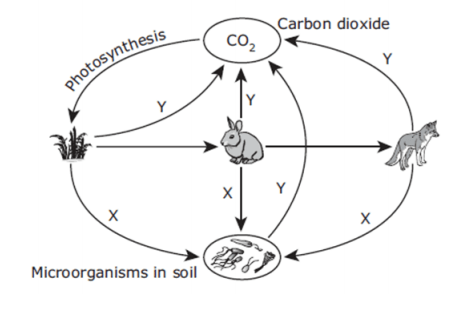
The diagram shows the flow of organic molecules through an ecosystem. What two processes are identified by the labels X and Y?
a)
X : Respiration
Y : Predation
b)
X : Adaptation
Y : Decomposition
c)
X : Fermentation
Y : Nitrogen Fixation
d)
X : Decomposition
Y : Respiration
22.

According to most scientists, what is the ultimate cause of most mass extinctions?

a)

overhunting

b)

evolution of new species to replace old ones

c)

major change in environment due to extreme natural events

d)

asteroid impact

23.
Which of the following species is extinct?
a)
woolly mammoth
b)
giant panda
c)
bald eagle
d)
green sea turtle
24.
Where the better adapted organisms survive to pass traits along to offspring.
a)
Evolution
b)
Natural Selection
c)
Extinction
d)
Artifical Selection
25.
Change over time
a)
Natural Selection
b)
Selective Breeding
c)
Homeostasis
d)
Evolution