wayground logo

Free Printable Worksheets

NEW

Font size

S
M
L
XL
Worksheets

Digestive/Respiratory

Total questions: 35

Worksheet time: 22mins

Name
Class
Date
1.
Nutrients from digested food are absorbed in which digestive organ?
a)
Small Intestine
b)
Stomach
c)
Large Intestine
d)
Gallbladder
2.
Number 3 is pointing to the...
a)
Small intestine
b)
Rectum
c)
Large intestine
d)
Stomach
3.
Number 2 is pointing to the...
a)
Esophagus
b)
Stomach
c)
Small intestine
d)
Anus
4.
Which organ pushes food down to the stomach?
a)
Mouth
b)
Esophagus
c)
Rectum
d)
Large intestine
5.
As waste moves through the digestive system, the ______ absorbs water before storing waste in the rectum.
a)
Small intestine
b)
Stomach
c)
Esophagus
d)
Large intestine
6.
Which is NOT a function of the Digestive System?
a)
To rid the body of solid waste
b)
Absorb nutrients for energy & growth
c)
Break down nutrients from food
d)
Pump blood around the body
7.
Where does digestion begin?
a)
Mouth
b)
Esophagus
c)
Stomach
d)
Small Intestine
8.

What is the correct order of digestion?

a)

Mouth - stomach - esophagus - Large intestine - Small intestine - anus - rectum

b)

Mouth - esophagus - stomach - gall bladder - small intestine - rectum - anus - large intestine

c)

Mouth - pancreas - stomach - rectum - gall bladder - small intestine - rectum - anus

d)

Mouth - esophagus - stomach - small intestine - large intestine - rectum - anus

9.

Which of the following is NOT part of the digestive system?

a)

liver

b)

gall bladder

c)

kidney

d)

pancreas

10.

Which of the following is the best synonym for "digestion"?

a)

breaking down

b)

building up

c)

formation

d)

respiration

11.
Feces that contain high water content is a form of diarrhea.  Which digestive organ did not function properly for this to occur?
a)
stomach
b)
small intestines
c)
large intestines
d)
rectum
12.
In which digestive organs does both mechanical AND chemical digestions occur?
a)
mouth & stomach
b)
mouth & esophagus
c)
small intestines & large intestines
d)
rectum & anus
13.
Which substance is produced by the liver to break down fats?
a)
bile
b)
bowel
c)
gastric juices
d)
saliva
14.
The digestive system works with which system to distribute nutrients to the cells of your body?
a)
skeletal
b)
circulatory
c)
respiratory
d)
digestive
15.
The teeth are considered to be a part of which two (2) systems?
a)
skeletal & digestive
b)
skeletal & muscular
c)
circulatory & digestive
d)
skeletal & respiratory
16.
Which part of the mouth provides chemical digestion?
a)
teeth
b)
saliva
c)
smooth muscles
d)
gastric juices (HCl acid)
17.
Which part of the stomach provides mechanical digestion?
a)
teeth
b)
saliva
c)
smooth muscles
d)
gastric juices (HCl acid)
18.
Which part of the stomach provides chemical digestion?
a)
teeth
b)
saliva
c)
smooth muscles
d)
gastric juices (HCl acid)
19.
Given the following structures:
1. larynx
2. nasal cavity
3. pharynx
4. trachea
Which of the following is the correct order that air would flow during inhalation. 
a)
1,2,3,4
b)
2,3,1,4
c)
2,1,3,4
d)
4,2,3,1 
20.
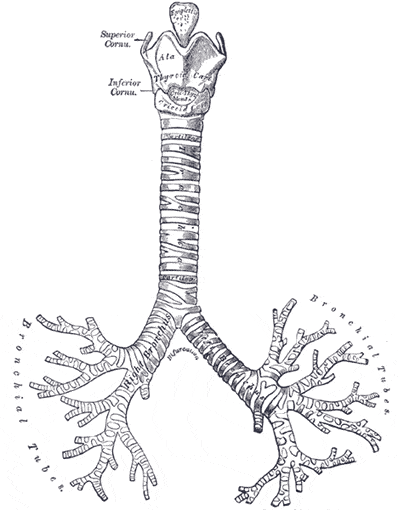
The two main branches from the trachea (one to each lung)
a)
bronchi
b)
alveoli
c)
capillaries
d)
bronchioles
21.
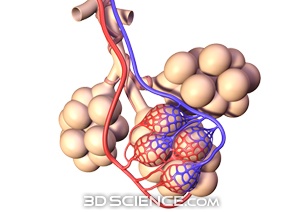
The air sacs that are covered with capillaries where gas exchange takes place
a)
bronchi
b)
lungs
c)
oxygen
d)
alveoli
22.
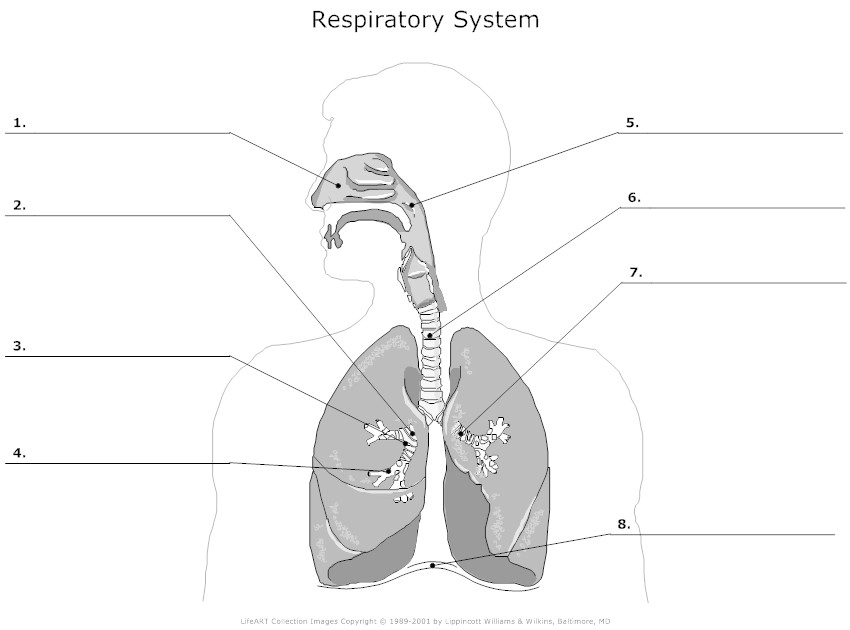
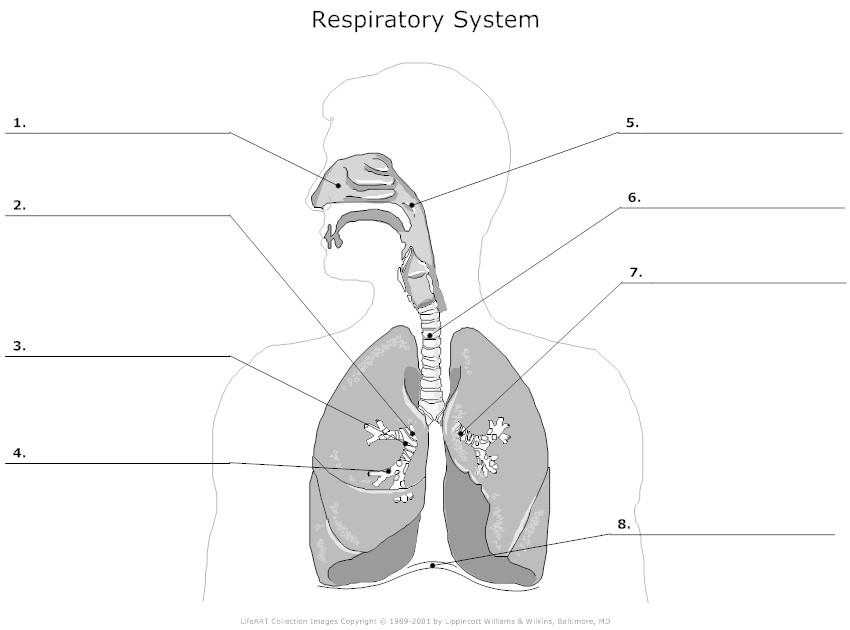
Name the organ label # 6. 
a)
alveoli 
b)
bronchi 
c)
trachea 
d)
lungs 
23.
Name the structure labeled 8 
a)
lungs 
b)
trachea 
c)
diaphragm 
d)
alveoli 
24.

When you breathe, your lungs take in ___ and remove ___.

a)

air/oxygen

b)

oxygen/carbon dioxide

c)

carbon dioxide/waste

d)

waste/air

25.
a flap of tissue that closes when we eat so food doesn't not go down the trachea
a)
larynx
b)
pharynx
c)
trachea
d)
epiglottis
26.

When air is pushed OUT of the lungs, what is the correct order for the tubes it passes through?

a)

bronchiole -> bronchi -> trachea -> nose

b)

bronchi -> bronchiole -> trachea -> nose

c)

trachea-> bronchi -> bronchiole-> nose

27.

What keeps your bronchi and bronchiole tubes open?

a)

cartilage rings

b)

ligament squares

c)

ciliated cells

d)

muscle

28.

A capillary is a form of...

a)

Gas exchange

b)

Respiration

c)

Blood vessel

d)

Alveoli

29.

Gaseous exchange happens because of...

a)

Osmosis

b)

Respiration

c)

Diffusion

d)

Semi-permeable membranes

30.
Passage way that moistens the air and has hairs to trap dust and particles
a)
Nasal cavity
b)
Bronchi
c)
Mouth cavity
d)
Larynx
31.
What is the function of the respiratory system
a)
Take in O2 only
b)
Remove CO2 only
c)
Take in O2 ad remove CO2
d)
Make sugar
32.
Alveoli increase the surface area in the lungs to allow...
a)
More nutrients to be absorbed
b)
You to breathe faster
c)
You to breathe slower
d)
More O2 and CO2 to exchange
33.
Illness of the lungs where the alveoli become inflamed and filled with fluid
a)
Lung cancer
b)
Bronchitis
c)
Pneumonia
d)
Emphysema
34.

The volume of air exchange during normal breathing is called

a)

vital capacity

b)

inspiratory reserve capacity

c)

total lung capacity

d)

tidal volume

35.

Asthma is a combination of...

a)

inflammation

b)

constriction of the bronchioles

c)

none

d)

both