wayground logo

Free Printable Worksheets

Font size

S
M
L
XL
Worksheets

Review (For Unit 3)

Total questions: 214

Worksheet time: 18hrs 50mins

Name
Class
Date
1.

Add to simplify the expression.

(4a3 - 8a - 4a2) + (7a3 - 7 - 6a)

a)

11a3 - 4a2 - 14a - 7

b)

5a3 - 4a2 - 14a - 7

c)

5a3 - 4a2 - 20a - 7

d)

5a3 - 9a2 - 20a - 7

2.
a)
b)
c)
d)
3.

Solve by elimination.

4x + 2y = 12

4x + 8y = -24

a)

(5,6)

b)

(6,-6)

c)

(6,-2)

d)

(4,-3)

4.
Identify the solution to this system of equations.
a)
(4, -1)
b)
(-1, 4)
c)
(-4, 1)
d)
(-4, -1)
5.
What is the solution to the system?
a)
(0, 3)
b)
(1, -1)
c)
(-3, 1)
d)
(1, 3)
6.
Solve by elimination
4x-6y= -6
-2x-12y= -12
a)
(0,1) 
b)
(1,0)
c)
(1,1)
d)
(2,1)
7.
If a system of equations has no solution, what does the graph look like? 
a)
intersecting lines
b)
parallel lines
c)
skew lines
d)
intersecting lines
8.

How many solutions does this system have?

a)

One Solution

b)

Two Solutions

c)

No Solutions

d)

Many Solutions

9.

How many solutions does this system of equations have?

a)

one solution

b)

two solutions

c)

three solutions

d)

no solutions

10.

The formula shown below is called the __________

a)

distance formula

b)

midpoint formula

c)

quadratic formula

d)

slope formula

11.

How would the equation below look when converted to exponential form?

 log39 = 2\log_39\ =\ 2  

a)

 23 = 92^{3\ }=\ 9  

b)

 92=39^2=3  

c)

 32=93^2=9  

d)

 39 = 23^{9\ }=\ 2  

12.

If the table shown gives values for f(x), which of the following could be a point found on the inverse of f(x)?

a)

(3, 5)

b)

(4, 1)

c)

(2, 7)

d)

(2, 1)

13.

What are the zeros of the function shown?

a)

{-2, 1, 2}

b)

{-3, 1, 2}

c)

{-4, 2, 5}

d)

{-4, 3, 4}

14.
Factor
81m2 - 1 
a)
not factorable
b)
(m-9)(m+9)
c)
9m(9m-1)
d)
(9m-1)(9m+1)
15.
Factor
v2 - 6v + 9
a)
(v-3)2
b)
(v-6)2
c)
(v-9)(v+6)
d)
not factorable
16.
   6m2 + 16m
a)
2(3m2 + 8m)
b)
2m(3m + 8)
c)
2m(3m - 8m)
d)
not factorable
17.
Solve
a² + 10a + 21 = 0
a)
± √21
b)
-3 , -7
c)
3 , 7
d)
28 , -7
18.
Solve
h2 + 7h + 10 = 0
a)
A. h= -5, -2
b)
B. h= 5, 2
c)
C. h = -1, -10/6
d)
D. h = -2/5, -10
19.
What is the first question you ask yourself when factoring a polynomial? 
a)
How many terms does it have? 
b)
Is there a GCF? 
c)
What strategy should I use? 
d)
Why do I have to learn this?!?!?!
20.
What are the x- intercepts?
a)
x= 0 and x= -4
b)
x= 0 and x= 4
c)
y= 0
d)
x= 2
21.
Solve using Zero-Product Property
(x-11)(5x+1) = 0
a)
x = 11 or x = -1/5
b)
x = -11 or x = -1/5
c)
x = 11 or x - 1/5
d)
x = -11 or x = 1/5
22.
What should you do first in solving this equation?
x2 + 6x - 13 = 3
a)
Get factored form
b)
Write down: a=1, b=6, c=-13
c)
Make it equal 0 by subtracting 3 on each side
d)
Type it all in a calculator.
23.
a)
516
b)
471
c)
542
d)
567
24.

3282 ÷ 6, use long division.

a)

499

b)

545

c)

547

d)

582

25.

What is 2637 divided by 18? Use long division.

a)

146

b)

152

c)

67

d)

231

26.

398 ÷ 11, use long division

a)

36.7

b)

36.2

c)

42.8

d)

36

27.

353 ÷ 18, use long division.

a)

11 R17

b)

18 R29

c)

11 R19

d)

19 R11

28.

1245 divided by 83 using long division.

a)

15

b)

16

c)

14

d)

17

29.

247 divided by 19 equals. Use long division.

a)

11

b)

21

c)

13

d)

23

30.
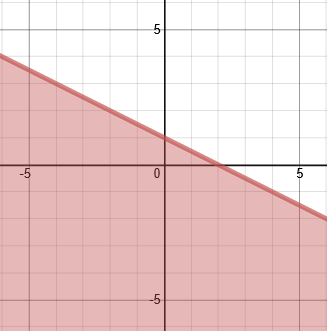
Which of the following equations match the given graph?
a)
x ≥ -1
b)
x ≤ -1
c)
x > -1
d)
x < -1
31.
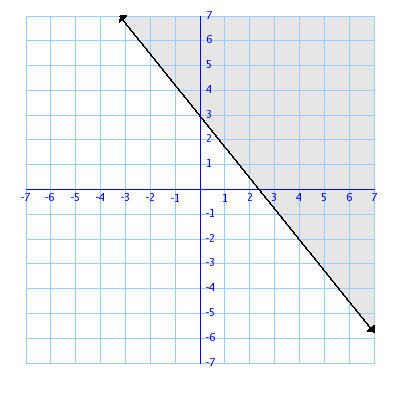
Which of the following equations match the given graph?
a)
y ≤ -3/4 x + 3
b)
y ≥ -3/4 x + 3
c)
y < -3/4 x + 3
d)
y > -3/4 x + 3
32.
Are the points on the boundary line part of the solution set or not?
a)
Yes, they are part of the solution set
b)
No, they are NOT part of the solution set
33.
How can I tell if an inequality will have a solid line?
a)
It has an equal sign.
b)
The symbol is greater than.
c)
The symbol has "or equal to."
d)
You just guess.
34.
Which point below is NOT a part of the solution set?
a)
(0, 0)
b)
(0, 1)
c)
(-100, -3)
d)
(5, 10)
35.
Which point below is NOT part of the solution set?
a)
(0, 0)
b)
(-10, -10)
c)
(-1, 5)
d)
(5, 20)
36.
Which point is a solution?
a)
(0, 6)
b)
(-3, 4)
c)
(1, 0)
d)
(-4, 3)
37.
Which of the following is not a solution to this system of inequalities?
a)
(0,-1)
b)
(0,3)
c)
(4,0)
d)
(6,-2)
38.

What word(s) correlate with the x-values of a relation?

a)

inputs

b)

outputs

c)

domain

d)

range

39.

What word(s) correlate with the y-values of a relation?

a)

inputs

b)

outputs

c)

domain

d)

range

40.

Given the following relation, tell me the domain:

 (3,5)(2,4)(1,0)(3,7)\left(3,5\right)\left(-2,4\right)\left(-1,0\right)\left(-3,7\right)  

a)

-3,-2,-1,3

b)

-3,-2,-1

c)

0,4,5,7

d)

4,5,7

41.

Given the following relation, tell me the range:

 (3,5)(2,4)(1,0)(3,7)\left(3,5\right)\left(-2,4\right)\left(-1,0\right)\left(-3,7\right)  

a)

-3,-2,-1,3

b)

-3,-2,-1

c)

0,4,5,7

d)

4,5,7

42.

True or False: The following relation is a function:

 (1,3)(0,3)(5,3)(3,3)\left(1,3\right)\left(0,3\right)\left(5,3\right)\left(-3,3\right)  

a)

True

b)

False

43.

True or False: The following relation is a function:

 (1,5)(2,3)(3,0)(1,3)\left(-1,5\right)\left(-2,3\right)\left(3,0\right)\left(-1,3\right)  

a)

True

b)

False

44.

Given the following graph, determine if the relation is a function:

a)

Function

b)

Not a function

45.

Given the following graph, determine if the relation is a function:

a)

Function

b)

Not a function

46.

Given the following graph, determine if the relation is a function:

a)

Function

b)

Not a function

47.

Evaluate f(-2) for the following function:

 f(x)=4x+7f\left(x\right)=-4x+7  


(a)  

48.

Evaluate f(-5) for the following function:

 f(x)=x3f\left(x\right)=-x-3  


(a)  

49.

Given the two functions evaluate the following:

 f(3)g(2)\frac{f\left(3\right)}{g\left(-2\right)}   f(x)=12xf\left(x\right)=12-x   g(x)=4(5x)g\left(x\right)=4\left(5-x\right)  


(a)  

50.

Is the following a function?

a)

Yes, this is a function.

b)

No, it's not a function.

c)

Can't be determined with this information.

51.

What type of function is this?

a)

absolute value

b)

quadratic

c)

linear

d)

logarithmic

52.

What type of function is this?

a)

quadratic

b)

absolute value

c)

linear

d)

exponential

53.

What type of function is this?

a)

Logarithmic

b)

cubic

c)

quadratic

d)

linear

54.

What type of function is this?

a)

cubic

b)

quadratic

c)

linear

d)

rational

55.

What type of function is this?

a)

logarithmic

b)

square root

c)

exponential

d)

rational

56.

What type of function is this?

a)

Linear

b)

quadratic

c)

cubic

d)

square root

57.

What type of function is this?

a)

square root

b)

quadratic

c)

linear

d)

exponential

58.

What type of function is this?

a)

ladder

b)

step

c)

quadratic

d)

linear

59.

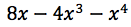
What is the leading coefficient of this polynomial?

a)

8

b)

-4

c)

-1

d)

1

60.
Classify by the DEGREE:
3x - 2
a)
1
b)
2
c)
3
d)
4
61.
What is the value of the constant?
2x² + 4x − 5
a)
2
b)
4
c)
5
d)
−5
62.
Classify the polynomial by its number of terms.
 4x² - 2
a)
A
monomial
b)
B
binomial
c)
C
trinomial
d)
D
polynomial
63.

Is  y=5x47x3+17x23x+1y=5x^4-7x^3+17x^2-3x+1  a polynomial?

a)

Yes, and the degree is 4 with leading coefficient 5.

b)

No

64.

Is  y= 23x53x4+8x216y=\ \frac{2}{3}x^5-3x^4+8x^2-16  a polynomial?

a)

Yes, and the degree is 5 with leading coefficient 2/3.

b)

No

65.

What are the roots of f(x) = (x - 4)(x +1) (x + 3)

a)

-4, 1, and 3

b)

-4 and 1

c)

4, -1. -3

d)

3

66.

How many roots does f(x) = (x + 1)(x -6)(x -10) have?

a)

3

b)

1

c)

6

d)

10

67.

Which one of these is NOT another word for roots?

a)

solutions

b)

y intercepts

c)

zeros

68.

Which form is this polynomial?

f(x) = x5 + 6x4 - x3 + 3x2 +5x - 10

a)

Standard form

b)

Factored form

69.

Which form is this polynomial?

f(x) = (x + 4)(x - 8)(x -12)

a)

Standard form

b)

Factored form

70.

y = x8 + 9x4 + 6 is an example of a __________________.

a)

monomial

b)

binomial

c)

trinomial

71.

Polynomial means "many terms".

a)

True

b)

False

72.
What type of function is y=2x+4?
a)
Linear
b)
Linear Absolute Value
c)
Linear Piecewise
d)
Exponential
73.
What type of function is y=5x?
a)
Quadratic
b)
Linear Absolute Value
c)
Linear Piecewise
d)
Exponential
74.
What type of function is y=x2-4?
a)
Quadratic
b)
Linear Absolute Value
c)
Linear Piecewise
d)
Exponential
75.
What type of function is 
y=| 2x+3 |?
a)
Quadratic
b)
Linear Absolute Value
c)
Linear Piecewise
d)
Exponential
76.
Which function best matches the graph?
a)
f(x) = x
b)
f(x)= x2
c)
f(x) = |x|
d)
f(x) = √x
77.
Is this exponential growth or decay?
a)
Growth
b)
Decay
78.
Is the pictured graph exponential growth or decay?  
a)
Exponential
 Decay
b)
Exponential 
Growth
79.
What is the pattern you see in this table? LOOK AT THE Y'S!
a)
Multiplying by 1/3
b)
Adding 8
c)
Multiplying by 3
d)
Dividing by 3
80.
Does the table represent a linear, quadratic, or exponential function? LOOK AT THE Y'S!
a)
Linear
b)
quadratic
c)
exponential
81.
Does the table represent a linear, quadratic, or exponential function? LOOK AT THE Y'S!
a)
linear
b)
quadratic
c)
exponential
82.
Is the table linear, quadratic, exponential, or neither? LOOK AT THE Y'S!
a)
Linear
b)
Quadratic
c)
Exponential
d)
Neither
83.
Name the parent function.
a)
cube root
b)
square root
c)
quadratic
d)
linear
84.

Determine if this relation is a function.

a)

Yes, it is a function.

b)

No, it is not a function.

85.

If  f(x) = x1f\left(x\right)\ =\ x-1 and g(x)=5x2g\left(x\right)=5x-2 , then  (f+g)(x)=\left(f+g\right)\left(x\right)= 

a)

 5x2+15x^2+1  

b)

 5x235x^2-3  

c)

 6x+16x+1  

d)

 6x36x-3  

86.

If  f(x) = x1f\left(x\right)\ =\ x-1 and g(x)=5x2g\left(x\right)=5x-2 , then  (fg)(x)=\left(f-g\right)\left(x\right)= 

a)

-4x - 3

b)

-4x +1

c)

6x + 1

d)

6x - 3

87.

If  f(x) = x1f\left(x\right)\ =\ x-1 and g(x)=5x2g\left(x\right)=5x-2 , then  (fg)(x)=\left(f\cdot g\right)\left(x\right)= 

a)

 5x35x-3  

b)

 5x2+25x^2+2  

c)

 5x27x+25x^2-7x+2  

d)

 5x75x-7  

88.

If  f(x) = x1f\left(x\right)\ =\ x-1 and g(x)=5x2g\left(x\right)=5x-2 , then  (fg)(x)\left(\frac{f}{g}\right)\left(x\right) 

a)

 x15x2\frac{x-1}{5x-2}  

b)

 5x2x1\frac{5x-2}{x-1}  

c)

 13\frac{-1}{3}  

d)

 3-3  

89.

If  f(x) = 3x24f\left(x\right)\ =\ 3x^2-4 and g(x)=x28x+4g\left(x\right)=x^2-8x+4 , then  (f+g)(x)=\left(f+g\right)\left(x\right)= 

a)

 4x48x84x^4-8x-8  

b)

 4x48x4x^4-8x  

c)

 4x28x84x^2-8x-8  

d)

 4x28x4x^2-8x  

90.

If  f(x) = 3x24f\left(x\right)\ =\ 3x^2-4 and g(x)=x28x+4g\left(x\right)=x^2-8x+4 , then  (fg)(x)=\left(f-g\right)\left(x\right)= 

a)

 2x28x82x^2-8x-8  

b)

 2x2+8x82x^2+8x-8  

c)

 2x28x2x^2-8x  

d)

 2x2+8x2x^2+8x  

91.
f(x)=x2-5x
f(4)=
a)
-4
b)
126
c)
24
d)
84
92.
Evaluate f(x) = x2 for f(-8)
a)
64
b)
-64
c)
-16
d)
16
93.
Evaluate f(t)=-2t2+ 1 for f(-3)
a)
19
b)
37
c)
-17
d)
-11
94.

Evaluate f(2).

a)

f(2) = 5

b)

f(2) = 12

c)

f(2) = 10

d)

f(2) = 0.5

95.

Evaluate f(6).

a)

f(6) = 18

b)

f(6) = 12

c)

f(6) = 10

d)

f(6) = 1

96.

Evaluate the expression

a)

5

b)

8

c)

2

d)

1.52

97.

Evaluate the expression

a)

-2

b)

3

c)

4

d)

-3

98.

evaluate the expression

a)

9

b)

-7

c)

4

d)

-6

99.

What is the domain of this graph?

a)

(-6,6)

b)

(-∞,∞)

c)

(-∞,6)

d)

(6,∞)

100.
Logarithmic functions are the inverse of...
a)
Linear Functions
b)
Exponential Functions 
c)
Quadratic Functions 
d)
Polynomial Functions 
101.

Find the function's maximum and minimum points

a)

no maximum

minimum (-4,-1)

b)

no minimum

maximum (-3, 1)

c)

no maximum

minimum (-1,-4)

d)

maximum (-3,1)

minimum (0,-3)

102.

Identify the intervals where the function is positive and where it is negative.

a)

positive (-1, ∞) and negative (-∞, -1)

b)

positive nowhere and negative (-1, -4)

c)

positive (-∞,-3) and (1,∞) and negative (-3,1)

d)

positive (-∞,∞) and negative (-4,∞)

103.

Identify where the function is increasing and where it is decreasing.

a)

increasing (-1, ∞) and decreasing (-∞,-1)

b)

increasing (-∞, -1) and decreasing (-1, ∞)

c)

increasing (-∞,∞) and decreasing nowhere

d)

increasing (-1, -4) and decreasing (-3, 1)

104.

Identify the function's domain and range.

a)

domain (-∞,∞) and range (-∞,∞)

b)

domain (-∞, ∞) and range (-4,∞)

c)

domain (-∞,∞) and range [-4,∞)

d)

domain [-3, 1] and range [-4,∞)

105.

Where is the function increasing and where is it decreasing?

a)

increasing nowhere and decreasing (-∞,∞)

b)

increasing (-∞,1) and decreasing (1,∞)

c)

increasing (3,∞) and decreasing (-∞,3)

d)

increasing (-1,3) and decreasing nowhere

106.

Where is the function positive and where is it negative?

a)

positive (-∞,3) and negative (3,∞)

b)

positive nowhere and negative (-∞,∞)

c)

positive (0,1) and negative (3,0)

d)

positive (0,3) and negative (-1,0)

107.

What are the domain and the range of the function?

a)

domain (-∞,∞) and range (-∞,∞)

b)

domain (∞,-∞) and range (∞,-∞)

c)

domain (-∞, 3] and range [3,∞)

d)

domain (-∞,1] and range [1,∞)

108.

Identify the function's x- and y-intercepts.

a)

x-int (1,0) and y-int (0,-1)

b)

x-int (0,1) and y-int (-1,0)

c)

x-int (1,∞) and y-int (-∞,-1)

d)

x-int none and y-int (-1,1)

109.

Where is the function positive and where is it negative?

a)

positive (1,∞) and negative (-∞,1)

b)

positive (0,∞) and negative (-∞,-1)

c)

positive (-∞,∞) and negative nowhere

d)

positive (∞,1) and negative (1,-∞)

110.

Where is the function increasing and decreasing?

a)

increasing (-∞,∞) and decreasing nowhere

b)

increasing nowhere and decreasing (-∞,∞)

c)

increasing (1,∞) and decreasing (-∞,1)

d)

increasing (-1,∞) and decreasing (-∞,-1)

111.

Identify the function's x- and y-intercepts.

a)

x-int (-2,0), (1,0), and (3,0) and y-int (3,0)

b)

x-int (-2,0), (1,0), and (3,0) and y-int (0,3)

c)

x-int (0,-2), (0,1), and (0,3) and y-int (0,3)

d)

x-int (0,-2), (0,1), and (0,3) and y-int (3,0)

112.

Where is the function positive and where is it negative?

a)

positive (-2,1) and (3,∞) and negative (-∞,-2) and (1,3)

b)

positive (-∞,-1) and (2,∞) and negative (-1,2)

c)

positive (-1,4) and negative (2,-2)

d)

positive (∞,3) and (1,-2) and negative (3,1) and (-2,-∞)

113.

Describe the function's end behavior.

a)

As x, yAs\ x\rightarrow-\infty,\ y\rightarrow-\infty
As x, yAs\ x\rightarrow\infty,\ y\rightarrow-\infty

b)

As x, yAs\ x\rightarrow-\infty,\ y\rightarrow-\infty
As x, yAs\ x\rightarrow\infty,\ y\rightarrow\infty

c)

As x, yAs\ x\rightarrow-\infty,\ y\rightarrow\infty
As x, yAs\ x\rightarrow\infty,\ y\rightarrow-\infty

d)

As x, yAs\ x\rightarrow-\infty,\ y\rightarrow\infty
As x, yAs\ x\rightarrow\infty,\ y\rightarrow\infty

114.
Find the slope of the line that passes through the points (2, 4) and (6, 12)
a)
1/2
b)
-1/2
c)
2
d)
-2
115.
Average Rate of Change is also known as...
a)
y-intercept
b)
x-intercept
c)
linear
d)
slope
116.
Is the function Linear or Nonlinear?
a)
Linear
b)
Nonlinear
117.
What does "m" represent in y=mx+b?
a)
y-intercept
b)
slope
c)
macaroni
d)
nothing
118.
What does 'b" represent in y=mx=b
a)
y-intercept
b)
macaroni
c)
nothing
d)
slope
119.
Simplify to an equivalent expression BUT leave in exponent form.
                                   43⋅45
a)
48
b)
168
c)
415
d)
1615
120.
Simplify   (2m4)(5m2)
a)
10m6
b)
10m8
c)
7m6
d)
7m8
121.
Simplify the expression.
x4 (x12)
a)
x3
b)
x48
c)
x16
d)
x8
122.
X⋅ X⋅ X⋅ X
a)
x9
b)
x24
c)
x10
d)
x25
123.

Simplify the following expression:


(xyz)0 =

a)

0

b)

1

c)

xyz

d)

-1

124.
True or False: 
a)
True 
b)
False
125.

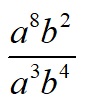
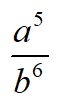
Simplify:  9h63h3\frac{9h^6}{3h^3}  

a)

 3h93h^9  

b)

 3h3 3h^{3\ }  

c)

 3h183h^{18}  

d)

 h3 h^{3\ }  

126.

 (x4x2)3\left(\frac{x^4}{x^2}\right)^3   Click on the play button if you need a hint

a)

 x8x^8  

b)

 x6x^6  

c)

 x3x^3  

d)

 x9x^9  

127.

Simplify using your exponent rule(s) (2x3y)6

a)

2x18y6

b)

64x18y6

c)

64x3y6

d)

2x3y6

128.
Identify the transformation from ABC to A'B'C'.
a)
90o clockwise rotation
b)
90o counter clockwise rotation
c)
Reflection across the y-axis
d)
Reflection across the x-axis
129.
Identify the transformation from ABCD to A'B'C'D'.
a)
Translation
b)
Reflection across the y-axis
c)
Reflection across the x-axis
d)
90o counter clockwise Rotation
130.
Identify the transformation.
a)
Reflection across y-axis
b)
90 Rotation counter clockwise
c)
Translation 5 units left, 1 unit up.
d)
Translation 5 units right, 1 unit down
131.
Point (-5,2) is reflected over the y axis.  Where is the new point located?
a)
(5,2)
b)
(-5,-2)
c)
(-5,2)
d)
(5,-2)
132.
Point (7,2) is translated vertically 2 units and horizontally -5 units.  Where is the new point located?
a)
(9,-3)
b)
(2,4)
c)
(2,0)
d)
12,4)
133.

What is the lowest degree of rotation greater than 0° that will carry the hexagon onto itself?

a)

90 degrees

b)

180 degrees

c)

270 degrees

d)

360 degrees

134.
Name the alternate interior angle to angle 3.
a)
4
b)
5
c)
6
d)
8
135.
Name the angle relationship.
a)
Alternate Interior
b)
Alternate Exterior
c)
Corresponding
d)
Vertical Angles
136.
Name the angle relationship.
a)
Alternate Interior
b)
Alternate Exterior
c)
Corresponding
d)
Vertical Angles
137.
A line that passes through 2 or more lines is called a ______________.
a)
transitive
b)
passer through line
c)
transversal
d)
bisector
138.
Angle S and A are...
a)
Alternate Interior Angles
b)
Consecutive Interior Angles
c)
Corresponding Angles
d)
Alternate Exterior Angles
139.
Angles which add up to 180° are called _____.
a)
Vertical angles
b)
Corresponding Angles
c)
Supplementary Angles
d)
Alternate Interior Angles
140.

State if the two triangles are congruent. If they are, state how you know.

a)

A

b)

B

c)

C

d)

D

141.

State if the two triangles are congruent. If they are, state how you know.

a)

A

b)

B

c)

C

d)

D

142.

State if the two triangles are congruent. If they are, state how you know.

a)

A

b)

B

c)

C

d)

D

143.

State if the two triangles are congruent. If they are, state how you know.

a)

A

b)

B

c)

C

d)

D

144.

State if the two triangles are congruent. If they are, state how you know.

a)

A

b)

B

c)

C

d)

D

145.

State if the two triangles are congruent. If they are, state how you know.

a)

A

b)

B

c)

C

d)

D

146.

State if the two triangles are congruent. If they are, state how you know.

a)

A

b)

B

c)

C

d)

D

147.

Find the measure of each angle indicated.

a)

A

b)

B

c)

C

d)

D

148.

Are f(x) =x+6 and g(x) =x-6 inverses?

a)

Yes

b)

No

149.

Find the inverse: f(x) = 3x + 2

a)

f-1(x) = 2x + 3

b)

f-1(x) = -3x + 2

c)

f-1(x) = (x-2)/3

d)

f-1(x) = (x-3)/2

150.

Graph the inverse

a)
b)
c)
d)
151.

Is the inverse of this a function?

a)

No

b)

Yes

152.

Is the inverse of this a function?

a)

Yes

b)

No

153.

To graph the inverse of a function...

a)

Rotate it around the origin

b)

Reflect it across the x-axis

c)

Reflect it across the y-axis

d)

Switch the x and y coordinates and plot the new points

154.

This line is...

a)

The x-axis

b)

The y-axis

c)

y=x

155.

f-1(x) is written when...

a)

The inverse is not a function

b)

The function fails the HLT

c)

The inverse is a function

d)

There are two different functions

156.

Find the inverse: f(x) = x3-1

a)

f-1(x)= 3√x+1

b)

f-1(x)= 3√x-1

c)

f-1(x)= (x-1)/3

d)

f-1(x)= (x+1)/3

157.

When two functions are inverses of each other, their graphs are reflective over...

a)

y=x

b)

x-axis

c)

y-axis

158.

A function has an inverse function if...

a)

It passes the Vertical Line Test

b)

It fails the Horizontal Line Test

c)

It passes the Horizontal Line Test

d)

It fails the Vertical Line Test

159.
If the equation of f(x) goes through (1, 4) and (4, 6), what points does f-1(x) go through?
a)
(1, 4) and (4, 6)
b)
(-4, -1) and (-6, -4)
c)
(-1, -4) and (-4, -6)
d)
(4, 1) and (6, 4)
160.
What is the inverse of the given coordinates: (1, 2) (3, 8) (-3, 6)
a)
(1, 2) (3, 8) (-3, 6)
b)
(1, 2) (8, 3) (-3, 6)
c)
(-1, -2) (-3, -8) (3, -6)
d)
(2, 1) (8, 3) (6, -3)
161.
Are these the graphs of two inverse functions?
a)
Yes
b)
No
c)
No way to tell
162.
Will the inverse of this function, be a function?
a)
No
b)
Yes
c)
No way to tell
163.
When finding the inverse of a relation, 
1st you replace f(x) with y
2nd switch the x's and y's
What do you do next?
a)
solve for y
b)
replace y with f-1(x)
c)
solve for x
d)
find the greatest common factor
164.
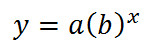
What values of b make an exponential growth function?
a)
b > 0
b)
b <1
c)
b > 1
d)
0 < b < 1
165.

In an exponential function, what does the 'a' represent?

a)

Slope

b)

Multiplier

c)

y-intercept

d)

Growth

166.
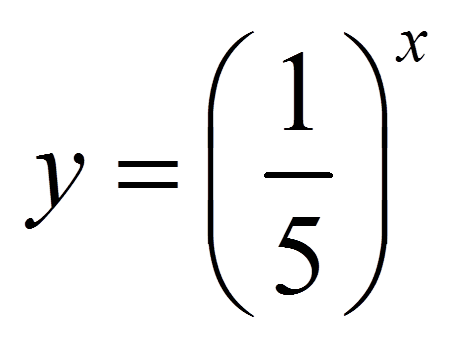
What type of function is f(x)=2(1/7)x ?
a)
Exponential Growth
b)
Linear
c)
Exponential Decay
d)
None of the Abovee
167.
The growth factor for this table is 
a)
2
b)
4
c)
12
d)
144
168.
The equation for this table is 
a)
y = 1(2x)
b)
y = 1(12x)
c)
y = 12x
d)
y = 12x + 1
169.
Identify the y-intercept (initial value) of the function f(x)=2(4)x.
a)
2
b)
4
c)
(2)x
d)
8
170.
Which of the following is an increasing exponential function whose y-intercept is 50?
a)
y = 50(.05)x
b)
y = 50x - 4
c)
y = (2)x + 50
d)
y = 50(1.4)x
171.
Solve:
3x-2 = 274x
a)
-2/11
b)
-2/3
c)
2/11
d)
2/3
172.
Solve:
51/2x + 4 = 125
a)
1
b)
2
c)
-2
d)
14
173.
Solve:
16x-3 = 8x-3
a)
9
b)
-3
c)
0
d)
3
174.
Solve:
24x+1 = √2
a)
-1/8
b)
1/8
c)
0
d)
-1/4
175.
To solve 36 = 6x, re-write 36 as what base and exponent?
a)
36
b)
63
c)
62
d)
312
176.
To solve 8 = 25x+7, you would need to re-write 8 as what base?
a)
8
b)
4
c)
2
d)
Cannot be determined
177.
Solve 8 = 25x+7
a)
b)
¼
c)
-⅘
d)
178.
Solve 33 = 34x + 2
a)
¼
b)
c)
½
d)
179.
Solve for n:
2-2n = 26
a)
-1
b)
-7
c)
5
d)
-3
180.
Solve for b:
43b - 3 = 1/16
a)
7
b)
-1/4
c)
1/2
d)
1/3
181.
Solve for p:
4p+2 = 64
a)
-16/9
b)
1
c)
8
d)
7/6
182.

5x-6=18

a)

6.1

b)

9.2

c)

7.8

d)

8

183.

5(6)3x=20

a)

2.3

b)

.26

c)

.04

d)

4

184.

7x=36

a)

1.8416

b)

3.5835

c)

1.5563

d)

3.0903

185.

46x-12=7

a)

1.4

b)

2.23

c)

13.40

d)

3

186.

logx1000=3

a)

1

b)

10

c)

30

d)

3

187.

log8(4x+4)=2

a)

15

b)

12

c)

10

d)

3

188.

log81x = 3/4

a)

2

b)

3

c)

27

d)

81

189.
Log with a base "e" (loge) is the same thing as...
a)
"e"
b)
Natural Logarithm (LN)
c)
Common Logarithm (Log)
d)
Natural Log, base "e"
LNe
190.
Change to Logarithmic Form:
53 = 125
a)
log 5 125 = 3
b)
log125 = 5
c)
log 5 3 =125
d)
log125 3 = 5
191.
Solve for x:
42+ 1 = 17
a)
x = 1
b)
x = -1
c)
x = 2
d)
x = -2
192.

lnx = -3

a)

8.1548

b)

-8.1548

c)

0.0498

d)

-0.0498

193.

log8(1/2) = x

a)

-1/3

b)

1/3

c)

1/2

d)

-1/2

194.
log6(2x + 3) = 3
a)
x = 106.5
b)
x = 100
c)
x = 16
d)
x = 50
195.
Find the time required for an investment of $1000 to grow to $5000 at an interest rate of 8% per year compounded monthly. (round to nearest year)
a)
1 year
b)
242 years
c)
20 years
d)
13 years
196.
Write an equation that models the following situation:
Samantha's hair was known to grow very rapidly. It began at a length of 6 in and grew at a rate of 14% a week.
a)
y=6(0.14)x
b)
y=6(1+14)x
c)
y=6(1.14)x
d)
y=6(0.86)x
197.
The inverse function of an exponential function is known as a...?
a)
quadratic function
b)
square root function
c)
absolute value function
d)
logarithmic function
198.
How many times a year does semiannual mean?
a)
1
b)
2
c)
4
d)
12
199.
Kennedy won $3,000 from a radio contest. If she puts this money in a bank account that earns 2.9% interest compounded quarterly, how much total will she earn in 10 years?
a)
$4915.59
b)
$3933.28
c)
$2979.81
d)
$4005.09
200.
Caiden earned $475 from mowing lawns last summer. He deposited this money in an account that pays an interest rate of 3.8% compounded annually. What will be his balance after 15 year?
a)
$827.52
b)
$831.10
c)
$839.45
d)
$846.80
201.
You invest $1600 at an annual interest rate of 4.6% compounded continuously. How much will you have in the account after 4 years.
a)
$800.26
b)
$6,701.28
c)
$10,138.07
d)
$1,923.23
202.
Riley invested $1,000 in savings bonds. If the bonds earn 6.75% interest compounded semi-annually, how much total will Riley earn in 15 years?
a)
$1,584.62
b)
$2,651.39
c)
$2,706.86
d)
$1,825.10
203.
If $1,000 is invested at 16% interest, compounded continuously, for five years, what is the ending balance?
a)
$1,225,54
b)
$2,225.54
c)
$22,255.40
d)
$225.54
204.

Which of the following exponential equations is the formula for compound interest?

a)
b)
c)
d)
205.

What does the n stand for in this formula?

a)

Initial amount

b)

Final amount

c)

Rate

d)

Time

e)

The number of times compounded per year

206.

What does the r stand for in this formula?

a)

Initial amount

b)

Final amount

c)

Rate

d)

Time

e)

The number of times compounded per year

207.

Change 6.5% to a decimal

a)

.65

b)

6.5

c)

.065

d)

.065%

208.

What does the P stand for in this formula?

a)

Initial amount

b)

Final amount

c)

Rate

d)

Time

e)

The number of times compounded per year

209.

Quarterly means how many times a year?

a)

4

b)

2

c)

1

d)

6

210.

Steve deposited $5,000 in a savings account that pays 4% interest compounded annually.


Which equation could be used to find the value of the account after 3 years?

a)

A = 5,000(1 + 4)3

b)

A = 5,000(1 + 0.04)3

c)

A = 5,000(1 + 0.4) x 3

d)

A = 5,000(0.04)3

211.

Which formula is shown?

a)

Compounded n times per year

b)

Compounded continously

212.

Cora invested $400 at a rate of 35% for 8 months, compounded continuously. How much is her investment worth after 8 months?

a)

$520.07

b)

$505.12

c)

$460.11

d)

$7,643.74

213.

Chelsea put $7500 into an account paying 5% compounded continuously. She now has $10,643.01. How long has the money been in the account?

a)

7 years

b)

6 years

c)

5 years

d)

4 years

214.

How much money do you need to invest at 2.8% compounded continuously in order to have $25,500 at the end of 8 years? Round your answer to the nearest dollar

a)

$20,383

b)

$2,715

c)

$27,147

d)

$2,038