wayground logo

Free Printable Worksheets

NEW

Font size

S
M
L
XL
Worksheets

Ecosystem

Total questions: 40

Worksheet time: 1hrs 14mins

Name
Class
Date
1.

What are the living and nonliving things in an environment or area?

a)

predator

b)

producer

c)

ecosystem

d)

abiotic factor

2.

An organism that can make its own food

a)

decomposer

b)

producer

c)

consumer

3.

Breaks down and feeds on the remains of other organisms

a)

decomposer

b)

consumer

c)

producer

4.

Small consumers that are hunted and eaten by larger consumers

a)

producer

b)

prey

c)

predator

5.

Interacting food chains found in an ecosystem

a)

food web

b)

food chain

c)

predator

6.

An animal that hunts and eats other animals for energy

a)

prey

b)

predator

c)

decomposer

7.

These organisms cannot make their own food; they must eat something for energy

a)

decomposer

b)

consumer

c)

producer

8.

Choose the decomposer.

a)

grass

b)

elephant

c)

bacteria

d)

bird

9.
All of the different populations that live in a specific area.
a)
ecosystem
b)
habitat
c)
ecology
d)
community
10.
The place where an organism lives that provides it with shelter, food and water.
a)
ecosystem
b)
population
c)
community
d)
habitat
11.
The study of the interaction of living and nonliving things in the environment.
a)
biology
b)
ecology
c)
zoology
d)
psychology
12.
All the members of one type of species in a specific area.
a)
habitat
b)
community
c)
population
d)
ecosystme
13.

A pride of lions stalks, tackles, and kills an antelope. Which is best being demonstrated?

a)

predation

b)

mutualism

c)

parasitism

d)

commensalism

14.

A tapeworm inside a dog is

a)

competition

b)

predation

c)

commensalism

d)

parasitism

15.

A symbiotic relationship that involves species having to fight for something they both need or want

a)

competition

b)

predation

c)

commensalism

d)

parasitism

16.

A living relationship between two species in which one organism is harmed is called...

a)

mutualism

b)

commensalism

c)

parasitism

d)

niche

17.

symbiotic relationship in which one organisms benefits and the other organism is not affected

a)

invasive (non-native) species

b)

mutualism

c)

parasitism

d)

commensalism

18.

symbiotic relationship in which both organisms benefit

a)

competition

b)

Mutualism

c)

nitrogen fixation

d)

energy pyramid

19.
In an ecological pyramid, which type of organism always has the least amount of energy available?
a)
Producers
b)
Herbivores
c)
Carnivores
d)
Top Predator
20.
How much of the energy in each level of a ecological pyramid gets lost as heat or used by the organism so that it cannot be passed on to the next trophic level?
a)
80%
b)
90%
c)
10%
d)
20%
21.
If there are 100 Kcal of energy available in the producers, how much energy would be available in the herbivores?
a)
10 Kcal
b)
1 Kcal
c)
100 Kcal
d)
1000 Kcal
22.
In this ecological pyramid which type of consumer gets only 10% of the energy stored in plants?
a)
Herbivore
b)
Carnivore
c)
Omnivore
d)
Secondary Consumer
23.
The diagram represents a pyramid of energy in an ecosystem.  Which level would most likely contain organisms that do photosynthesis?
a)
A
b)
B
c)
C
d)
D
24.
In this energy pyramid, what is the proper name for ANY ORGANISM ABOVE THE PRODUCER LEVEL?
a)
decomposers
b)
consumers
c)
producers
d)
omnivores
25.

What is biomass?

a)

the total dry weight of organisms in an ecosystem

b)

the total volume of organisms in an ecosystem

c)

the total dry weight of producers in an ecosystem

d)

the total volume of animals in an ecosystem

26.

What type of ecological pyramid is never inverted?

a)

ecological pyramid

b)

energy pyramid

c)

numbers pyramid

d)

biomass pyramid

27.

What type of organisms could box J contain?

a)

herbivores

b)

decomposers

c)

carnivores

d)

producers

28.

What type of organisms could box K contain?

a)

herbivores

b)

decomposers

c)

carnivores

d)

producers

29.
In this ecosystem, what is there the LEAST of?
a)
hyperparasites
b)
herbivores
c)
producers 
d)
parasites
30.
What type of pyramid does this show?
a)
biomass
b)
energy
c)
numbers
d)
producers
31.
They caracal is prey to which animal?
a)
snake
b)
mouse
c)
grasshopper
d)
baboon
32.

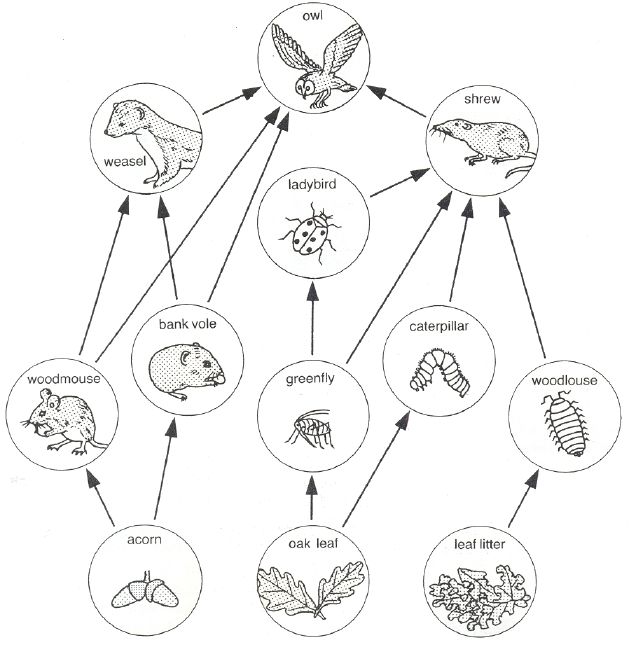
What type of consumer is the shrew?

a)

herbivore

b)

omnivore

c)

carnivore

d)

detritivore

33.
According to this food web, how many consumers are herbivores?
a)
2
b)
1
c)
4
d)
5
34.

Which one is NOT an example of a decomposer?

a)

mushroom

b)

shrimp

c)

mold

d)

bacteria

35.
Which of the following is a predator of the shrew?
a)
cricket
b)
grasshopper
c)
frog
d)
snake
36.
What type of consumer is the wolf?
a)
herbivore
b)
omnivore
c)
carnivore
d)
decomposer
37.
All energy on Earth ultimately comes from what source?
a)
Water
b)
Sun
c)
Consumers
d)
Oxygen
38.

An organism that uses sunlight to create its own food is known as a:

a)

Autotroph

b)

Heterotroph

c)

Consumer

d)

Decomposer

39.

Identify the possible link 'B' in the following food chain:
Plant \longrightarrow  Insect  \rightarrow   'B'  \rightarrow     Eagle

a)

Lion

b)

Frog

c)

Peacock

d)

Human

40.

The nature's cleaner are

a)

Producers

b)

Consumers

c)

Decomposers and scavengers

d)

Symbionts