Worksheets
Matter
Total questions: 20
Worksheet time: 40mins

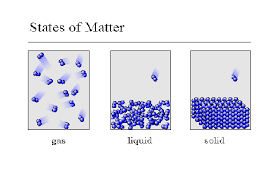
The diagram shows particles of a gas inside a box.
If we heat the box up, which of these statements is true?
The particles move closer together
The particles move slower
The particles expand
The particles have more kinetic energy

A crystal of purple potassium manganate(VII) was added to each of the beakers shown in the diagram.
One beaker contained hot water and the other beaker contained cold water. In both beakers the purple colour of the potassium manganate(VII) spreads out. Which result and explanation are correct?
result - colour spreads faster in cold water
explanation - particles move faster at a higher temperature
result - colour spreads faster in cold water
explanation - particles move slower at a higher temperature
result - colour spreads faster in hot water
explanation - particles move faster at a higher temperature
result - colour spreads faster in hot water
explanation - particles move slower at a higher temperature
Which change of state takes place during evaporation?
gas to liquid
liquid to gas
solid to gas
liquid to solid

Two gas jars are set up as shown.
The lid is removed and the gas jars are left to stand. After some time the contents of both gas jars are brown. Which process causes this to happen?
condensation
diffusion
evaporation
filtration

Kuku just made himself a cup of hot tea.
Which row describes the water particles in the air above the cup compared with the water particles in the cup?
A
B
C
D
A bottle of aqueous ammonia is placed on a table in a corner of the laboratory. The stopper is removed and after a few minutes all the students in the room can smell the ammonia. Which process occurs?
Brownian motion
diffusion
dissolving
distillation

The changes that occur when a substance changes state are shown below.
Which process, W, X, Y or Z, is occurring in the following four situations?
1 Butter melts on a warm day.
2 Water condenses on a cold surface.
3 The volume of liquid ethanol in an open beaker reduces. 4 Ice forms inside a freezer.
1-W 2-X 3-Y 4-Z
1-W 2-Y 3-X 4-Z
1-X 2-Y 3-Z 4-W
1- X 2 -Z 3-Y 4-W
A sugar cube is dropped into a hot cup of tea. The tea is not stirred. Which statement explains why the tea becomes sweet?
The heated water molecules penetrate the sugar cube.
The hot tea causes the sugar to melt.
The sugar cube dissolves and its molecules diffuse.
The sugar molecules get hot and evaporate.
‘Particles moving very slowly from an area of higher concentration to an area of lower concentration.’ Which process is being described?
a liquid being frozen
a solid melting
a substance diffusing through a liquid
a substance diffusing through the air
This state of matter has a firm, unchanging physical structure.
Solid
Liquid
Gas
Plasma
I can compress the volume of these states of matter.
Solid
Liquid
Gas
Plasma
An ice cube turning to water is an example of what phase change?
Condensation
Melting
Sublimation
Vaporization
Solid dry ice turning into gaseous carbon dioxide is an example of what phase change?
Condensation
Melting
Sublimation
Recombination
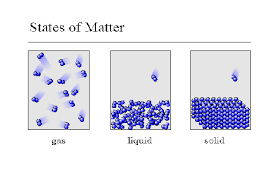

How can you stop the movement of particles?
Increase the temperature
Decrease the temperature
You can't.
Hold them still with your hands.