wayground logo

Free Printable Worksheets

Font size

S
M
L
XL
Worksheets

P1b end of unit quizziz revision

Total questions: 113

Worksheet time: 2hrs 57mins

Name
Class
Date
1.
What kind of energy is in a moving skateboard?
a)
Potential
b)
Kinetic
2.
What kind of energy is in a rock at the edge of a cliff?
a)
Potential
b)
Kinetic
3.
____________ is the ability to cause change. 
a)
Energy 
b)
Force 
c)
Friction
d)
Motion
4.
When the temperature of matter increases the particles...
a)
speed up and move closer
b)
speed up and move farther apart
c)
slow down and move closer together
d)
slow down and move farther apart
5.
The phase change from water vapor to liquid water is known as...
a)
evaporation
b)
precipitation
c)
condensation
d)
sublimation
6.
Change from Gas to Solid is called........
a)
Sublimation
b)
Deposition
c)
Fusion
d)
condensation
7.
Can result from adding or removing thermal energy
a)
explosion
b)
change of conservation
c)
change of state of matter
d)
Change of Newton's law
8.
The change of state from a gas to a liquid
a)
condensation
b)
deposition
c)
evaporation
d)
sublimation
9.
Temperature at which matter changes from liquid to solid
a)
freezing point
b)
melting point
c)
boiling point
d)
absolute zero
10.
Stored energy resulting from the interactions between particles or objects
a)
kinetic energy
b)
mechanical energy
c)
potential energy
d)
thermal energy
11.
Vaporization that occurs only at the surface of a liquid
a)
vaporization
b)
deposition
c)
sublimation
d)
evaporation
12.
The energy an object has due to its motion
a)
potential energy
b)
kinetic energy
c)
thermal energy
d)
solar energy
13.
Gas becomes solid without first becoming liquid
a)
sublimation
b)
deposition
c)
vaporization
d)
evaporation
14.
Total potential and kinetic energy of an object
a)
kinetic energy
b)
potential energy
c)
thermal energy
d)
mechanical energy
15.
Solid becomes gas without first changing to liquid
a)
deposition
b)
sublimation
c)
evaporation
d)
condensation
16.
Measure of the average kinetic energy of all the particles in an object 
a)
motion
b)
thermal movement
c)
energy
d)
temperature
17.
What is an example of sublimation?
a)
Ice cream melting
b)
Dry ice
c)
Fog
d)
Smoke
18.
What is the definition of sublimation?
a)
a chemical process where a solid turns into a gas without going through a liquid stage
b)
the process of a liquid changing into a gas
c)
the chemical energy activating
d)
the process of a solid changing to a liquid
19.
Temperature at which a solid state changes to a liquid state
a)
boiling point
b)
melting point
c)
freezing point
d)
absolute zero
20.
In which state are the particles least able to move?  (Which is the solid?)
a)
State A
b)
State B
c)
State C
d)
None
21.
When a  piece of aluminum foil is taken out of the oven and cools from 100° to 50°, What is the change in temperature?
a)
50°
b)
c)
100°
d)
150°
22.
Specific heat of water is  4.18 J/g°C. Specific heat of wood is 1.760 J/g°What material needs more heat energy to raise the temperature?
a)
Water
b)
Wood
c)
Both are same
23.

Which will heat up faster?

a)

copper

b)

granite

c)

iron

d)

basalt

24.

Which will heat up slower?

a)

water

b)

lead

c)

granite

d)

iron

25.
If I heat up 2 pans of water one has 100 mL in it and one has 1000mL. Which one heats up the fastest?
a)
100 mL
b)
1000 mL
c)
They both heat up at the same speed
d)
They cool down.
26.

Which of the following best explains why the sand at the beach is hotter than the water?

a)

Sand has a higher specific heat than water.

b)

Sand has a lower specific heat than water.

c)

There is more water than sand at the beach.

d)

There is more sand than water at the beach.

27.
How does heat flow?
a)
Always from cold to warm
b)
Always from warm to cold
c)
Both warm to cold & cold to warm
d)
It depends on the temperature
28.
What would be the effect on the particles if more heat is supplied to the system?
a)
They would slow down
b)
They would stop moving
c)
They would speed up
d)
There would be no effect
29.
Copper, Stainless Steel, Carbon Steel, and Zinc were all heated using the same thermal energy.  What material would be the coolest after being heated?
a)
Copper
b)
Carbon Steel
c)
Zinc
d)
Stainless Steel
30.

The amount of energy required to raise the temperature 1ºC for every gram is called____?

a)

Thermal Energy

b)

Specific Heat

c)

Temperature

d)

Kinetic Energy

31.
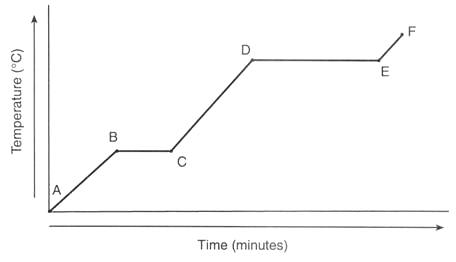
Describe the substance between letters D and E. 
a)
Gas
b)
Liquid
c)
Melting
d)
Evaporating
32.
Between which points is the temperature of the substance remaining constant?
a)
A-B only. 
b)
A-B, C-D, E-F
c)
B-C only. 
d)
B-C, D-E
33.
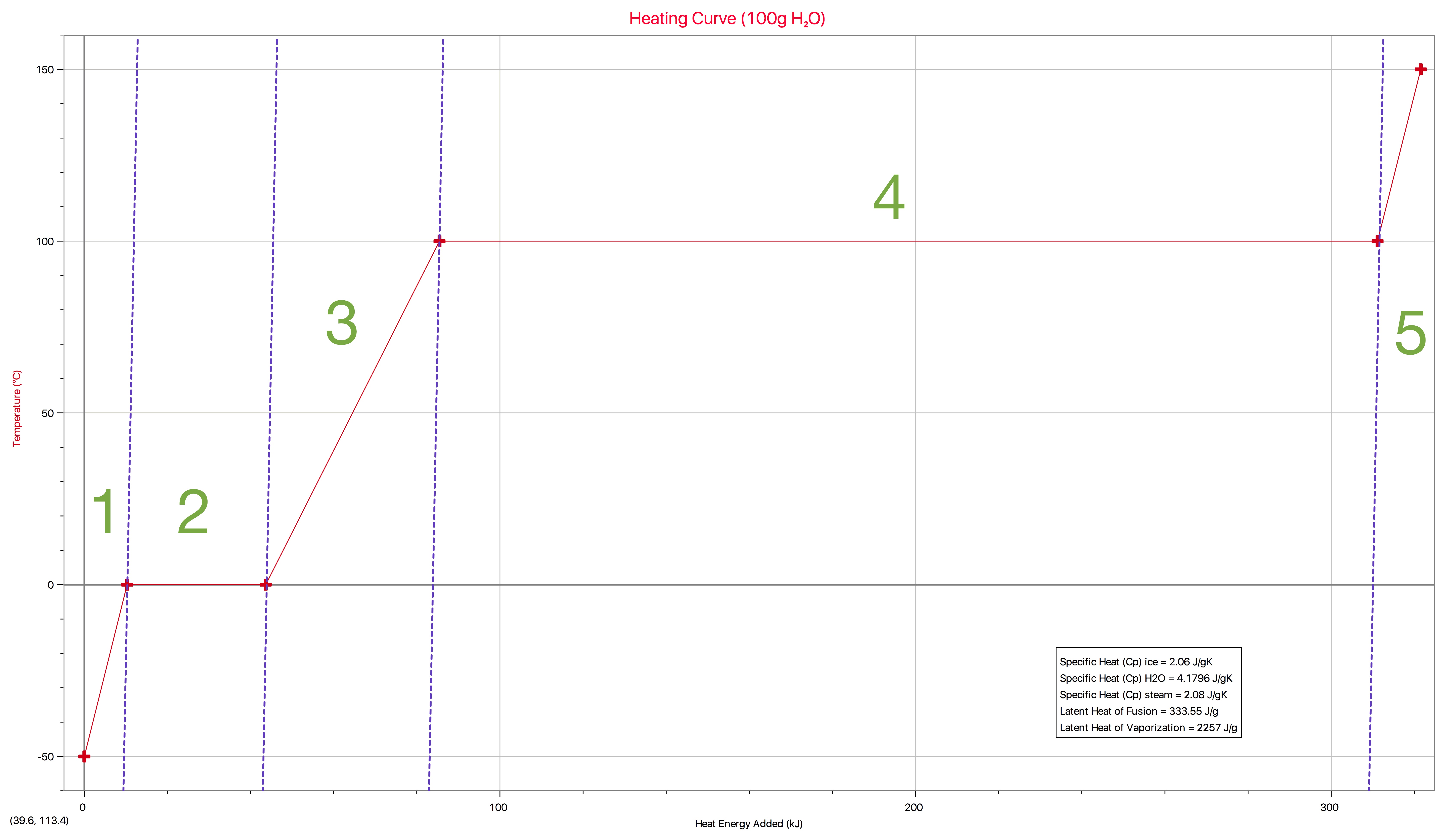
In which region(s) does temperature remain constant?
a)
Region 1, 3, & 5
b)
Region 2 & 4
c)
Region 1 only
d)
Region 1 & 2
34.
In which region(s) does temperature increase?
a)
Region 1, 3, & 5
b)
Region 2 & 4
c)
Region 1 only
d)
Region 1 & 2
35.

The melting point of the sample is

a)

-60 ºC

b)

-100 ºC

c)

60 ºC

d)

100 ºC

36.

In which region(s) of the graph would the substance be melting?

a)

No melting occurs on this graph

b)

Region C-E

c)

Region E-G

d)

Region G-I

e)

Region I-K

37.

This curve indicates what about the heat energy?

a)

Heat energy is being added or absorbed

b)

Heat energy is being released

38.

In which region(s) of the graph would the substance be a liquid and a gas at the same time?

a)

Region 1

b)

Region 2

c)

Region 3

d)

Region 4

e)

Region 5

39.

What is the freezing point of the substance?

a)

0oC

b)

60oC

c)

120oC

d)

180oC

40.

From point A to point F, the sample is going through an __________ process by __________.

a)

exothermic, releasing heat to the surroundings

b)

exothermic, absorbing heat from the surroundings

c)

endothermic, releasing heat to the surroundings

d)

endothermic, absorbing heat from the surroundings

41.

Given the heating curve of a solid being heated at a constant rate, what is the boiling point of this substance?

a)

20°C

b)

50°C

c)

110°C

d)

170°C

42.

Given the heating curve of a solid being heated at a constant rate, how much total time was required to boil this substance after it reached its melting point?

a)

3 minutes

b)

4 minutes

c)

10 minutes

d)

14 minutes

43.

NaCl(s) was heated up starting at an initial temperature of 0°C. The heating curve is shown in the picture. What is the melting point of this substance?

a)

0°C

b)

801°C

c)

1000°C

d)

1465°C

44.

Given the heating curve of water, what is happening to potential and kinetic energy during segment CD?

a)

the potential energy and kinetic energy both increase

b)

the potential energy increases while the kinetic energy decreases

c)

the potential energy is constant while the kinetic energy increases

d)

the potential energy increases while the kinetic energy is constant

45.

Given the heating curve for water, during which line segment could I find water in both the solid and liquid phase at the same time?

a)

AB

b)

BC

c)

CD

d)

DE

e)

EF

46.

Specific latent heat is the amount of energy required to change the state of 1 kg of a substance without changing its (a)   .

47.

Select the state changes that latent heat of vaporisation applies to.

a)

melting

b)

evaporating

c)

freezing

d)

condensing

e)

sublimation

48.

Select the state changes that latent heat of fusion applies to.

a)

melting

b)

evaporating

c)

freezing

d)

condensing

e)

sublimation

49.

Select the correct equations.

a)

thermal energy = specific latent heat / mass

b)

thermal energy = specific latent heat x mass

c)

mass = specific latent heat / thermal energy

d)

specific latent heat = thermal energy / mass

e)

mass = specific latent heat x thermal energy
50.

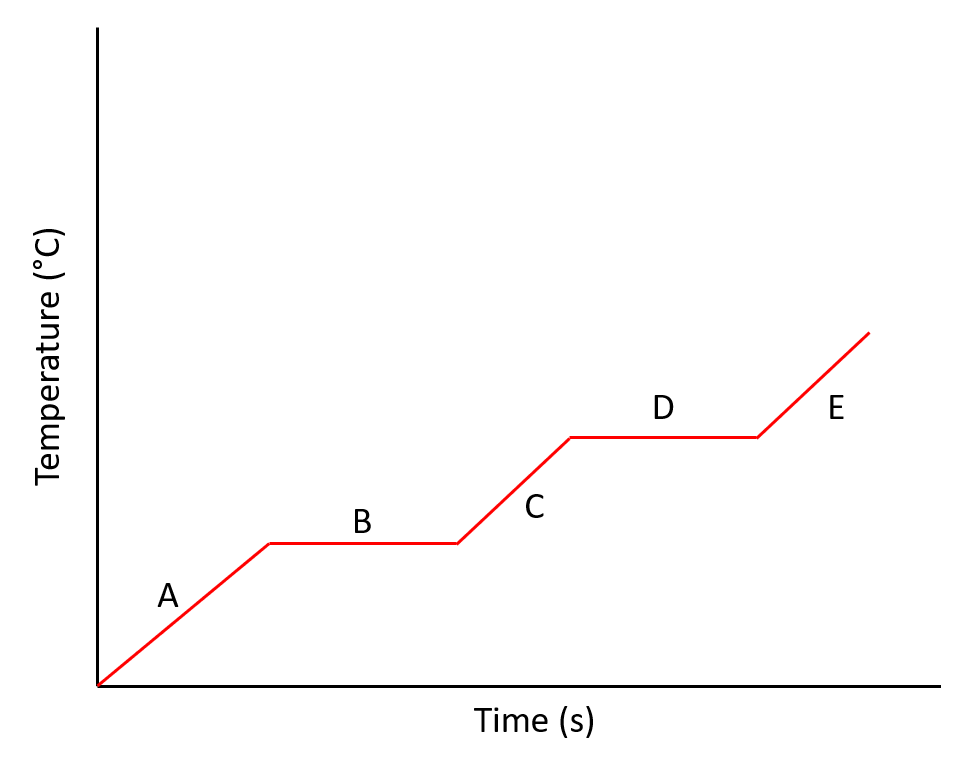
The diagram shows a heating curve for ice. Which line represents the ice melting?

a)

A

b)

B

c)

C

d)

D

e)

E

51.

Why are lines B and D flat?

a)

The ice is melting

b)

The ice is freezing

c)

All of the thermal energy is used to break the bonds

d)

They stopped the stopwatch

e)

They stopped heating the ice.

52.

The diagram shows a heating curve for ice. Which line represents the ice in a liquid state (water)?

a)

A

b)

B

c)

C

d)

D

e)

E

53.

The diagram shows a cooling curve for ice. Which line represents the ice in a liquid state (water)?

a)

A

b)

B

c)

C

d)

D

e)

E

54.

The diagram shows a cooling curve for ice. Which line represents the ice freezing?

a)

A

b)

B

c)

C

d)

D

e)

E

55.

The diagram shows a cooling curve for ice. Which line represents the ice in a solid form?

a)

A

b)

B

c)

C

d)

D

e)

E

56.
This particle is found in the nucleus and has no charge
a)
Neutron
b)
Proton
c)
Electron
57.
This particle is found in the nucleus and has a positive charge
a)
Electron
b)
Proton
c)
Neutron
58.
What scientist is best known for his "Plum Pudding" model of the atom?
a)
J.J. Tomson
b)
Ernest Rutherford
c)
John Dalton
d)
Democritus
59.
Place the following scientists in order, from earliest to latest: 
A) Ernest Rutherford
B) J.J. Thomson
C) John Dalton
a)
B,C,A
b)
C,A,B
c)
A,C,B
d)
C,B,A
60.
What particle was used in the gold foil experiment?
a)
Beta Particle
b)
Alpha particle
c)
Gamma ray 
61.
Most of the alpha particles went straight through the gold foil.  This suggested that....
a)
There is no interference between alpha and gold.
b)
Most of the atom is made up of empty space.
c)
The alpha particles were very tiny.
d)
None of the above
62.
Some of the alpha particles fired at the gold foil were deflected at angles.  This was due to...
a)
reflection of the alpha source when it it the fluorescent screen.
b)
The alpha particles hitting the gold nucleus.
c)
Repulsion forces between the positively charged nucleus and the positively charged alpha particles. 
d)
A mis-firing of the alpha source
63.
Which statement is true according to current thinking?
a)
An atom is mostly empty space.
b)
An atom is a collection of particles, so tightly packed that there is little empty space.
c)
The atomic nucleus is very mobile, and moves around inside a cloud of electrons.
d)
The size of atoms changes over time, pulsating from large to small to large again.
64.

The Gold Foil Method through scattering of alpha particles was used to discover what part of the atom?

a)

protons

b)

electrons

c)

neutrons

d)

nucleus

65.

Which Greek Philosopher believed that matter is composed of tiny particles called atoms?

a)

Democritus

b)

Aristotle

c)

Phytagoras

d)

Plato

66.

What is the charge of the nucleus?

a)

+

b)

-

c)

0

67.
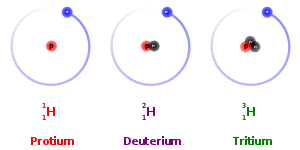
What is an isotope? 
a)
A charged atom
b)
An atom with different amounts of neutrons
c)
An atom with different amounts of protons
d)
A neutral atom
68.
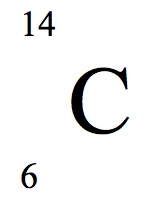
The photo above shows the isotopic notation for which isotope?
a)
Carbon 12
b)
Carbon 13
c)
Carbon 14
d)
Carbon 15
69.
Different isotopes have...
a)
different masses
b)
different atomic numbers
c)
different electrons
d)
different protons
70.
How many neutrons does a Sodium 24 isotope have?
a)
12
b)
13
c)
14
d)
15
71.
How many neutrons does a Carbon 13 atom have?
a)
6
b)
5
c)
7
d)
8
72.
How many neutrons does a Calcium 48 isotope have?
a)
16
b)
20
c)
28
d)
12
73.
How many neutrons does an Oxygen-19 isotope have?
a)
19
b)
8
c)
11
d)
10
74.
How many neutrons does an Iodine-133 isotope have?
a)
80
b)
133
c)
53
d)
77
75.
How many neutrons does a Sulfur-32 isotope have?
a)
15
b)
16
c)
32
d)
12
76.
How many neutrons does a Flourine-14 isotope have?
a)
4
b)
5
c)
9
d)
14
77.
What is the atomic mass of the pictured isotope?
a)
2
b)
4
c)
6
d)
Hehehehe
78.
What is the atomic mass of the pictured isotope?
a)
17
b)
35
c)
18
d)
What a "clorious" isotope!
79.
What is the name of the pictured isotope?
a)
Chlorine-Schmorine
b)
Chlorine-17
c)
Chlorine-35
d)
Chlorine-18
80.
What is the name of the pictured isotope?
a)
Copper-29
b)
Copper-63
c)
Copper-34
d)
CopperWopperHopperBopper
81.
What is the name of the pictured isotope?
a)
Carbon-12
b)
Carbon-13
c)
Carbon-14
d)
Carbon-15
82.
What decay product has a mass number of 4?
a)
alpha
b)
beta
c)
gamma
d)
none of them
83.

What decay product has an atomic number of 4?

a)

alpha

b)

beta

c)

gamma

d)

none of them

84.

What decay product has an atomic number of -1

a)

alpha

b)

beta

c)

gamma

d)

none of them

85.

What type of radiation is the most penetrating?

a)

alpha

b)

beta

c)

gamma

d)

none of them

86.
What type of radiation is the least penetrating?
a)
alpha
b)
beta
c)
gamma
d)
none of them
87.
What type of radiation is the most ionising?
a)
alpha
b)
beta
c)
gamma
d)
none of them
88.

What type of radiation is the least ionising?

a)

alpha

b)

beta

c)

gamma

d)

none of them

89.

What types of radiation are affected by magnetic fields?

a)

all of them

b)

alpha and beta

c)

beta and gamma

d)

alpha and gamma

90.
What decay product is also a helium nucleus?
a)
alpha
b)
beta
c)
gamma
d)
none of them
91.

What decay product is an electron?

a)

alpha

b)

beta

c)

gamma

d)

none of them

92.

What decay product is a high energy electromagnetic wave?

a)

alpha

b)

beta

c)

gamma

d)

none of them

93.

What decay prodcut(s) can be stopped by aluminum?

a)

alpha

b)

beta

c)

alpha and beta

d)

gamma

e)

all of them

94.
What decay product(s) can be stopped by paper?
a)
alpha
b)
beta
c)
alpha and beta
d)
gamma
e)
all of them
95.

If some Protactinium (Pa) decays by alpha it would become...


[The large number at the top is the atomic number]

a)

Actinium (Ac)

b)

Thorium( (Th)

c)

Uranium (U)

d)

Neptunium (Np)

e)

Plutonium (Pu)

96.

If some Protactinium (Pa) decays by beta it would become...


[The large number at the top is the atomic number]

a)

Actinium (Ac)

b)

Thorium( (Th)

c)

Uranium (U)

d)

Neptunium (Np)

e)

Plutonium (Pu)

97.

If some Uranium (U) decays by gamma it would become...


[The large number at the top is the atomic number]

a)

Thorium (Th)

b)

Protactinium (Pa)

c)

Uranium (U)

d)

Neptunium (Np)

e)

Plutonium (Pu)

98.

How many protons are in a boron nucleus?

a)

5

b)

6

c)

11

d)

none of the above

99.

How many neutrons are in a boron nucleus?

a)

5

b)

6

c)

11

d)

none of the above

100.

How many electrons are in a boron nucleus?

a)

5

b)

6

c)

11

d)

none of the above

101.

What decay product(s) has a mass number of 0?

a)

alpha

b)

beta

c)

gamma

d)

beta and gamma

e)

none of them

102.

The term given to unstable radioactive atoms.

a)

Parent

b)

Daughter

c)

Half Life

d)

Igneous

103.

The % of the parent isotope remaining after 3 Half Lives.

a)

50%

b)

25%

c)

12.5%

d)

6.25%

104.

The % of the parent isotope remaining after 1 Half Life.

a)

50%

b)

25%

c)

12.5%

d)

6.25%

105.

The % of the parent isotope remaining after 2 Half Lives.

a)

50%

b)

25%

c)

12.5%

d)

6.25%

106.

After one half life, a sample will begin to have more of the parent isotope than the daughter isotope.

a)

TRUE

b)

FALSE

107.

A sample will lose half of the parent isotope after 1 half life.

a)

TRUE

b)

FALSE

108.

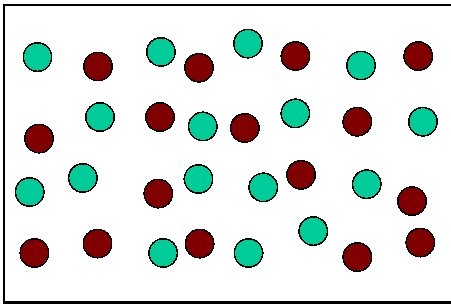
The diagram shows 32 atoms

8 of the Red are parent isotopes

24 of the Green are daughter isotopes

How many half-lives have occurred?

a)

0

b)

1

c)

2

d)

3

109.

The diagram shows 32 atoms.

16 of the Red are parent isotopes

16 of the Green are daughter isotopes

How many half-lives have occurred?

a)

0

b)

1

c)

2

d)

3

110.

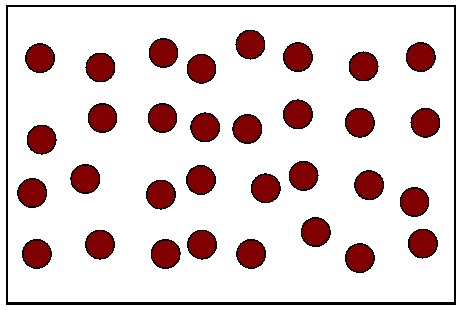
The diagram shows 32 atoms

32 of the Red are the parent isotope

0 of the atoms are daughter isotopes

How many half-lives have occurred?

a)

0

b)

1

c)

2

d)

3

111.

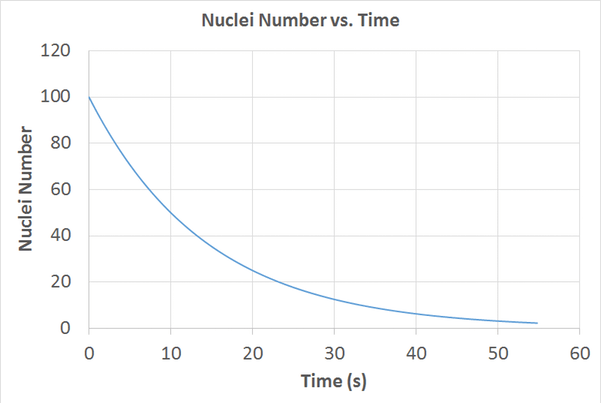
What is the Half life of this isotope?

a)

5 seconds

b)

10 seconds

c)

15 seconds

d)

20 seconds

112.

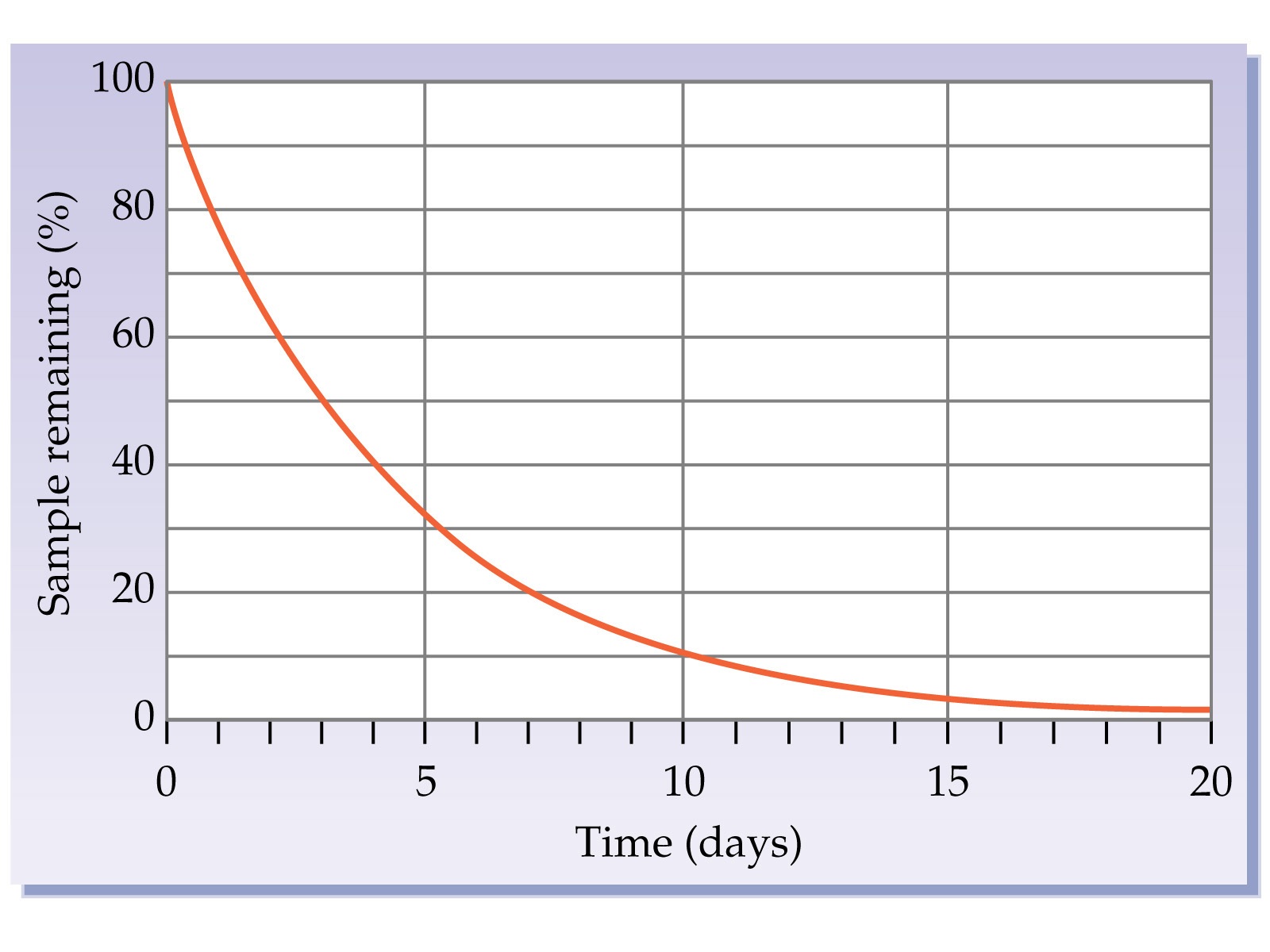
What is the Half Life of this isotope?

a)

3 days

b)

5 days

c)

8 days

d)

10 days

113.

The Half Life of Californium 252 is 5 years.

a)

TRUE

b)

FALSE