
 Worksheets
Forces 7.4 and 7.5 Review
Total questions: 109
Worksheet time: 2hrs 13mins
Name
Class
Date
1.
Which statement describes a vector?
a)
It has magnitude but no direction
b)
It has direction but no magnitude
c)
It has both direction and magnitude
d)
It has constant magnitude but no
direction
direction
2.

The president’s airplane, Air Force One, flies at 250 m/s to the east with respect to the air. The air is moving at 35 m/s to the north with respect to the ground. Find the velocity of Air Force One with respect to the ground.
a)
252 m/s
b)
222 m/s
c)
435 m/s
d)
125 m/s
3.
A motorboat, which has a speed of 5 meters per second in still water, is headed east as it crosses a river flowing south at 3.3 meters per second. What is the magnitude of the boat’s resultant velocity with respect to the starting point?
a)
3.3 m/s
b)
5.0 m/s
c)
6.0 m/s
d)
8.3 m/s
4.
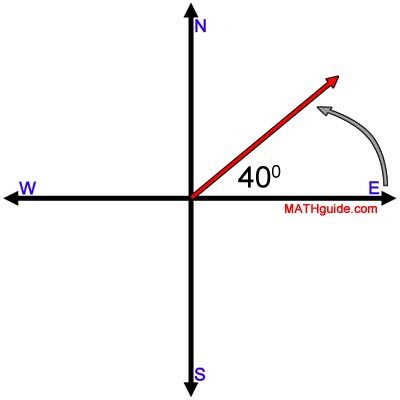
What direction is the angle?
a)
east of north
b)
south of east
c)
north of east
d)
west of east
5.
A velocity vector has a direction of 22 degrees SE, which is larger?
a)
its x component
b)
its y component
6.
A train moves forward with a speed of 4.0 m/s relative to the ground, if a man walks toward the rear of the train with a speed of 2.5 m/s relative to the train what is the speed of the man relative to the ground? Which vector equation would be best for solving this problem?
a)
VMG=VMT+VTG
b)
VMG=VTG-VMT
c)
VMG=VTM+VTM
d)
VMG=VTG+VGT
7.
When drawing a graphical representation of a vector that is the resultant of two or more vectors, how should the resultant be drawn?
a)
from the head of the last to the tail of the first
b)
from the tail of the first to the head of the last
c)
from the head of the last to the direction is was going
d)
from the tail of the first to the tail of the last
8.
A cannonball is fired at a 45.0° angle and an initial velocity of 625 m/s. Assume no air resistance. What is the vertical component of the cannonball’s velocity? What is the horizontal component of the cannonball’s velocity?
a)
-625 m/s; 625 m/s
b)
441.9 m/s; 441.9 m/s
c)
-441.9 m/s; 441.9 m/s
d)
0 m/s; 625 m/s
9.
A cannonball is fired at a 45.0° angle and an initial velocity of 625 m/s. Assume no air resistance. How long until the cannonball hits the ground?
a)
75.4 s
b)
45.2 s
c)
62.3 s
d)
90.2 s
10.
A baseball is thrown at a 22.5° angle and an initial velocity of 65 m/s. Assume no air resistance. What is the vertical component of the ball’s velocity? What is the horizontal component of the ball’s velocity?
a)
24.9 m/s; 60.1 m/s
b)
60.1 m/s; 24.9 m/s
c)
0 m/s; 65 m/s
d)
17183.25 m
11.
A baseball is thrown at a 22.5° angle and an initial velocity of 65 m/s. Assume no air resistance. How far did the ball travel horizontally when it hit the ground?
a)
500.76 m
b)
31.63 m
c)
103.7 m
d)
305.05 m
12.
What states that "every object in the universe attracts every other object"?
a)
Law of Universal Gravitation
b)
Newton's First Law of Motion
c)
My mother
d)
Inertia & gravity
13.
Force of gravity is inversely proportional to
a)
Mass
b)
Weight
c)
Distance
d)
Time
14.
Force of gravity is directly proportional to
a)
Mass
b)
Weight
c)
Distance
d)
Time
15.
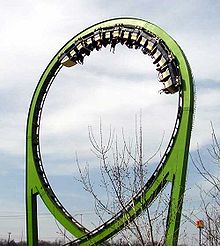
Where is the net force when the rollercoaster is at the top of the loop?
a)
Towards the sky
b)
Towards the Right
c)
Towards the left
d)
Towards the ground
16.

If centripetal force stopped acting on all satellites they would continue traveling in space in a constant direction and constant speed.
a)
True
b)
False
17.

As this ride starts to spin in a circular motion the swings move outward. What is the cause of this outward motion?
a)
Gravity
b)
Centripetal Force
c)
Speed
d)
Inertia
18.

As distance separating the objects increases the force
a)
increases
b)
decreases
c)
stays the same
19.
Double the mass of an object, what happens to the force of attraction?
a)
4 times stronger gravity force
b)
4 times weaker gravity force
c)
2 times weaker gravity force
d)
2 times stronger gravity force
20.
Calculate the velocity of an object moved around a circle with a radius of 1.65 m and an acceleration of 3.5 m/s2.
a)
2.4 m/s
b)
3.6 m/s
c)
3.9 m/s
d)
4.2 m/s
21.
If the mass on Mars is 6.4 kg x 1023 kg and the mass on Earth is 6.0 kg x 1024 kg, which one would you weigh more on?
a)
Earth
b)
Mars
22.
The period of a satellite refers to the satellite's _______.
a)
mass
b)
speed
c)
time of orbit
d)
gps shift
23.
The number 6.67 x 10 -11 N* m^2 / kg^2 is called the _______________.
a)
universal speed constant
b)
the speed force
c)
universal gravitational constant
d)
Earth's gravitational constant
24.

Kepler's first law that refers to the shape of planetary orbits is called ___________.
a)
the Law of Equal Areas
b)
the Law of Ellipses
c)
the Law of Harmonies
d)
the Universal Law of Gravitation
25.

Kepler's second law that refers to the amount of distance covered in equal time intervals along an orbit is referred to as ____________.
a)
the Law of Ellipses
b)
the Law of Equal Areas
c)
the Law of Harmonies
d)
the Law of Universal Gravitation
26.

Kepler's law that determines the relationship between the period of an orbit and the distance that object is from the object it orbits, is know as the ___________.
a)
Law of Ellipses
b)
Law of Equal Areas
c)
Law of Harmonies
d)
Law of Universal Gravitation
27.

The gravitational force between two objects that are 2.1x10‐1 m apart is 3.2x10‐6 N. If the mass of one object is 55 kg, what is the mass of the other object?
a)
50.1 kg
b)
55.5 kg
c)
38.4 kg
d)
Asteroid 2 has no mass
28.
Find the force of gravity (Fg) for two objects with:
m1 = 100 kg
m2 = 1000 kg
d = 500 m
m1 = 100 kg
m2 = 1000 kg
d = 500 m
a)
2.67 * 10-11 N
b)
0.4 N
c)
6.67 * 10-11 N
d)
1.3 * 10-8 N
29.
Find the distance between two objects with:
m1 = 50,000 kg
m2 = 200,000 kg
Fg = 3 * 10-5 N
m1 = 50,000 kg
m2 = 200,000 kg
Fg = 3 * 10-5 N
a)
149.1 m
b)
22223.3 m
c)
18257419 m m
d)
300000 m
30.
How much will the force of an object change if you triple one mass and double the distance?
a)
3x as strong
b)
3/4 of what it was
c)
1/4 of what it was
d)
2x as strong
31.
Luke Skywalker has a mass of 13 kg and weight of 127.4 N on earth. Find his weight on the Endor moon. Acceleration due to gravity of 2 m/s/s.
a)
254.8 N
b)
13 kg
c)
26 N
d)
127.4 kg
32.
The measure of the pull of gravity on an object is ___________________.
a)
motion
b)
weight
c)
speed
d)
friction
33.
Which law explains why when you put a book on a table the table pushes on the book
a)
3rd law
b)
4th law
c)
1st law
d)
2nd law
34.

When Ronda Rousey got kicked in the face, What is the interaction pair?
a)
The foot and the face
b)
Ronda Rousey and media criticism
c)
The foot and the air flow
d)
Ronda Rousey and the floor
35.
Newton's third law states that any action will have a(n) _______ and ______ reaction
a)
Equal and similar
b)
Equal and opposite
c)
Equal and different
d)
Greater and opposite
36.
A bike accelerates at 10 m/s2 when a force of 50N is applied. What is the mass of the bike and its rider?
a)
25 kg
b)
200 kg
c)
20 kg
d)
5 kg
37.
A 20 kg bike accelerates at 10 m/s2. How much force was applied?
a)
25
b)
200 N
c)
20 N
d)
10 N
38.
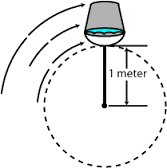
You swing a bucket of water attached to a string in a circle above your head. What keeps the water in the bucket?
a)
Friction
b)
Centripetal Force
c)
Gravity
d)
Inertia
39.
A 4 kg object travelling in circular motion with a radius of 3 m has a velocity of 8 m/s. Find the centripetal force.
a)
85.33 N
b)
10.67 N
c)
96 N
d)
56 N
40.

A ball on a string is travelling in circular motion. Which vector represents the centripetal force?
a)
The green vector because it points towards the center of the circular path
b)
The blue vector because it shows the direction of the object's inertia
c)
The red circular vector because it shows the path of the ball
d)
None of the vectors. Centripetal force acts away from the center of the circular path.
41.
As the car goes around the curve, the centripetal force is directed--
a)
toward the center of the circular curve
b)
away from the center of the circular curve
c)
tangent to the curve in the direction of motion
d)
tangent to the curve opposite the direction of motion
42.
When an object is in circular motion it is constantly changing its velocity.
a)
True
b)
False
43.

A rope attaches a tire to an overhanging tree limb. A girl swinging on the tire has a centripetal acceleration of 3.0 m/s^2. If the length of the rope is 2.1 m, what is the girl’s tangential speed?
a)
3.5 m/s
b)
2.5 m/s
c)
8.5 m/s
d)
12.5 m/s
44.

A racecar moving along a circular track has a centripetal acceleration of 15.4 m/s2.If the car has a tangential speed of 30.0 m/s, what is the distance between the car and the center of the track?
a)
33.7 m
b)
88.6 m
c)
44.2 m
d)
58.4 m
45.

A 2.10 m rope attaches a tire to an overhanging tree limb. A girl swinging on the tire has a tangential speed of 2.50 m/s. If the magnitude of the centripetal force is 88.0 N, what is the girl’s mass?
a)
54.3 kg
b)
29.6 kg
c)
33.8 kg
d)
99.6 kg
46.
A measure of the inertia of an object; The amount of matter an object has.
a)
Mass
b)
Gravity
c)
Force
d)
Momentum
47.
The unit of force is
a)
m/s
b)
m/s^2
c)
newton
d)
kg
48.
What is the acceleration of a 50 kg object pushed with a force of 500 newtons?
a)
100 m/s2
b)
25,000 m/s2
c)
10 m/s2
d)
25 m/s2
49.
A force of 250 N is applied to an object that accelerates at a rate of 5 m/sec2. What is the mass of the object?
a)
100kg
b)
1,250kg
c)
50kg
d)
5kg
50.
Determine the accelerations that result when a 12-N net force is applied to a 3-kg object and then to a 6-kg object.
a)
A 3-kg object experiences an acceleration of 2 m/s/s. A 6-kg object experiences an acceleration of 2m/s/s.
b)
A 3-kg object experiences an acceleration of 4 m/s/s. A 6-kg object experiences an acceleration of 2 m/s/s.
c)
A 3-kg object experiences an acceleration of 2 m/s/s. A 6-kg object experiences an acceleration of 4 m/s/s.
d)
A 3-kg object experiences an acceleration of 4 m/s/s. A 6-kg object experiences an acceleration of 4 m/s/s.
51.
If the net force is equal to zero, the forces acting on the object are
a)
balanced
b)
unbalanced
52.
Which of the following measurement units can be used to measure mass?
a)
Newton
b)
kilogram
c)
cm3
d)
m/s
53.
What is the correct unit for acceleration?
a)
m/s/s
b)
m/h
c)
Newtons
d)
grams
54.

What is the net force
a)
10 N
b)
0 N
c)
25 N
d)
1 N
55.

What is the net force?
a)
400 N Up
b)
400 N Down
c)
- 400 N Down
d)
800 N Down
56.

Which way is the object moving?
a)
It is not or moving at a constant speed
b)
moving to the right
c)
moving to the left
d)
going up
57.

What is the net force?
a)
5000 N right
b)
4000 N right
c)
40 N left
d)
4000 N left
58.
Any object resting against a surface feels
a)
tension force
b)
buoyant force
c)
normal force
d)
frictional force
59.
The SI Unit of force is
a)
Pascal
b)
Meter/second
c)
Newton
d)
kg
60.
The gravitational force (Fe) exerted on an object would be represented by which vector?
a)
↑
b)
→
c)
↓
d)
←
61.
Gravitational force (Fe) can be classified in the group of
a)
Contact Forces
b)
Field Forces
c)
Wiki Forces
d)
Tension Forces
62.
What makes a rolling ball stop moving?
a)
gravity
b)
friction
c)
a balanced force
63.

Name the missing force...
a)
tension force
b)
frictional force
c)
normal force
d)
spring force
64.
A person is pushed forward into their seat belt when a car stops. Which law is this?
a)
1st
b)
2nd
c)
2 and 3
d)
3rd
65.
Friction is a force that acts in an ___________ direction of movement.
a)
similar
b)
opposite
c)
parallel
d)
west
66.
What is the appropriate way to indicate Gravity in a diagram?
a)
b)
c)
d)
67.
The best way to label a push or a pull on a diagram is to use
a)
b)
c)
d)
68.

An airplane is flying at a constant speed of 500 mph. What can be said about the forces acting on the airplane?
a)
Forces are balanced
b)
Forces are unbalanced
c)
There are no forces acting on the airplane
d)
There is a net force acting on the airplane
69.

What type of friction is not moving?
a)
static
b)
sliding
c)
fluid
d)
rolling
70.
What is the force of friction between a block of ice that weighs 950 N and the ground if μ = .12?
a)
65 N
b)
226 N
c)
175 N
d)
114 N
71.
What is the coefficient of static friction if it takes 44 N of force to move a box that weighs 86 N?
a)
0.78
b)
0.51
c)
0.78 N
d)
0.58 N
72.
What are the units on the coefficient of friction?
a)
none
b)
Newtons
c)
meters
d)
kilograms
73.
Two factors effecting the magnitude of the force of gravity between 2 objects are...
a)
mass and distance
b)
mass and matter
c)
distance and weight
d)
weight and mass
74.
As distance between two objects increase the pull of gravity
a)
Increases
b)
Decreases
c)
Stays the same
75.
Two factors effecting the magnitude of the force of gravity between 2 objects are...
a)
mass and distance
b)
mass and matter
c)
distance and weight
d)
weight and mass
76.
As distance between two objects increase the pull of gravity
a)
Increases
b)
Decreases
c)
Stays the same
77.
As the product of two objects' masses increases, the pull of gravity
a)
Increases
b)
Decreases
c)
Stays the same
78.
Double the product of the masses of two objects
a)
4 times stronger gravity force
b)
4 times weaker gravity force
c)
2 times weaker gravity force
d)
2 times stronger gravity force
79.
If the force of gravity has been reduced by 1/4 which could be true?
a)
Mass was increased 4 times
b)
Mass was decreased 2 times
c)
Distance was increased 4 times
d)
Distance was doubled
80.

Centripetal acceleration always points
a)
in the direction of the object's motion
b)
in the opposite direction of the object's motion
c)
towards the center of the circle
d)
towards the outside of the circle
81.
A ball on a string is travelling in circular motion. Which vector represents the centripetal force?
a)
The green vector because it points towards the center of the circular path
b)
The blue vector because it shows the direction of the object's inertia
c)
The green vector because it shows the path of the ball
d)
The blue vector because this is the way the ball will move when it is released.
82.
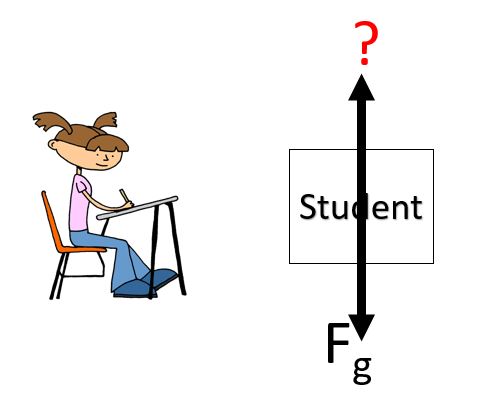
Name the missing force....
a)
weight force
b)
normal force
c)
frictional force
d)
tension force
83.
Name the missing force...
a)
tension force
b)
frictional force
c)
normal force
d)
spring force
84.
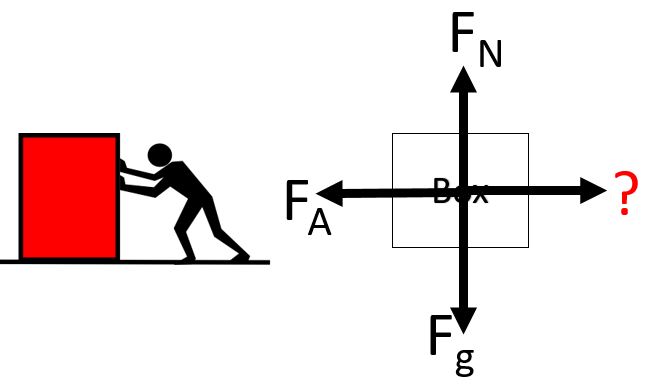
Name the missing force...
a)
frictional force
b)
weight force
c)
thrust
d)
buoyant force
85.

Name the missing force...
a)
weight force
b)
normal force
c)
buoyant force
d)
applied force
86.
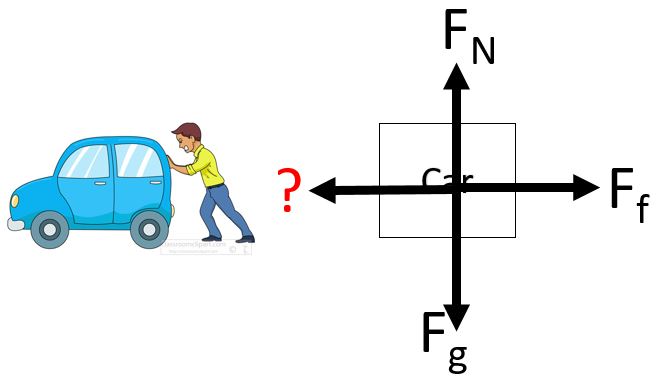
Name the missing force...
a)
applied force
b)
weight force
c)
tension force
d)
drag
87.

Forces that have a net force of zero ( the object is still).
a)
Balanced force
b)
Unbalanced force
88.
What makes a rolling ball stop moving?
a)
gravity
b)
friction
c)
a balanced force
89.

What is the net force in this picture?
a)
50 Newtons to the right
b)
950 Newtons to the right
c)
950 Newtons to the left
d)
50 Newtons to the left
90.
If there are two forces going in the same direction how would you find the net force?
a)
Subtract
b)
Add
c)
Neither
d)
Multiply
91.
8 N to the left , and 4 N to the right. Find the net force. Is this balanced
a)
12 N Right No
b)
4 N Left No
c)
12 N Right Yes
d)
4 N Left Yes
92.

When forces are balanced an object can be stationary or
a)
slowing down
b)
speeding up
c)
moving at a constant speed
d)
accelerating
93.
If an object has only one force acting on it, it can be at rest.
a)
True
b)
False
94.
If something is hanging from the ceiling by a string, does the normal force act on it?
a)
yes
b)
no
95.
If something is sitting on a table, does the normal force act on it?
a)
yes
b)
no
96.
Why do spaceships continue to move in outer space even with their engines off?
a)
they have hidden engines
b)
they use solar panels
c)
they were already in motion so they will stay in motion
d)
the space wind pushes them forward
97.
In what direction does the normal force act?
a)
up
b)
down
c)
perpendicular to the surface
d)
parallel to the surface
98.

Which of the following is not a necessary step in the problem solving strategy?
a)
Free Body Diagram
b)
Find the components of the forces
c)
Determine or not the system is in equilibirum
d)
All steps are completely necessary
99.

Raymond is hover boarding down they hall at a constant velocity. Assuming there is friction, which of the following must be true?
a)
The force applied by the board must be greater than the frictional force
b)
The frictional force must equal the force applied by the board
c)
The force applied must equal zero
d)
There is not enough information
100.

Given the FBD, which of the following must be true?
a)
The frictional force must be accelerating the system to the left.
b)
The box must be accelerating to the right.
c)
The box must be moving to the right.
d)
The FBD is incorrectly drawn. This situation isn't possible
101.
A magician pulls a tablecloth out from under dishes and glasses on a table without disturbing them.
a)
Newton's 1st Law
b)
Newton's 2nd Law
c)
Newton's 3rd Law
d)
None of them
102.
Which causes accelerations?
a)
Balanced forces
b)
Unbalanced forces
c)
Changes in velocity
d)
Equilibrium
103.
The acceleration of an object is directly proportional to the _______ the object.
a)
mass of
b)
momentum of
c)
net force on
d)
magnitude of
104.
A gorilla weighs 1,100 Newtons when standing on two feet, how much does it weigh when standing on one foot?
a)
1,100 N
b)
550 N
c)
2,200 N
105.
When a 550 N sky-diver is experiencing 100 N of air resistance the net force experienced by the diver is ______.
a)
450 N
b)
55 Kg
c)
650 N
d)
550 N
106.
A 2000kg satellite is in space where there is no friction. What force is required in order for the satellite to maintain a velocity of 300m/s?
a)
2000N
b)
20000N
c)
300N
d)
0
107.
What term has the definition, the combination of all forces?
a)
Force of friction
b)
Normal Force
c)
Net Force
d)
Force Air Resistance
108.

Calculate the Acceleration.
a)
8
b)
1
c)
.125
d)
5
109.

An elevator accelerates upward at 2.0 m/s2, as illustrated in the diagram below:
The passenger has a mass of 85 kg. Calculate the force the floor exerts on the passenger.
The passenger has a mass of 85 kg. Calculate the force the floor exerts on the passenger.
a)
1003 N
b)
0 N
c)
833 N
d)
663 N
100 %

