wayground logo

Free Printable Worksheets

NEW

Font size

S
M
L
XL
Worksheets

Graphs of Polynomials

Total questions: 55

Worksheet time: 2hrs 38mins

Name
Class
Date
1.
Where is the graph increasing?
a)
(-∞, -2.55) U (2.55, ∞)
b)
(0, ∞)
c)
(-2.55, 0) U (2.55, ∞)
d)
(-6.25, 36)
2.
Where is the decreasing?
a)
(-∞, -2.55) U (0, 2.55)
b)
(+∞, -6.25) U (36, -6.25)
c)
(-∞, ∞)
d)
(-∞, 0)
3.
What are all the y-intercepts?
a)
(0, -6.25)
b)
(-3,0), (-2,0), (2,0), (3,0)
c)
(0, 36)
d)
(-∞, ∞)
4.
What is the relative max?
a)
(0, 36)
b)
(-2.55, -6.55), (2.55, -6.55)
c)
(-∞, ∞)
d)
None
5.
What is the relative min?
a)
(0, 36)
b)
(-2.55, -6.55), (2.55, -6.55)
c)
(-∞, ∞)
d)
None
6.
a)
(-∞, ∞)
b)
[-2, 2]
c)
(-2, 2)
d)
[-5, 5]
7.
What is the relative maximum value?
a)
y = 4
b)
y = 2
c)
y = 1
d)
y = -1
8.
Which of the following does this graph not show?
a)
absolute max
b)
absolute min
c)
relative max
d)
relative min
9.
How many zeros does the following function have?
f(x)= x5 - 3x3 + x
a)
8
b)
9
c)
5
d)
3
10.
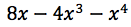
What would be the leading coefficient if this this polynomial was written in standard form?
a)
8
b)
-4
c)
-1
d)
1
11.
The degree of the polynomial determines the number of roots.
a)
True
b)
False
12.

Find the zeros of the polynomial.

f(x) = (x - 5)(2x + 3)(7x - 4)(x + 6)

a)

x = 5, (2/3), 6, (7/4)

b)

x= -5, (3/2), (-4/7), 6

c)

x= 5, (-3/2), (4/7), -6

d)

x= 6, 5, -2/3, -4/7

13.

This graph increases from...

a)

( -1, 1 )

b)

( 0, 4 )

c)

[ -1, 1 ]

d)

[ 0, 4 ]

14.

When determining where a graph is increasing/ decreasing use...

a)

x-values

b)

y-values

15.

This is increasing on the interval (s)...

a)

( - ∞, -2 ) U ( 2, ∞ )

b)

( - ∞, 16 ) U ( -16, ∞ )

c)

( -2, 2 )

d)

( - ∞, -2 )

16.

This graph is _______ in the highlighted areas.

a)

Decreasing

b)

Increasing

17.

This graph is decreasing on the intervals...

a)

( -∞, -2 ) U ( 2, ∞ )

b)

( -∞, 0 ) U ( 4, ∞ )

c)

( -2, 2 )

d)

( 0, 4 )

18.
What is the degree of the polynomial function
P(x)=3x4-7x2-2x7-x+4?
a)
4
b)
7
c)
2
d)
1
19.

What are the zeros of f(x) = x2+9x+14

a)

2, 7

b)

-2, -7

c)

2, -7

d)

-2, 7

20.

The blue dot on this graph represents a(n)...

a)

Absolute Maximum

b)

Absolute Minimum

c)

Relative Maximum

d)

Relative Minimum

21.

What is the range of the function?

a)

[-1, ∞)

b)

(-1,1)

c)

[1.5, ∞)

d)

(-2, 2)

22.

The domain of a polynomial function is always (-∞, ∞).

a)

True

b)

False

23.

The range of a polynomial function is always (-∞, ∞).

a)

True

b)

False

24.

What is the range of this quadratic function?

a)

(-∞, ∞)

b)

[2, ∞)

c)

[4, ∞)

d)

(-∞, 4]

25.

What is the range of this function?

a)

(-∞, ∞)

b)

[2, ∞)

c)

[-2, ∞)

d)

[0, ∞)

26.

What is the interval of increase?

a)

(-∞, -2)

b)

(-2, ∞)

c)

(2, ∞)

d)

(-∞, 2)

27.

What is the interval of decrease?

a)

(-∞, -2)

b)

(-2, ∞)

c)

(2, ∞)

d)

(-∞, 2)

28.
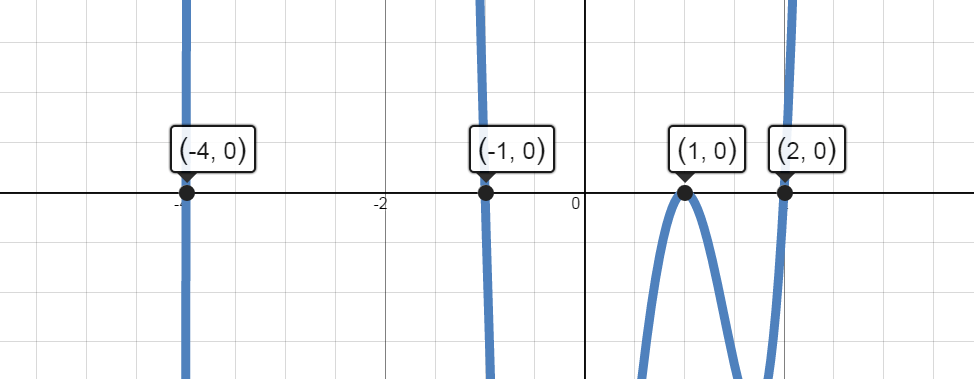
What are the zeros of the graph?
a)
-4, -1, 2, 1 multiplicity 2
b)
-4, -1, 1, 2
c)
4, 1, -2, -1 multiplicity 2
d)
4, 1, -1, -2
29.
State the zeros of the polynomial (include multiplicity):
f(x) = x(x+3)2(x - 2)
a)
x = 0, 3, 2
b)
x = 0, -3 (multiplicity of 2), 2
c)
-3, 2
d)
0, 2 (multiplicity of 3)
30.
f(x)= x2(x – 2)3(x – 7)

Find and select each real zero and its multiplicity
a)
0 (Mult of 2), 2 (Mult of 3), 7 (mult 1)
b)
2 (Mult of 3), 7 (mult 1)
c)
0, 2, 7
d)
2 (mult of 2), 7 (mult of 3)
31.
What does multiplicity mean in terms of the roots of an equations?
a)
To clone a polynomial
b)
How many times a particular number is a zero for a given polynomial.
c)
how many times a polynomial function crosses the x-axis
d)
how many end behaviors a polynomial has
32.
What is the leading coefficient?
a)
Positive
b)
Negative
c)
Odd
d)
Even
33.
What is the degree?
a)
Positive 
b)
Negative
c)
Odd 
d)
Even
34.
What is the degree?
a)
Positive
b)
Negative
c)
Even
d)
Odd
35.
What is the leading coefficient?
a)
Positive
b)
Negative
c)
Even
d)
Odd
36.
What is the leading coefficient?
a)
Positive
b)
Negative
c)
Odd
d)
Even
37.
What is the degree?
a)
Positive
b)
Negative
c)
Odd
d)
Even
38.
What is the leading coefficient?
a)
Positive
b)
Negative
c)
Odd
d)
Even
39.
What is the degree?
a)
Positive
b)
Negative
c)
Odd
d)
Even
40.
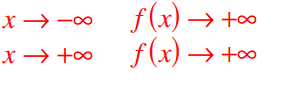
Which function has this end behavior?
a)
-x2-3x+1
b)
-x3+2x2+3
c)
x4+3x3-4x+1
d)
x5-4x4+2x2-1
41.
Which function has this end behavior?
a)
-x2-3x+1
b)
-x3+2x2+3
c)
x4+3x3-4x+1
d)
x5-4x4+2x2-1
42.
Which function has this end behavior?
a)
-x2-3x+1
b)
-x3+2x2+3
c)
x4+3x3-4x+1
d)
x5-4x4+2x2-1
43.

Which function has this end behavior?

a)

-x2-3x+1

b)

-x3+2x2+3

c)

x4+3x3-4x+1

d)

x5-4x4+2x2-1

44.
Which function has this end behavior?
a)
-1x4-3x3+3
b)
-2x7+2x4+4
c)
3x8+3x5-4x+7
d)
4x5-4x4+2x3-9
45.
Which function has this end behavior?
a)
-1x4-3x3+3
b)
-2x7+2x4+4
c)
3x8+3x5-4x+7
d)
4x5-4x4+2x3-9
46.
Which function has this end behavior?
a)
-1x4-3x3+3
b)
-2x7+2x4+4
c)
3x8+3x5-4x+7
d)
4x5-4x4+2x3-9
47.
Which function has this end behavior?
a)
-1x4-3x3+3
b)
-2x7+2x4+4
c)
3x8+3x5-4x+7
d)
4x5-4x4+2x3-9
48.
What is the degree?
a)
Positive 
b)
Negative
c)
Odd 
d)
Even
49.
What is the leading coefficient?
a)
Positive 
b)
Negative
c)
Odd 
d)
Even
50.
Select polynomial whose zeros and degree are given.
Zeros: – 5(multiplicity of 3), 9(multiplicity of 2), – 2, 4
Degree: 7
a)
(x + 5)3(x - 9)2
(x + 2)(x - 4)
b)
(x + 5)3(x - 9)2
(x + 2)7(x - 4)7
c)
(x + 5)3(x - 9)2(x + 2)
d)
(x + 5)(x - 9)(x + 2)
(x - 4)
51.
What is the degree of x2 + 2x + 1?
a)
1
b)
2
c)
3
d)
4
52.
Which zero will "bounce" off of the x-axis for x2(x - 1)(x + 2)(x + 3)
a)
0
b)
1
c)
-2
d)
-3
53.
What is the degree of x2 + 3x3 - x4?
a)
2
b)
3
c)
4
d)
5
54.

Which zero(s) will "bounce" off the x-axis for (x + 1)2(x - 2)2(x+ 3)

a)

2

b)

2 and -1

c)

-1

d)

2 and -3

55.
What is the degree of the function graphed here?
a)
2
b)
3
c)
4
d)
5