wayground logo

Free Printable Worksheets

Font size

S
M
L
XL
Worksheets

Unit 6: Consequences of Industrialization Review

Total questions: 50

Worksheet time: 29mins

Name
Class
Date
1.

What caused the Taiping and Boxer rebellions?

a)

Foreign economic involvement in China

b)

British selling opium to China

c)

Indians refusing to touch the gunpowder pouches

d)

Americans moving into West North America

2.

Which country had the largest sphere of influence in Latin America during the Age of Imperialism?

a)

United States

b)

Spain

c)

Mexico

d)

England

3.

What was Japan's response to foreign interference in the nineteenth century?

a)

Adapt to Western politics and culture (Meiji Restoration)

b)

Isolate themselves further by resisting and fighting

c)

Became allies with the Chinese to become the dominant power in the region

d)

Adapt to the ideas of the islanders and tribal people to resist

4.

How were people able to migrate cheaper and faster?

a)

New more affordable methods of transportation

b)

Horses became more affordable for the common people

c)

The elite paid for the lower class to migrate out of their country

d)

Free trade policies made people wealthy in the countries

5.

Which company took over other European states colonies in India?

a)

British East India Company

b)

British West India Company

c)

Dutch East India Company

d)

French East India Company

6.

Why did European powers divide Africa by diplomatic agreements between each other?

a)

Fear of going to war because of fierce competition

b)

Rapid population increase in European colonies in Asia

c)

Atlantic revolutions lead Europeans states to seek new troops

d)

Creation of transnational business fostered exchange of raw materials

7.
What happened during the Berlin Conference?
a)
Europeans decided how to divide up Africa.
b)
Africans decided how to divide up Africa.
c)
Africans mapped out routes for the slave trade.
d)
Germany staked claim to most of Africa.
8.
Pride in one's country is known as ____.
a)
apartheid
b)
imperialism
c)
nationalism
d)
communism
9.
European nations rushing to claim territories in Africa has been called ________ by historians.
a)
the gold rush 
b)
the scramble for Africa 
c)
get money in a hurry
d)
quick claims in Africa 
10.
Which is NOT a natural resource Europeans were interested in while colonizing Africa?
a)
Gold
b)

Ivory

c)
Rubber
d)
Tobacco 
11.

Which European countries would control most of northern Africa during the 1800s?

a)

Britain

b)

Germany

c)

Egypt

d)

France

12.

The phrase "The White Man's Burden" is the title of a poem by which British poet?

a)

Boba Fett

b)

Grover Cleveland

c)

Rudyard Kipling

d)

Cecil Rhodes

13.

King _______ was notorious for his poor treatment of the Congolese People

a)

Leonard II

b)

Leopard II

c)

Leopold II

d)

Leotard II

14.

Which best describes the European attitudes toward the native people of African Countries?

a)

Europeans were impress by the large African civilizations

b)

African wanted to be more European and accepted their way of life

c)

They were equals, but they just needed assistance in being more European

d)

Africans were uneducated and without religion

15.

Which European country held the most territory in both the north AND south of Africa?

a)

France

b)

Belgium

c)

Italy

d)

England

16.

What was Social Darwinism?

a)

The idea that people descended from monkeys

b)

The idea that certain races (whites) were better than others

c)

The idea that only the fittest could survive in society

d)

Parties held by scientists to share new ideas

17.

True or False: Europeans greatly improved the lives of people in their colonies.

a)

False

b)

True

18.

Which is true about China after the Opium Wars?

a)

Britain had complete control over its markets, its government, and its resources

b)

It was divided physically into separate colonies and lost its Emperor to addiction

c)

China pushed back invaders and built its own land-based Empire

d)

China was politically unified, but had its economy divided into Spheres of Control by others.

19.

What Policy does the image represent?

a)

Dollar Diplomacy

b)

Square Deal

c)

Big Stick Diplomacy

d)

New Freedom

20.

Native Indians who served in the British East India Co. as soldiers.

a)

Raja

b)

Viceroy

c)

Sepoy

d)

Varna

21.
 What happened as a result of the Berlin Conference of 1884-1885? 
a)
France and Britain agreed to combine African colonies
b)
less fighting between African leaders and European powers
c)
African leaders voiced their suggestions
d)
Europeans divided Africa into colonies 
22.
The theory that it was natural for stronger nations to dominate weaker ones is known as   
a)
Berlin Conference
b)
Social Darwinism
c)
Sphere of Influence
d)
Scramble for Africa
23.
 Imperialism was brought on as a result of 
a)
Democratic Revolutions 
b)
World War I 
c)
Industrialization 
d)
The Renaissance 
24.
When a strong country takes over a weaker country for economic, social or political reasons it is called
a)
industrialization
b)
miliatrism
c)
imperialism
d)
nationalism
25.

The Meiji Restoration included all of the following EXCEPT:

a)

ending feudalism

b)

modernization of the military

c)

absolute rule

d)

the military defeat of the USA

26.

China and Britain fought a war over:

a)

the Korean peninsula

b)

conquests along the Nile River

c)

opium production and distribution

d)

the elimination of the samurai

27.
One of the most important motives for the European imperialism in Africa in the late 1800s was that   Africa provided a source of
a)
religious conversion of Africans
b)
slaves for the American colonies
c)
raw materials used in industry
d)
new technology to gain from Africans
28.
Economic motives for imperialism include _________.
a)
a desire to spread Christianity
b)
a need for military bases around the world
c)
a need for raw materials to be used in factories
d)
a desire to gain glory
29.
What rebellion led to the end of indirect rule and the beginning of direct rule in India?
a)
The Boxer Rebellion
b)
The Zulu War
c)
The Sepoy Rebellion
d)
The Boer Rebellion
30.
Why were the Sepoys offended by the new weapons that used animal fat to grease the gun cartridges?
a)
Most Sepoys were Muslim or Hindu and their religions had specific rules about cows and pigs
b)
The grease stained their uniforms, which were expensive to replace
c)
The Sepoys were pacifists and did not believe in war
d)
The Sepoys invented the new weapons and were not paid for their use
31.
What natural resources did Great Britain gain in India?
a)
rubber, ivory and timber
b)
coal, iron and diamonds
c)
cotton, tea, spices and opium
d)
fur, wool and flax
32.
Who was excluded from the Berlin Conference?
a)
representatives for the US
b)
representatives of European countries
c)
representatives of African countries
d)
representatives of the 3rd Estate
33.
the use of machines instead of human or animal power
a)
expansionism
b)
industrialization
c)
militarism
d)
sovereignty
34.
Nationalism in European nations led to imperialism because  
a)
the nations wanted fueling stations for their naval ships.
b)
 the people of Africa and Asia were poor and in need of help.
c)
the countries of Europe were competing to become the strongest in power. 
d)
because the Europeans wanted a market for goods made in factories
35.
The Sepoy Rebellion was an example of  
a)
the United States  setting up colonies.
b)
a successful rebellion against imperialism. 
c)
a nation attempting to practice isolationism. 
d)
a nation fighting against imperialism. 
36.
What was the name of the conflicts between Britain and China over trade rights?
a)
Opium Wars
b)
Anglo-Chinese Wars
c)
Clone Wars
d)
Hundred Days War
37.
What was the name of "unequal treaty" signed by the British and Chinese in 1842?
a)
Treaty of Nanking
b)
Treaty of Hong Kong
c)
The Free Trade Treaty
d)
The New Port Authority Treaty
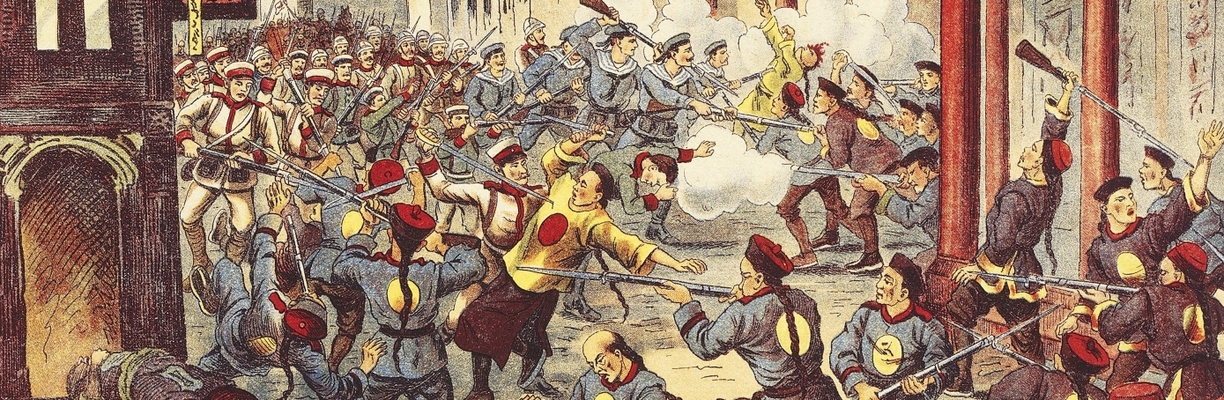
38.
What rebels attacked foreigners in China and especially hated Chinese who converted to Christianity?
a)
The Boxers
b)
The Wuchang Clan
c)
Sworn Chinese Brotherhood
d)
The New Army
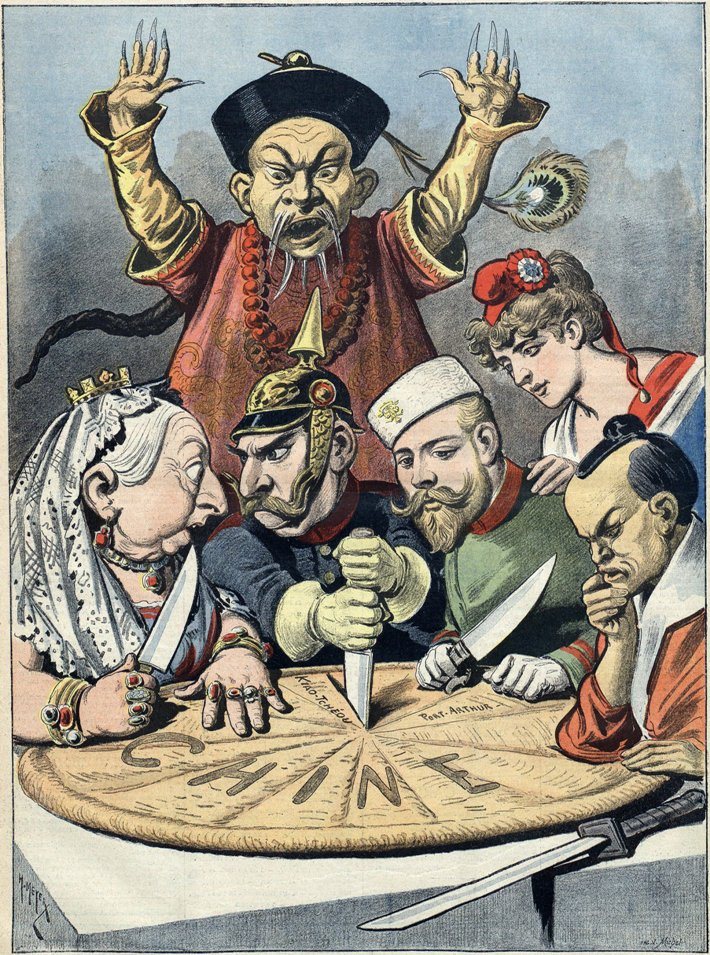
39.
What is the best interpretation of this political cartoon?
a)
China successfully resisted imperialism
b)
Chine modernized and became imperialist
c)
China was divided into spheres of influence by imperialist powers
d)
China isolated itself from trade with other nations
40.
How the loss of the Opium War impact China?
a)
It allowed foreign countries to imperialize China
b)
It caused Chinese peasants to rebel against their govt.
c)
China modernized and became an imperialist power
d)
China returned to isolationism from trade with the West
41.
What did England sell to China?
a)
Opium
b)
Tea
c)
Cotton
d)
Salt
42.
What event took place in China that started because the Chinese wanted western countries out?
a)
Boxer Rebellion
b)
Sepoy Mutiny
c)
Tea Rebellion
d)
Trade Rights Rebellion
43.
What was the result of the Boxer Rebellion?
a)
an alliance of imperialist nations suppressed the rebels
b)
imperialist nations were forced to withdraw from China
c)
imperialist nations fought each other over control of China
d)
China became a territory of the United States
44.
The theme of this image is
a)
Industrialism
b)
Communism
c)
Capitalism
d)
Imperialism
45.
Which country was granted independence in the Treaty of Paris of 1898 at the end of the Spanish American War?
a)
Guam
b)
Cuba
c)
Philippines 
d)
Puerto Rico
46.
What was the purpose of the Open Door Policy in China?
a)
End the Boxer Rebellion
b)
Ensure trading rights with China
c)
Win leaseholds in China
d)
Establish a sphere of influence
47.
Which territory did the United States NOT gain direct control of after the Spanish-American War? 
a)
Puerto Rico
b)
Cuba
c)
Philippines 
d)
Guam
48.
Alfred T. Mahan argued:
a)
to become an empire, the US needed to acquire naval bases and strengthen its naval power
b)
the burden of the white man is to support and uplift non-whites
c)
imperialism was not democratic and engaging in it would be hypocritical
d)
the nation's economic needs could be satisfied from within as the US should avoid risking itself in foreign entanglements
49.
What policy gave the United States justification for helping Cuba?
a)
Big Stick Diplomacy
b)
Declaration of Human Rights
c)
Monroe Doctrine
d)
Dollar Diplomacy
50.
According to the Roosevelt Corollary, what was the role of the US in the Western Hemisphere? 
a)
Ok for Europeans to imperialize
b)
international police force
c)
allow imperialism in the Americas
d)
allow European nations to take over