wayground logo

Free Printable Worksheets

Font size

S
M
L
XL
Worksheets

Klein Cain Purple Out QSE3 Super Review

Total questions: 239

Worksheet time: 8hrs 30mins

Name
Class
Date
1.
Name the discontinuity at x=2. 
a)
Infinite Discontinuity
b)
Removable Discontinuity
c)
Jump Discontinuity
d)
Continuous at x=2
2.
Name the discontinuity at x=2. 
a)
Infinite Discontinuity
b)
Removable Discontinuity
c)
Jump Discontinuity
d)
Continuous at x=2
3.
Name the discontinuity at x=2. 
a)
Infinite Discontinuity
b)
Removable Discontinuity
c)
Jump Discontinuity
d)
Continuous at x=2
4.
Name the discontinuity at x=2. 
a)
Infinite Discontinuity
b)
Removable Discontinuity
c)
Jump Discontinuity
d)
Continuous at x=2
5.
Name the discontinuity at x=2. 
a)
Infinite Discontinuity
b)
Removable Discontinuity
c)
Jump Discontinuity
d)
Continuous at x=2
6.
Name the discontinuity at x=2. 
a)
Infinite Discontinuity
b)
Removable Discontinuity
c)
Jump Discontinuity
d)
Continuous at x=2
7.
Name the discontinuity at x=2. 
a)
Infinite Discontinuity
b)
Removable Discontinuity
c)
Jump Discontinuity
d)
Continuous at x=2
8.
Name the discontinuity at x=2. 
a)
Infinite Discontinuity
b)
Removable Discontinuity
c)
Jump Discontinuity
d)
Continuous at x=2
9.
Name the discontinuity at x=2. 
a)
Infinite Discontinuity
b)
Removable Discontinuity
c)
Jump Discontinuity
d)
Continuous at x=2
10.
What is the Vertical Asymptotes? 
a)
x= -5
b)
x= 5
c)
x= 6
d)
x= -6
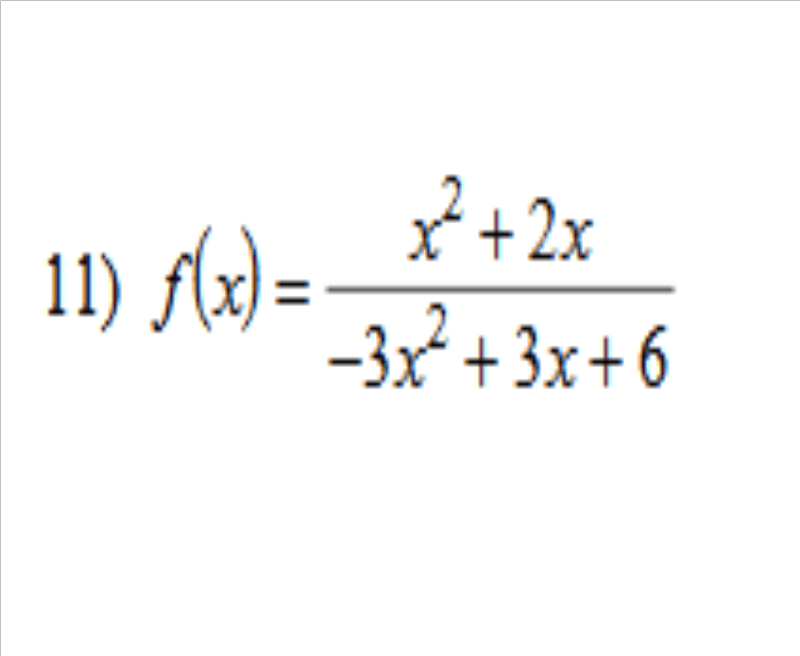
11.

Where are the discontinuities?

a)

holes: x=-1

asymptotes: x=5/3

b)

holes: x=-1

asymptotes: x=2/3

c)

holes: x=1

asymptotes: x=5/3

d)

holes: x=1

asymptotes: x=2/3

12.

Which of the following graphs presents an infinite discontinuity at x = 1?

a)
b)
c)
d)
13.

What is the removable discontinuity?

a)

x= 4

b)

x= -4

c)

x= 5

d)

x= -5

14.
What is the definition of an ASYMPTOTE?
a)
A curved line. 
b)
A line that only touches the origin. 
c)
A line that only lives on the first quadrant. 
d)
A line that a curve approaches, as it heads towards infinity. 
15.

The equation of a vertical asymptote is written in the form:

a)

x=

b)

y=

c)

none of the above

16.
Which of the following is determined by just looking at the denominator?
a)
vertical asymptote
b)
horizontal asymptote
c)
holes
d)
slant asymptote
17.

Find the vertical asymptote.

g(x)=(x+3)(x2)(x+5)(2x1)g\left(x\right)=\frac{\left(x+3\right)\left(x-2\right)}{\left(x+5\right)\left(2x-1\right)}  

a)

x=-5

b)

x=1/2

c)

x=-1/2

d)

x=-3

e)

x=2

18.

Does this function have any vertical asymptotes? If so, what are their equations? y=(x+3)(x4)(x+7)(x4)y=\frac{\left(x+3\right)\left(x-4\right)\left(x+7\right)}{\left(x-4\right)}  

a)

No vertical asymptotes.

b)

One vertical asymptote: x = 4

c)

Two vertical asymptotes: x = -3 and x = -7

d)

Three vertical asymptotes:  x = -3, x = 4, and x = -7

19.
The holes of a rational function occur when :
a)
my pencil pokes a hole in the paper I'm working on
b)
there is something left in the denominator
c)
the value of f(0)
d)
a factor in the denominator cancels with a factor in the numerator
20.

What is the x-value of the hole? g(x)=(x2)(x+6)(x+2)(x2)g\left(x\right)=\frac{\left(x-2\right)\left(x+6\right)}{\left(x+2\right)\left(x-2\right)}  

a)

2

b)

-2

c)

-6

d)

6

21.

f(x)=(x+7)(x3)(x+1)(x3)(x5)f\left(x\right)=\frac{\left(x+7\right)\left(x-3\right)\left(x+1\right)}{\left(x-3\right)\left(x-5\right)}  

Select all of the true statements.

a)

A hole occurs where x=3

b)

vertical asymptote at x=3

c)

vertical asymptote at x=5

d)

A hole occurs where x=5

22.

State the vertical asymptote: 

g(x)=(x+2)(2x+3)g\left(x\right)=\frac{\left(x+2\right)}{\left(2x+3\right)}  

a)

x=2

b)

x=23x=\frac{2}{3}  

c)

x=23x=-\frac{2}{3}  

d)

x=-2

e)

x=32x=-\frac{3}{2}  

23.

h(x)=x(x3)(x6)(x+3)3x(x+3)(x6)(x+7)h\left(x\right)=\frac{x\left(x-3\right)\left(x-6\right)\left(x+3\right)}{3x\left(x+3\right)\left(x-6\right)\left(x+7\right)}  

Identify the x-value of the hole(s).

a)

x=0

b)

x=-3

c)

x=6

d)

x=-7

e)

x=3

24.
What is the Vertical Asymptotes? 
a)
x= -5
b)
x= 5
c)
x= 6
d)
x= -6
25.
Find the horizontal asymptote.
a)
None
b)
y = 0
c)
y = -1/3
d)
y = -3
26.
Which asymptote(s) are determined by looking at the denominator?
a)
vertical
b)
horizontal
c)
slant
d)
none
27.
Find the horizontal asymptote.
a)
y = -2
b)
none
c)
y = 0
d)
y = 1/2
28.
Where is the removable discontinuity?
a)
x=2
b)
x=2 and x=3
c)
x=-3
d)
x=3
29.

Where are the discontinuities?

a)

holes: x=-3

asymptotes: x=-1

b)

holes: none

asymptotes: x=-1

c)

holes: x=-1

asymptotes: x=-3

d)

holes: x=-1

asymptotes: none

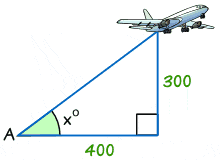
30.

Set up the problem so that you can solve for X.

a)

sin X = 41/28

b)

tan X = 41/28

c)

cos X = 28/41

d)

sin X = 28/41

31.

Solve for the missing angle

a)

50.5 degrees

b)

12.7 degrees

c)

36.9 degrees

d)

72.2 degrees

32.

Solve for x. Round to the nearest tenth.

a)

15.3

b)

16.6

c)

24.1

d)

24.3

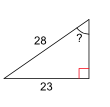
33.
Find the measure of the indicated angle (?) round to the nearest tenth.
a)
9.4
b)
55.2
c)
20.15
d)
19.4
34.
Find the measure of the missing angle.
a)
64o
b)
26o
c)
61o
d)
8o
35.
Solve for the missing angle
a)
50.2
b)
93.1
c)
12.6
d)
42.2
36.
Find the measure of the missing angle.
a)
49o
b)
50o
c)
41o
d)
33o
37.
Choose the correct ratio.
a)
sin(37)=x/14
b)
cos(37)=x/14
c)
tan(37)=x/14
d)
sin(37)=14/x
38.
A hawk sitting on a tree branch spots a mouse on the ground 15 feet from the base of the tree.  The hawk swoops down toward the mouse at an angle of 30 degrees. What is the distance from the tree branch to the mouse? 
a)
7.5 ft 
b)
15 ft 
c)
26 ft 
d)
30 ft 
39.
Susan is flying a kite, which gets caught in the top of a tree.  Use the diagram to estimate the height of the tree. 
a)
63 ft
b)
65 ft
c)
74 ft
d)
87 ft
40.
What is the length of y in this picture?
a)
45
b)
5√2
c)
90
d)
5
41.
What is the length of x in this 45-45-90 triangle?
a)
4√2
b)
4
c)
8
d)
4√3
42.
What is the length of y in this 45-45-90 triangle?
a)
8√2
b)
4√2
c)
4
d)
8
43.
What is the length of u and v in this 30-60-90 triangle?
a)
u = 8 v = 4√3
b)
u = 4√2 v = 8
c)
u = 16 v = 8
d)
u = 4√3 v = 8
44.
What is the length of y in this picture?
a)
45
b)
5√2
c)
90
d)
5
45.
A tourist views a deer from a height of 45 feet.  The horizontal distance between the tourist and the deer is 130 feet.  At what angle (x) should the tourist hold his camera to photograph the deer? Round your answer to the nearest degree.  
a)
19 degrees
b)
45 degrees
c)
71 degrees
d)
138 degrees 
46.
Solve for the misssing distance
a)
18.9 meters
b)
19.5 meters
c)
47.2 meters
d)
27.5 meters
47.

A rectangular field is 50 yards wide and 100 yards long. Ethan walks diagonally across the field. How far does he walk?

a)

111.8 yards

b)

115 yards

c)

127.3 yards

d)

119 yards

48.
The __________ represents half the distance between the max and min of a sine or cosine graph. 
a)
Period
b)
Frequency
c)
Extreme Values
d)
Amplitude
49.
The period of a sine or cosine graph can be found by ....
a)
It's always 2π
b)
2π/B
c)
B(2π)
d)
2π+B
50.
Which value represents a vertical shift in the following function y=a*sin(bx - c)+d?
a)
a
b)
b
c)
c
d)
d
51.
Sine or Cosine?
a)
y=sinx
b)
y=cosx
52.
Sine or Cosine?
a)
y=sinx
b)
y=cosx
53.
What is the period of
y= -3sin(x)
a)
π
b)
c)
d)
54.
What is the midline for
y=2cos(1/3x +π/6) +2
a)
1/3
b)
-2
c)
+2
d)
4
55.
What is the amplitude of y = 3 cos 2x?
a)
3
b)
2
c)
90
90⁰
d)
350⁰
56.
Where does the graph of y = cos x begin?
a)
(0,0)
b)
(0,1)
c)
(0, Pi)
d)
(1, Pi)
57.
What is the equation of the graph?
a)
 y = 2 cos x
b)
y = sin x
c)
y = 2 sin x
d)
y = sin 2x 
58.
What is the period
of
 y = 3 sin 2x?
a)
2
b)
3
c)
180
d)
360
59.
Write the equation for a sine function with an amplitude of 6 and a period of π/4.
a)
y=6sin(8x)
b)
y=6sin8(x-1)
c)
y=6sin1/4x
d)
y=6sinx
60.
Write an equation for the cosine function with amplitude 3, period 2pi, phase shift of pi, and vertical shift of 5.
a)
y = 5cos(x - pi) + 3
b)
y = 3cos(x - pi) + 5
c)
y = 3cos(2x - pi) + 5
d)
y = 5cos(2x - pi) + 3
61.

Which function has a domain of all real numbers?

a)

y = tan x

b)

y = sec x

c)

y = cot x

d)

y = cos x

62.

Which parent function is shown?

a)

y = sin x

b)

y = cos x

c)

y = tan x

d)

y = csc x

63.

What's the range of y = csc x ?

a)
b)
c)
d)
64.

What's the range of y = cot x

a)
b)
c)
d)
65.

Which parent functions include the point (0, 1)?

a)

sine and cosecant

b)

cosine and secant

c)

cosine, secant, and tangent

d)

sine, cosecant, and cotangent

66.

Which parent function satisfies the given conditions?

a)

y = tan x

b)

y = cot x

c)

y = csc x

d)

y = sec x

67.

Which parent functions have the given domain?

a)

tangent and cotangent

b)

secant and cosecant

c)

tangent and secant

d)

cotangent and cosecant

68.

Which parent function is shown?

a)

y = tan x

b)

y = sin x

c)

y = csc x

d)

y = sec x

69.

Which parent functions include the point (pi/2, 0) ?

a)

sine and tangent

b)

cosine and cotangent

c)

sine and cosecant

d)

cosine and secant

70.

How many of the trig parent functions satisfy the following conditions?

a)

0

b)

1

c)

2

d)

4

e)

6

71.

Which of the following functions does NOT have a period of 2pi?

a)

y = sin x

b)

y = tan x

c)

y = csc x

72.

Which parent function meets the following requirements?

a)

tangent

b)

cotangent

c)

secant

d)

cosecant

73.

What is the reference angle for 125°?

a)

235°

b)

125°

c)

75°

d)

55°

74.

What is the reference angle for -30°?

a)

150°

b)

30°

c)

80°

d)

60°

75.

What is the reference angle for -310⁰?

a)

50⁰

b)

-50⁰

c)

20⁰

d)

40⁰

76.

What is the reference angle for 275°?

a)

85°

b)

95°

c)

-85°

d)

-95°

77.

What is the reference angle for 63°?

a)

117°

b)

207°

c)

63°

d)

153°

78.

What is the reference angle?

a)

163

b)

73

c)

27

d)

107

79.

What is the reference angle?

a)

43

b)

-43

c)

47

d)

-47

80.

What is the reference angle?

a)

112

b)

68

c)

158

d)

248

81.

What is the reference angle?

a)

7

b)

63

c)

277

d)

97

82.

What is the reference angle?

a)

48

b)

138

c)

132

d)

42

83.

Find the reference angle for an angle measuring -300⁰

a)

60⁰

b)

-60⁰

c)

30⁰

d)

45⁰

84.
What is the reference angle for 240 degrees?
a)
60 degrees
b)
30 degrees
c)
45 degrees
d)
210 degrees
85.
Find a coterminal angle to -180 degrees.
a)
180
b)
90
c)
270
d)
360
86.
Find a coterminal angle to 45 degrees.
a)
360
b)
405
c)
315
d)
295
87.

Find a coterminal angle to 200 degrees.

a)

-520

b)

-200

c)

160

d)

-380

88.
Which quadrant is -570⁰
a)
I
b)
II
c)
III
d)
IV
89.
What is the degree equivalent to -135o
a)
225o
b)
215o
c)
235o
d)
45o
90.

Formula [Reference angle = Actual angle - 180] is for

a)

quadrant 1

b)

quadrant 2

c)

quadrant 3

d)

quadrant 4

91.
What is the reference angle for 30 degrees?
a)
70 degrees
b)
30 degrees
c)
150 degrees
d)
330 degrees
92.
What is the reference angle for -30 degrees?
a)
150 degrees
b)
30 degrees
c)
80 degrees
d)
60 degrees
93.
What is the reference angle for 240 degrees?
a)
60 degrees
b)
30 degrees
c)
45 degrees
d)
210 degrees
94.

What is the sin(120)?

a)

-1/2

b)

1/2

c)

-root(3)/2

d)

root(3)/2

95.

What is the cos(585)?

a)

1/2

b)

root(2)/2

c)

-root(2)/2

d)

-root(3)/2

96.

What is sin(-660)?

a)

root(3)/2

b)

1/2

c)

-1/2

d)

1

97.

What is cos(810)?

a)

1/2

b)

1

c)

0

d)

-1

98.

What is sin(300)?

a)

1/2

b)

-1/2

c)

root(3)/2

d)

-root(3)/2

99.

Which angle is coterminal with 190'?

a)

610'

b)

-160'

c)

910'

d)

-510'

100.

What is the reference angle for 54π/8 ?

a)

3π/4

b)

π/2

c)

3π/2

d)

π/4

101.

This diagram represents...

a)

a reference angle of 30'

b)

a reference angle of 210'

c)

a coterminal angle of 210'

d)

a standard position of an angle that is 210'

e)

a standard position of an angle that is 30'

102.

Arrange the following angles in ascending order.

I. 240 degrees

II. 4 radians

III. 5/6 of a revolution

IV. smallest positive coterminal of -135 degrees

a)

IV, II, I, III

b)

III, I, II, IV

c)

I, II, III, IV

d)

IV, II, III, I

103.

What is the measure of the angle rotation made by the minute hand from 3 pm to 4 pm?

a)

π\pi

b)

2π2\pi

c)

2π-2\pi

d)

4π-4\pi

104.

A positive angle in the second quadrant has more than one but less than two rotations. What is the angle if its reference angle is 15°?15\degree?  

a)

525°525\degree  

b)

555°555\degree  

c)

165°165\degree  

d)

885°885\degree  

105.

If I start at

2π3radians \frac{2\pi}{3}radians\  and move through 1 1/2 rotations, what is the sine of the angle I end up at?

a)

12-\frac{1}{2}  

12\frac{1}{2}  

b)

32-\frac{\sqrt{3}}{2}  

c)

32\frac{\sqrt{3}}{2}  

106.
What is the amplitude of the graph? 
a)
1
b)
3
c)
6
d)
9
107.
what is the amplitude of y=3sin(7x)-2
a)
7
b)
-2
c)
3
d)
6
108.
Convert 100⁰ to radians
a)
5π/9
b)
π/2
c)
5π/8
d)
5π/6
109.
What is the amplitude of this function?
a)
2
b)
2π
c)
-2
d)
1
110.
What is the domain and range of y=sinx?
a)
D: (-∞, ∞)
R: [-1, 1]
b)
D: (-∞, ∞)
R: [-
π, π]
c)
D: (∞, -∞)
R: [-1, 1]
d)
D: (-∞, ∞)
R: [-
∞, ∞]
111.
what is the period of y= -3sinx
a)
π
b)
c)
d)
112.
What is the period?
a)
π/4
b)
π/2
c)
3π/4
d)
π
113.
What is the period?
a)
b)
c)
π
d)
114.
What is the period of y=4cos5x
a)
2π/5
b)
π
c)
5
d)
5π
115.
Write the equation for a sine function with an amplitude of 6 and a period of π/4.
a)
y=6sin(8x)
b)
y=6sin8(x-1)
c)
y=6sin1/4x
d)
y=6sinx
116.
What is the period of this graph?
a)
b)
π/2
c)
π/4
d)
π
117.
What is the period of y = 4Cos(2x)?
a)
b)
π
c)
d)
π/2
118.
What is 90 degrees in radians? 
a)
π/4
b)
π/2
c)
π/6
d)
3π/2
119.
What is 45 degrees in radians?
a)
π/2
b)
π/6
c)
π/4
d)
3π/4
120.
What is the equation of the graph?
a)
 y = 2 cos x
b)
y = sin x
c)
y = 2 sin x
d)
y = sin 2x 
121.
What is the equation of graph? 
a)
y = sin 5x
b)
y =  cos 5x
c)
y = 5 sin x
d)
y = 5 cos x 
122.
What is the amplitude and period of y = 2sin(3x)
a)
2 and 3
b)
3 and 2
c)
2,2π/3,
d)
2π/3, 2
123.
What is the amplitude and period of y = 2sin(πx)
a)
2 and 2
b)
π and 2 
c)
2 and π
d)
2π and 2
124.

The __________ measure the distance from the midline to the max or min of the function.

a)

Amplitude

b)

Phase Shift

c)

Vertical Translation

d)

Horizantal Translation

125.
The vertical stretch of the graph; distance between the midline and the max/min.
a)
Period
b)
Cycle
c)
Axis of Oscillation
d)
Amplitude
126.
The horizontal length required to complete one cycle.
a)
Period
b)
Cycle
c)
Axis of Oscillation
d)
Amplitude
127.
The period of a sine or cosine graph can be found by ....
a)
It's always 2π
b)
2π/B
c)
B(2π)
d)
2π+B
128.
what is the period of y= -3sinx
a)
π
b)
c)
d)
129.
What is the period of y=4cos5x
a)
2π/5
b)
π
c)
5
d)
5π
130.
What is the amplitude of the graph? 
a)
1
b)
3
c)
6
d)
9
131.
What is the period of y = 4Cos(2x)?
a)
b)
π
c)
d)
π/2
132.
What is the amplitude and period of y = 2sin(πx)
a)
2 and 2
b)
π and 2 
c)
2 and π
d)
2π and 2
133.

Given y= 4sin(2x) -5; What is the amplitude?

a)

-5

b)

2

c)

4

d)

not possible

134.

Given y= 4sin(2x) -5; What is the midline?

a)

y=4

b)

y=2

c)

y= -5

d)

not possible

135.

What is the period of y=4cos5x

(Remember that period is 2π/B)

a)

2π/5

b)

π

c)

5

d)

5π

136.
The period of a function is 
a)
how long one cycle is before the function repeats
b)
how high and low the function goes from the center line
c)
the range of the function
137.
what is the period of y= -3sinx
a)
π
b)
c)
d)
138.
Amplitude refers to....
a)
how high and low the function varies from the center line.
b)
the length of the function
c)
how often the function repeats
139.
The period of a sine or cosine graph can be found by ....
a)
It's always 2π
b)
2π/B
c)
B(2π)
d)
2π+B
140.
what is the amplitude of y=3sin(7x)-2
a)
7
b)
-2
c)
3
d)
6
141.

What is the domain and range of y=sinx?

a)

D: (-∞, ∞)

R: [-1, 1]

b)

D: (-∞, ∞)

R: [-π, π]

c)

D: (∞, -∞)

R: (-1, 1)

d)

D: (-∞, ∞)

R: [-∞, ∞]

142.

What is the amplitude of y=4cos(5x)

a)

5

b)

π

c)

4

d)

4/5

143.
What is the radius of a unit circle?
a)
1
b)
2
c)
1/2
d)
0
144.

Convert π radians to degrees.

a)

90⁰

b)

180⁰

c)

360⁰

d)

60⁰

145.

Tangent is...

a)

a. Opposite/Adjacent

b)

b. Opposite/Hypotenuse

c)

c. neither a or b

d)

d. both a and b

146.
Which one is the easy way to remember trigonometric ratios?
a)
Sah Coh Toa
b)
Soh Cah Toa
c)
Soh Cah Tao
d)
Soh Ceh Toa
147.
Find the missing side u
a)
2√3
b)
4
c)
8
d)
4√3
148.
Give the Ratio for SIN X
a)
opp/adj
b)
Adj/hyp
c)
Opp/hyp
d)
adj/opp
149.
Find the measurement of the missing side indicated
a)
4.39
b)
3.21
c)
2.19
d)
2.05
150.
 sin(30o)=
a)
sqt2/2
b)
1/2
c)
1
d)
sqt3/2
151.
tan(225°)=
a)
-1
b)
√2
c)
2√3/3
d)
1
152.
The unit circle...
a)
Has center at (1,1)
b)
Has a circumference of 1
c)
Has a diameter of 1
d)
Has a radius of 1
153.

What is the degree of the reference angle for 225° ?What\ is\ the\ \deg ree\ of\ the\ reference\ angle\ for\ 225\degree\ ?  

a)

45°45\degree  

b)

25°25\degree  

c)

200°200\degree  

154.

Identify the angle that is coterminal  to 60°Identify\ the\ angle\ that\ is\ \cot er\min al\ \ to\ -60\degree  

a)

180°180\degree  

b)

60°60\degree  

c)

300°300\degree  

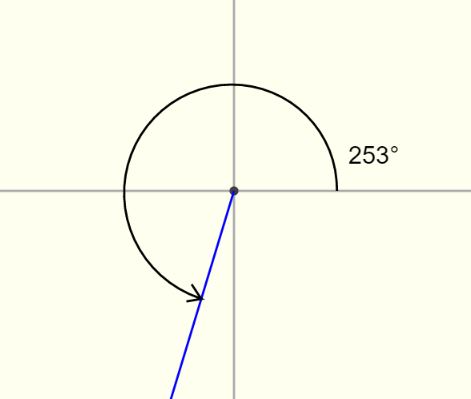
155.

Identify the angle of rotation

a)

110°-110\degree

b)

110°110\degree

c)

250°250\degree

d)

20°20\degree

156.

Based on the unit circle, what is the value of sin?

a)

y

b)

x

c)

x/y

d)

y/x

157.

Based on the unit circle, what is the value of cos?

a)

y

b)

x

c)

x/y

d)

y/x

158.

You have a 300 o angle. It passes through the point (x, y) on the unit circle. What does x equal?

a)

-.5

b)

.5

c)

.866

d)

-.866

159.

You have a 200o angle that passes through (x, y) on the unit circle. What is the value of y?

a)

-.94

b)

.342

c)

-.342

d)

.94

160.

Find the measure of the angle that passes through (8, -2). (Remember to think about which quadrant it is in.)

a)

14o

b)

-346o

c)

346o

d)

194o

161.

Find the measure of the angle whose terminal side passes through (-4, 3). (Think about which quadrant it is in.)

a)

143.1o

b)

46o

c)

-143.1o

d)

36.9o

162.

Find the measure of an angle whose terminal side passes through (-5, -8). (Think about which quadrant the angle is in.)

a)

58o

b)

238o

c)

-238o

d)

122o

163.

If a ferris wheel has 18 equally spaced seats, how many degrees separate each seat?

(a)  

164.

If a ferris wheel has 15 equally spaced seats, how many degrees separate each seat?

(a)  

165.
a)

36 degrees

b)

10 degrees

c)

72 degrees

d)

108 degrees

166.

a)

32 x Sin (36) + 50

b)

36 x Sin (32) + 50

c)

50 - 32 x Sin (36)

d)

50 - 36 x Sin (32)

167.

a)

50 + 32 x Sin (72)

b)

50 - 72 x Sin (32)

c)

50 - 32 x Sin (72)

d)

50 + 72 x Sin (32

168.

a)

10.8 ft

b)

10.3 ft

c)

47.7 ft

d)

12.7 ft

169.


(a)  

170.


(a)  

171.


(a)  

172.


(a)  

173.

a)

Seats F, C, H, and L are all the same distance from the center of the wheel

b)

Every seat has a reference angle of 30 degrees

c)

Seats C and K are the same distance above the ground

d)

There are 2 different reference angles in every quadrant

e)

Seat D is 90 feet above the ground

174.


(a)  

175.

a)

Seats E and H both have the same angle of rotation

b)

Seats E and K have the same reference angles

c)

Seats B and H are the same height above the ground

d)

Seats I and L are the same distance from the center line of the wheel

176.

You can only use SOH-CAH-TOA with what type of triangle?

a)

Acute

b)

Right

c)

Obtuse

177.

In a right triangle, the side directly across from the right angle is called the....

a)

Opposite

b)

Adjacent

c)

Hypotenuse

178.

With the Ferris Wheel, what trigonometric function do we use?

a)

Sine

b)

Cosine

c)

Tangent

179.

The Ferris Wheel has a radius of 20 feet, and its center is 35 feet above the ground. What is the height of the highest seat (in feet)? (only enter numerical answers)

(a)  

180.

The Ferris Wheel has a radius of 20 feet, and its center is 35 feet above the ground. What is the height of the lowest seat (in feet)? (only enter numerical answers)

(a)  

181.

The Ferris Wheel has a radius of 20 feet, and its center is 35 feet above the ground. What is the degree between each seat (in degrees)? (only enter numerical answers)

(a)  

182.

The Ferris Wheel has a radius of 45 feet, and its center is 60 feet above the ground. What is the degree between each seat (in degrees)? (only enter numerical answers)

(a)  

183.

The Ferris Wheel has a radius of 40 feet, and its center is 60 feet above the ground. What is the degree between each seat (in degrees)? (only enter numerical answers)

(a)  

184.

The Ferris Wheel has a radius of 15 feet, and its center is 35 feet above the ground. What is the height of the highest seat (in feet)? (only enter numerical answers)


(a)  

185.

The Ferris Wheel has a radius of 15 feet, and its center is 35 feet above the ground. What is the height of the lowest seat (in feet)? (only enter numerical answers)

(a)  

186.

The Ferris Wheel has a radius of 15 feet, and its center is 35 feet above the ground. What is the height of seat furthest to the right and left (in feet)? (only enter numerical answers)

(a)  

187.

The radius of the Ferris Wheel is 30ft and the height to the center is 40ft. What is the height of seat position B (in feet)? (only enter numerical answers)

(a)  

188.

The radius of the Ferris Wheel is 20ft and the height to the center is 25ft. What is the height of seat position 11 (in feet)? (only enter numerical answers, round to the nearest tenth)

(a)  

189.

The radius of the Ferris Wheel is 25ft and the height to the center is 30ft. What is the height of seat position C (in feet)? (only enter numerical answers, round to the nearest tenth)

(a)  

190.

Solve the equation for 0°θ360°0\degree\le\theta\le360\degree . Select ALL correct answers.

tanθ=3\tan\theta=-\sqrt{3}  

a)

60°60\degree  

b)

120°120\degree  

c)

240°240\degree  

d)

300°300\degree  

191.

Solve the equation for 0°θ360°0\degree\le\theta\le360\degree . Select ALL correct answers.

6sinθ=36\sin\theta=3  

a)

60°60\degree  

b)

300°300\degree  

c)

30°30\degree  

d)

150°150\degree  

192.

Solve the equation for 0°θ360°0\degree\le\theta\le360\degree . Select ALL correct answers.

4cosθ=24\cos\theta=-2  

a)

60°60\degree  

b)

120°120\degree  

c)

240°240\degree  

d)

300°300\degree  

193.

Solve the equation for 0°θ360°0\degree\le\theta\le360\degree . Select ALL correct answers.

1+sinθ=1-1+\sin\theta=-1  

a)

0°0\degree  

b)

90°90\degree  

c)

180°180\degree  

d)

270°270\degree  

e)

360°360\degree  

194.

Solve the equation for 0°θ360°0\degree\le\theta\le360\degree . Select ALL correct answers.

5+tanθ=45+\tan\theta=4  

a)

45°45\degree  

b)

135°135\degree  

c)

225°225\degree  

d)

315°315\degree  

195.

Solve the equation for 0°θ360°0\degree\le\theta\le360\degree . Select ALL correct answers.

15+4cosθ=1522-15+4\cos\theta=-15-2\sqrt{2}  

a)

45°45\degree  

b)

135°135\degree  

c)

225°225\degree  

d)

315°315\degree  

196.

Solve the equation for 0°θ360°0\degree\le\theta\le360\degree . Select ALL correct answers.

12sinθ=11-2\sin\theta=-1  

a)

0°0\degree  

b)

90°90\degree  

c)

180°180\degree  

d)

270°270\degree  

e)

360°360\degree  

197.

Solve the equation for 0°θ360°0\degree\le\theta\le360\degree . Select ALL correct answers.

123tanθ=12+3-12-3\tan\theta=-12+\sqrt{3}  

a)

30°30\degree  

b)

150°150\degree  

c)

210°210\degree  

d)

330°330\degree  

198.

Solve the equation for 0°θ360°0\degree\le\theta\le360\degree . Select ALL correct answers.

2sinθcosθ2cosθ=02\sin\theta\cos\theta-\sqrt{2}\cos\theta=0  

a)

45°45\degree  

b)

90°90\degree  

c)

135°135\degree  

d)

270°270\degree  

e)

315°315\degree  

199.

Solve the equation for 0°θ360°0\degree\le\theta\le360\degree . Select ALL correct answers.

sinθtanθ3sinθ=0\sin\theta\tan\theta-\sqrt{3}\sin\theta=0  

a)

0°0\degree  

b)

60°60\degree  

c)

180°180\degree  

d)

240°240\degree  

e)

360°360\degree  

200.
Which of the following is NOT
a solution to
sin θ = √(3) / 2 ?
a)
π / 3
b)
2π / 3
c)
5π / 3
d)
7π / 3
201.
TRUE or FALSE:
There is NO SOLUTION to sinθ = -1.
a)
TRUE
b)
FALSE
202.
Solve sinθ = ½ on θ∈[0, 2π)
a)
θ = π / 6,  7π / 6
b)
θ = π / 6,  5π / 6
c)
θ = 5π / 6,  7π / 6
d)
θ = 7π / 6,  11π / 6
203.
Solve sinθ = -1 on θ∈[0, 2π)
a)
θ = π /2, 3π /2 
b)
θ = π /2
c)
θ = 3π /2
d)
θ = π  
204.
Solve
cos θ = -1
on  θ∈[0, 2π)
a)
θ = π /2, 3π /2 
b)
θ = π /2
c)
θ = 3π /2
d)
θ = π  
205.
Which of these is NOT
 a solution to
tan θ = 0 ?
a)
θ = 0
b)
θ = π /2
c)
θ = π
d)
θ = 2π
206.
Solve
cos2θ = ½ 
on θ∈[0, 2π)
a)
θ = π /4, 7π /4
b)
θ = π /4, 3π /4
c)
θ = 3π /4, 5π /4
d)
θ = π /4, 3π /4, 5π /4, 7π /4
207.
Solve
cosθ = - √(3)/2  
on θ∈[0, 2π)
a)
θ = π /3, 2π /3
b)
θ = 2π /3, 4π /3
c)
θ = π /6, 5π /6
d)
θ = 5π /6, 7π /6
208.
a)
A
b)
B
c)
C
d)
D
209.
Solve on the Interval [0,2π)
tan(x)+1=2
a)
0 and π  
b)
3π/4 and 7π/4
c)
π/4 and 5π/4
d)
3π/4 and 5π/4
210.
a)
No solution
b)
π/3 +2πn, 5π/3 +2πn
c)
π/6 +2πn, 11π/6 +2πn
d)
2π/3 +2πn, 4π/3 +2πn
211.
2 sinθ+3=2
a)
π/6,2π/3
b)
7π/6 
c)
7π/6, 11π/6
212.
Solve on the domain [0,2π)
cos x + 1 = 0
a)
0
b)
No solution
c)
π
d)
3π/2
213.
Solve on the domain [0, 2π)
1/2sec x - 1 = 0
a)
π/6, 5π/6
b)
π/3, 5π/3
c)
2π/3, 4π/3
d)
7π/6, 11π/6
214.
Solve on the domain [0, 2π)
4sin2x = 3
a)
π/6, 11π/6
b)
π/3, 2π/3
c)
π/6, 5π/6, 7π/6, 11π/6
d)
π/3, 2π/3, 4π/3, 5π/3
215.
Solve on the domain [0, 2π)
2sin x cos x = √2 cos x
a)
π/2, 3π/2
b)
0, π/4, 3π/4
c)
π/2, 3π/2, π/4, 3π/4
d)
No solution
216.
Solve on the domain [0, 2π)
cos2 x + sin x + 1 = 0
a)
π
b)
3π/2
c)
π/6, 5π/6, 3π/2
d)
No solution
217.
Solve on the domain [0, 2π)
cos x + 2 = 3 cos x
a)
0, 2π/3, 4π/3
b)
π
c)
0
d)
No solution
218.
Solve on the domain [0,2π)
1/4sin x + 1= 0
a)
0
b)
7π/4
c)
5π/4
d)
No solution
219.
Which of the following is NOT
a solution to
sin θ = √(3) / 2 ?
a)
π / 3
b)
2π / 3
c)
5π / 3
d)
7π / 3
220.

Solve: 4sinθ + 1 = 3

State all solutions in the interval [0, 2π)

a)

π/ 6, 7π/6

b)

π/6, 5π/ 6

c)

5π/6, 7π/6

d)

7π/6, 11π/6

221.

Solve: 2cscθ + 2 = 0

State all solutions in the interval [0, 2π)

a)

π/2, 3π/2

b)

π/2

c)

3π /2

d)

π

222.

Solve: 23secθ + 4 = 02\sqrt{3}\sec\theta\ +\ 4\ =\ 0
State all solutions in the interval [0, 2π)

a)

π /3,  2π/3

b)

2π /3,  4π/3

c)

π /6,  5π/6

d)

5π /6,  7π/6

223.

Solve: 2cosx - 4 = 0

State all solutions in the interval [0, 2π)

a)

No solution

b)

π/3, 5π/3

c)

π/6, 11π/6

d)

2π/3, 4π/3

224.

Solve: 4sin2x = 3

State all solutions in the interval [0, 2π)

a)

π/6, 11π/6

b)

π/3, 2π/3

c)

π/6, 5π/6, 7π/6, 11π/6

d)

π/3, 2π/3, 4π/3, 5π/3

225.

Solve equation for 0θ<2π0\le\theta<2\pi  .
2+cotθ=3-2+\cot\theta=-3  

a)

θ=3π4,4π3,7π4\theta=\frac{3\pi}{4},\frac{4\pi}{3},\frac{7\pi}{4}  

b)

θ=3π4,7π4\theta=\frac{3\pi}{4},\frac{7\pi}{4}  

c)

θ=π3,4π3\theta=\frac{\pi}{3},\frac{4\pi}{3}  

d)

θ=3π4,4π3\theta=\frac{3\pi}{4},\frac{4\pi}{3}  

226.

Solve equation for 0θ<2π0\le\theta<2\pi  .
2=43cscθ2=-4-3\csc\theta  

a)

θ=2π3,7π6\theta=\frac{2\pi}{3},\frac{7\pi}{6}  

b)

θ=π3\theta=\frac{\pi}{3}  

c)

θ=7π6,11π6\theta=\frac{7\pi}{6},\frac{11\pi}{6}  

d)

θ=2π3,7π6,11π6\theta=\frac{2\pi}{3},\frac{7\pi}{6},\frac{11\pi}{6}  

227.

Solve equation for 0θ<2π0\le\theta<2\pi  .
12sec2θ=3sec2θ-1-2\sec^2\theta=-3\sec^2\theta  

a)

θ=0,π,4π3\theta=0,\pi,\frac{4\pi}{3}  

b)

θ=0\theta=0  

c)

θ=π4,3π4,5π4,7π4\theta=\frac{\pi}{4},\frac{3\pi}{4},\frac{5\pi}{4},\frac{7\pi}{4}  

d)

θ=0,π\theta=0,\pi  

228.

Solve equation for 0θ<2π0\le\theta<2\pi  .
3tan2θ 1 = 03\tan^2\theta\ -1\ =\ 0  

a)

θ=π6,5π6,7π6,11π6\theta=\frac{\pi}{6},\frac{5\pi}{6},\frac{7\pi}{6},\frac{11\pi}{6}  

b)

θ=π3,2π3,4π3,5π3\theta=\frac{\pi}{3},\frac{2\pi}{3},\frac{4\pi}{3},\frac{5\pi}{3}  

c)

θ=π6,7π6\theta=\frac{\pi}{6},\frac{7\pi}{6}  

d)

θ=π3,4π3\theta=\frac{\pi}{3},\frac{4\pi}{3}  

229.

Solve equation for 0θ<2π0\le\theta<2\pi  .
6tanθ + 63 = 06\tan\theta\ +\ 6\sqrt{3}\ =\ 0  

a)

θ=π6,7π6\theta=\frac{\pi}{6},\frac{7\pi}{6}  

b)

θ=5π6,11π6\theta=\frac{5\pi}{6},\frac{11\pi}{6}  

c)

θ=π3,4π3\theta=\frac{\pi}{3},\frac{4\pi}{3}  

d)

θ=2π3,5π3\theta=\frac{2\pi}{3},\frac{5\pi}{3}  

230.

Solve equation for 0θ<2π0\le\theta<2\pi  .
0=2sin2θ + 3sinθ0=2\sin^2\theta\ +\ \sqrt{3}\sin\theta  

a)

θ=0,2π3,π,5π3\theta=0,\frac{2\pi}{3},\pi,\frac{5\pi}{3}  

b)

θ=π2,7π6,3π2,11π6\theta=\frac{\pi}{2},\frac{7\pi}{6},\frac{3\pi}{2},\frac{11\pi}{6}  

c)

θ=0,π,4π3,5π3\theta=0,\pi,\frac{4\pi}{3},\frac{5\pi}{3}  

d)

θ=0,π,5π3\theta=0,\pi,\frac{5\pi}{3}  

231.

Solve  2sin2x + sinx  1 = 0  for 0  x < 2πSolve\ \ 2\sin^2x\ +\ \sin x\ -\ 1\ =\ 0\ \ for\ 0\ \le\ x\ <\ 2\pi  

a)

π6, π2, 5π6\frac{\pi}{6},\ \frac{\pi}{2},\ \frac{5\pi}{6}  

b)

π2, 7π6, 11π6\frac{\pi}{2},\ \frac{7\pi}{6},\ \frac{11\pi}{6}  

c)

π6, 5π6, 3π2\frac{\pi}{6},\ \frac{5\pi}{6},\ \frac{3\pi}{2}  

d)

7π6, 3π2, 11π6\frac{7\pi}{6},\ \frac{3\pi}{2},\ \frac{11\pi}{6}  

232.

Solve  cosx tanx + cosx = 0  for 0  x < 2πSolve\ \ \cos x\ \tan x\ +\ \cos x\ =\ 0\ \ for\ 0\ \le\ x\ <\ 2\pi  

a)

π4, π2, 5π4, 3π2\frac{\pi}{4},\ \frac{\pi}{2},\ \frac{5\pi}{4},\ \frac{3\pi}{2}  

b)

0, 3π4, π, 7π40,\ \frac{3\pi}{4},\ \pi,\ \frac{7\pi}{4}  

c)

π2, 3π4, 3π2, 7π4\frac{\pi}{2},\ \frac{3\pi}{4},\ \frac{3\pi}{2},\ \frac{7\pi}{4}  

d)

0, π4, π, 5π40,\ \frac{\pi}{4},\ \pi,\ \frac{5\pi}{4}  

233.

Solve the equation. Restrict your answer to [0,2π).

22=4sin3θ-2\sqrt{2}=4\sin3\theta  

a)

{π24,13π24,7π12,25π24,29π24,5π4,7π4}\left\{\frac{\pi}{24},\frac{13\pi}{24},\frac{7\pi}{12},\frac{25\pi}{24},\frac{29\pi}{24},\frac{5\pi}{4},\frac{7\pi}{4}\right\}  

b)

{7π12,25π24,13π12,7π4,23π12}\left\{\frac{7\pi}{12},\frac{25\pi}{24},\frac{13\pi}{12},\frac{7\pi}{4},\frac{23\pi}{12}\right\}  

c)

{25π24,41π24,7π4}\left\{\frac{25\pi}{24},\frac{41\pi}{24},\frac{7\pi}{4}\right\}  

d)

{5π12,7π12,13π12,5π4,7π4,23π12}\left\{\frac{5\pi}{12},\frac{7\pi}{12},\frac{13\pi}{12},\frac{5\pi}{4},\frac{7\pi}{4},\frac{23\pi}{12}\right\}  

234.

State the solutions in the interval [0, 2π)\left[0,\ 2\pi\right)
3tan3x  3 = 03\tan3x\ -\ \sqrt{3}\ =\ 0  

a)

π18, 7π18, 13π18, 19π18, 25π18, 31π18\frac{\pi}{18},\ \frac{7\pi}{18},\ \frac{13\pi}{18},\ \frac{19\pi}{18},\ \frac{25\pi}{18},\ \frac{31\pi}{18}  

b)

π18, 13π18, 25π18\frac{\pi}{18},\ \frac{13\pi}{18},\ \frac{25\pi}{18}  

c)

7π18, 19π18, 31π18\frac{7\pi}{18},\ \frac{19\pi}{18},\ \frac{31\pi}{18}  

d)

π9, 4π9, 7π9, 10π9, 13π9, 16π9\frac{\pi}{9},\ \frac{4\pi}{9},\ \frac{7\pi}{9},\ \frac{10\pi}{9},\ \frac{13\pi}{9},\ \frac{16\pi}{9}  

235.
When is this function increasing?
a)
-2.5 < x < 2.5
b)
0 < x < 5
c)
0 < x < 55
d)
-5 < x < 0
236.
Which trig function does this graph represent?
a)
sin
b)
sec
c)
tan
d)
cot
237.
Determine the equation
a)
tan θ
b)
cot θ
c)
tan 2θ
d)
cot 2θ
238.
Sine or Cosine?
a)
y=sinx
b)
y=cosx
239.
Sine or Cosine?
a)
y=sinx
b)
y=cosx