wayground logo

Free Printable Worksheets

Font size

S
M
L
XL
Worksheets

Precalculus Exam Review: Graphing

Total questions: 237

Worksheet time: 7hrs 7mins
Name
Class
Date
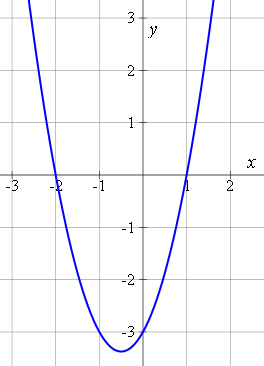
1.
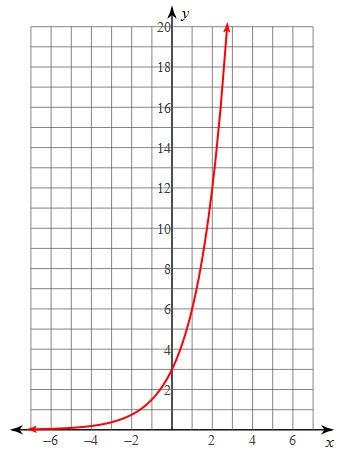
What is the y-intercept?
a)
(0,0)
b)
(0,1)
c)
(-3,0)
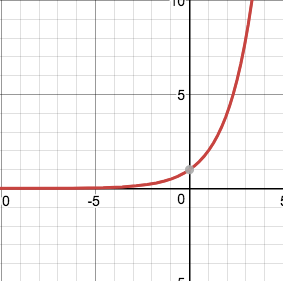
d)
(0,-3)
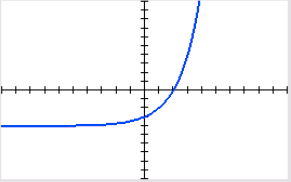
2.
What is the y-intercept of the function?
a)
2
b)
3
c)
1
d)
-2
3.
A line that the graph continually approaches but never touches is a(n) _____________________
a)
parabola
b)
asymptote
c)
rational function
d)
None of these
4.

What is the asymptote of y = 2x ?

a)

y = 0

b)

x = 0

5.

What is the asymptote of y = 2x - 3

a)

y = 0

b)

y = -3

c)

x = 0

d)

x = -3

6.

What is the asymptote of y = 2x-3 ?

a)

y = 0

b)

y = -3

c)

x = 0

d)

x = -3

7.
a)
The end behavior of the graph is x →∞, y→⁻∞ and x →⁻∞,y→⁻∞
b)
The end behavior of the graph is x →∞, y→∞ and x→⁻∞, y→∞
c)
The end behavior of the graph is x →∞, y→∞ and x→⁻∞, y→2
d)
The end behavior of the graph is x →∞,y→2 and x→⁻∞, y→∞
8.

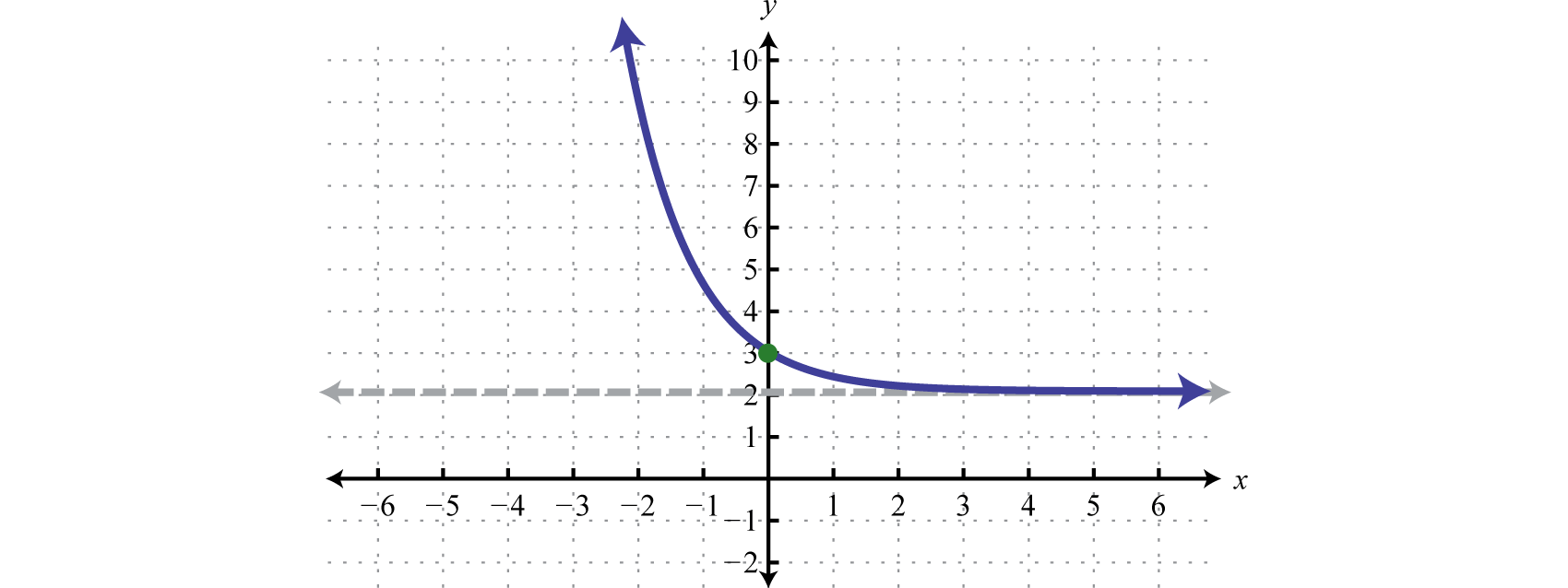
The asymptote is

a)

y = 3

b)

x = 3

c)

y = 2

d)

x = 2

9.

As x → -∞ , f(x) →

a)

-4

b)

-3

c)

d)

-∞

10.

As x → ∞ , f(x) →

a)

-4

b)

-3

c)

d)

-∞

11.

Using the parent function  y=3xy=3^x  
Describe the transformations for
   y=3x+1y=3^{x+1}  .

a)

Horizontal Shift to the right 1 unit

b)

Horizontal shift to the left one unit

c)

Vertical shift one unit up

d)

Vertical shift one unit down

12.

Using the parent function  y=3xy=3^x  
Describe the transformations for y=3x+1y=3^x+1  .

a)

Horizontal Shift to the right 1 unit

b)

Horizontal shift to the left one unit

c)

Vertical shift one unit up

d)

Vertical shift one unit down

13.

Using the parent function  y=2xy=2^x  
Describe the transformations for y=2x+57y=2^{x+5}-7  .

a)

Right 5 units and down 7 units

b)

Left 5 units and down 7 units

c)

Left 7 units and up 5 units

d)

Right 7 units and down 5 units

14.

What is the asymptote for the equation y=2x+57y=2^{x+5}-7  ?

a)

y = -7

b)

y = 7

c)

y = 5

d)

x = 2

15.

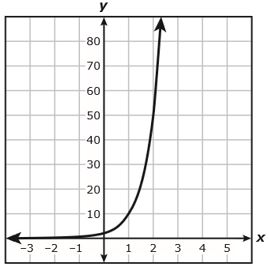
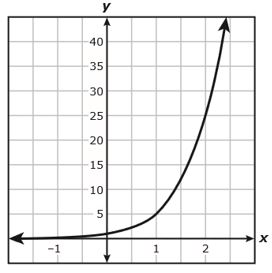
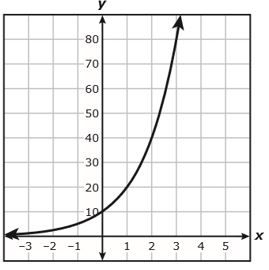
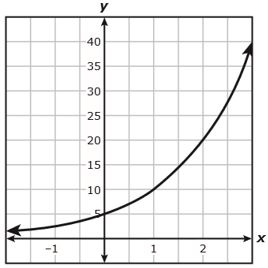
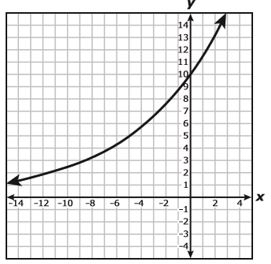
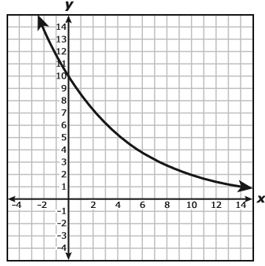
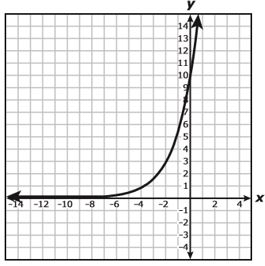
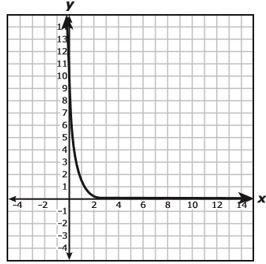
Which equation matches this graph?

a)
b)
c)
d)
16.

Which equation matches this graph?

a)
b)
c)
d)
17.

Which graph matches this equation?

a)
b)
c)
d)
18.

The graph of an exponential function is shown. Which of the following is NOT a true statement?

a)

The domain is the set of all real numbers

b)

The range is the set of all real numbers greater than 0

c)

The equation of the asymptote is at x=0x=0

d)

The graph is decreasing from left to right

19.

Which graph best represents f(x)=2(5)xf\left(x\right)=2\left(5\right)^x  ?

a)
b)
c)
d)
20.

Which graph best represents f(x)=10(0.85)xf\left(x\right)=10\left(0.85\right)^x  ?

a)
b)
c)
d)
21.

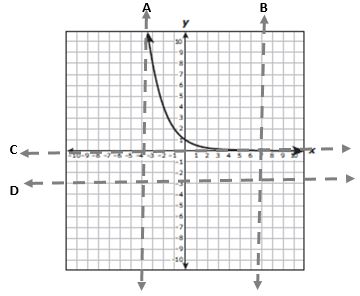
The graph of an exponential function is shown. Which dashed line represents the asymptote of the function?

a)

Line A

b)

Line B

c)

Line C

d)

Line D

22.
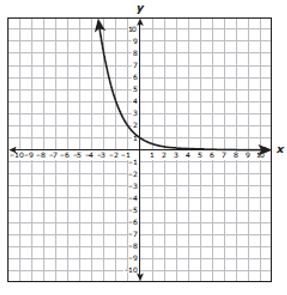
Classify the following graph.
a)
Exponential Growth
b)
Exponential Decay
c)
Logarithmic
23.
Classify the following graph.
a)
Exponential Growth
b)
Exponential Decay
c)
Logarithmic
24.
What equation matches the graph?
a)
f(x) = 3x
b)
f(x) = (⅓)x
c)
f(x) = log₃(x)
25.
Which has a vertical asymptote?
a)
Exponential
b)
Logarithmic
c)
Both
26.
Where would the asymptote be for this graph?
a)
y = 4
b)
y = -4
c)
x = 3
d)
x = -3
27.
What is the domain?
a)
(-∞, ∞)
b)
(0, ∞)
c)
[1, ∞)
d)
(1, ∞)
28.
Where is the asymptote?
a)
x = 1
b)
y = 1
c)
x = -1
d)
y = -1
29.
What is the transformation?
a)
Left 5
b)
Right 5
c)
Up 5
d)
Down 5
30.
find the asymptotey = log10 (x+3)
a)
x=-3
b)
x=3
c)
y=-3
d)
y=3
31.
Find the asymptote of the following: y = log10 x - 6
a)
x=6
b)
x=-6
c)
x= 0
d)
y=0
32.

Write the equation of the function f(x)=log3x after the following transformations:


Translate 6 units left and 4 units up.

a)

g(x)=log3(x+6)+4

b)

g(x)=log3(x+4)-6

c)

g(x)=log3(x-6)+4

d)

g(x)=3log(x+6)+4

33.

What is the asymptote of y = 2x - 3

a)

y = 0

b)

y = -3

c)

x = 0

d)

x = -3

34.
Which equation matches the graph?
a)
y = 2x+3
b)
y = 2x + 3
c)
y = 2x
d)
y = 2-x
35.
What is the domain and range of
f(x) = log 3 (x + 1)?
a)
D: (− ∞, ∞) R: (−1, ∞)
b)
D: (− ∞, ∞) R: (1, ∞)
c)
D: (−1, ∞) R: (− ∞, ∞)
d)
D: (1, ∞) R: (− ∞, ∞)
36.

f(x)=(x+4)(x-3)(x-2)

List the zeros for this function.

a)

x= -4, x=3, x= -2

b)

x= -4, x=3, x=2

c)

x= -4, x=-3, x=2

d)

x=4, x= -3, x= -2

37.
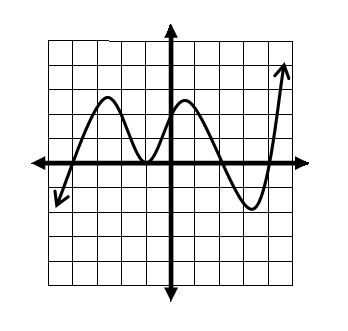
Identify the zeros:
a)
x=-2, x=-1, x=0
b)
x=-2, x=0
c)
x=-1, x=0, x=2
d)
x=-2, x=0, x=1
38.
a)
The function has an Even degree
b)
The function has a Negative coefficient
c)
The function has an Odd degree
d)
The function has 3 real zeros
39.
a)
Positive Odd
b)
Positive Even
c)
Negative Odd
d)
Negative Even
40.
a)
y=-(x+1)(x-2)(x-4)
b)
y=(x+1)2(x-3)(x-1)3
c)
y = 3x3 – 2x + 1
d)
y=(x+1)3(x-3)(x-1)2
41.
Which of the following could be the equation of this graph in factored form? (Careful-pay attention to multiplicity.)
a)
f(x) = (x-4)(x-1)2(x+2)(x+4)
b)
f(x) = (x-4)(x+1)2(x+2)(x+4)
c)
f(x) = (x-4)(x-1)2(x-2)(x+4)
d)
f(x) = (x+4)(x+1)2(x-2)(x-4)
42.
What does multiplicity of a zero mean?
a)
Look at the number of terms
b)
How many times the zero repeats
c)
Find the sum of all the coefficients
d)
Ratio your x and y
43.
Which of the following could be the equation of the graph in factored form?
a)
y=-(x+1)(x-2)(x-4)
b)
y=(x+1)2(x-2)
(x-4)3
c)
y = x(x+1)(x-2)
(x-4)
d)
y=(x+1)3(x-3)
(x-1)2
44.
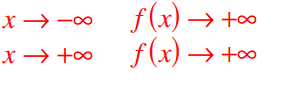
What is the end-behavior of the function 
y = -x3 + 6x2 + 7x
a)
as x-> -∞  f(x) -> ∞
 as x-> ∞  f(x) -> -∞
b)
as x-> -∞ f(x) -> ∞
 as x-> ∞  f(x) -> ∞
c)
as x->-∞ f(x) -> -∞
 as x-> ∞   f(x) -> ∞
d)
as x-> -∞ f(x) -> -∞
 as x-> ∞ f(x) -> -∞
45.
What is the end-behavior of the function 
y = x6 - 7x5 + 7x - 9
a)
as x-> -∞  f(x) -> ∞
 as x-> ∞  f(x) -> -∞
b)
as x-> -∞ f(x) -> ∞
 as x-> ∞  f(x) -> ∞
c)
as x->-∞ f(x) -> -∞
 as x-> ∞   f(x) -> ∞
d)
as x-> -∞ f(x) -> -∞
 as x-> ∞ f(x) -> -∞
46.
Which of the following could be the factored form for the equation representing the graph shown?
a)
(x+3)(x-2)(x-5)
b)
(x-5)2(x-2)(x+3)
c)
(x-3)(x+2)(x+5)2
d)
none of these
47.

What is the degree of the following polynomial?

y = (x2)(x+4)2(x+8)4y\ =\ \left(x-2\right)\left(x+4\right)^2\left(x+8\right)^4  

a)

4

b)

6

c)

7

d)

2

48.

What is the degree of the following polynomial?

y = 6x3(x3)(x+4)4(6x)2y\ =\ 6x^3\left(x-3\right)\left(x+4\right)^4\left(6-x\right)^2  

a)

9

b)

10

c)

11

d)

12

49.

What is the sign of the leading coefficient?

y=3(x5)(4x)(x+3)2y=-3\left(x-5\right)\left(4-x\right)\left(x+3\right)^2  

a)

Negative

b)

Positive

50.

What are the roots of the following polynomial?

y=(7x)(x+3)(102x)(5x20)y=\left(7-x\right)\left(x+3\right)\left(10-2x\right)\left(5x-20\right)  

a)

-3, 4, -5, -7

b)

3, 4, -7, 10

c)

-3, 4, 5, 7

d)

3, -4, 7, -10

51.

On which root will the graph "bounce"?

y = (x3)3(x+1)(4x)2(x9)y\ =\ \left(x-3\right)^3\left(x+1\right)\left(4-x\right)^2\left(x-9\right)  

a)

3

b)

-1

c)

4

d)

9

52.

In the above graph, which root has a multiplicity of 2?

a)

-1

b)

-3

c)

-120

d)

4

53.
a)
Even Degree
- Leading Coeff.
b)
Even Degree
+ Leading Coeff.
c)
Odd Degree
- Leading Coeff.
d)
Odd Degree
+ Leading Coeff.
54.
Which function has this end behavior?
a)
-x2-3x+1
b)
-x3+2x2+3
c)
x4+3x3-4x+1
d)
x5-4x4+2x2-1
55.
What is the maximum(s) and minimum(s) values of the function behind this text?
a)
Minimum(s): 1; Maximum(s): 2
b)
Maximum(s): .5; Minimum(s): -5,-2
c)
Maximum(s): -.5; Minimum(s): -5,-2
d)
Maximum(s): -.5; Minimum(s): -5
56.
What is the y-intercept?
f(x) = -2x2 + 4x - 6
a)
(0, 6)
b)
(0, -6)
c)
(6, 0)
d)
(-6, 0)
57.
What is the axis of symmetry?
f(x) = x- 8x + 15.
a)
x = -4
b)
x = 4
c)
y = 4
d)
y = -4
58.
What do we call the highest or lowest point of a quadratic?
a)
parabola
b)
vertex
c)
graph
d)
point
59.
What is the vertex?
f(x) = -x- 4x + 12.
a)
(-2, 16)
b)
(2, 0)
c)
(2, 4)
d)
(-2, 4)
60.
.How many zeros does this parabola have? 
a)
3
b)
2
c)
0
d)
1
61.
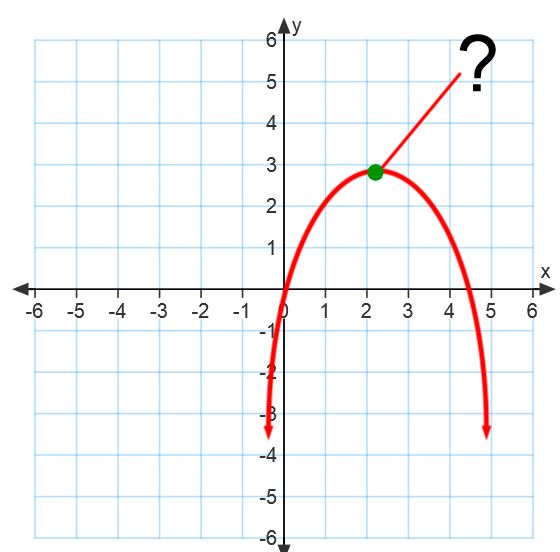
What is the green dot on the parabola called?
a)
maximum
b)
minumum
c)
roots
d)
zeros
62.

The standard form of a quadratic function is

a)

ax2 + bx + c

b)

a(x - h)2 + k

c)

y - y1 = m(x - x1)

d)

Ax + By = C

63.

If a is negative in the function, which way does the parabola

a)

up

b)

down

c)

left

d)

right

64.

Identify A, B, and C if y=3x2-8+5x

a)

A=3, B=5, C=-8

b)

A=3, B=-8, C=5

c)

A=3x2, B=5x, C=-8

d)

A=3x2 , B=-8, C=5x

65.
Does this parabola have a maximum or minimum?
a)
Maximum
b)
Minimum
66.
What do we call the graph of a quadratic?
a)
line
b)
vertex
c)
equation
d)
parabola
67.
Graph the quadratic.
a)
A
b)
B
c)
C
d)
D
68.
Graph the quadratic.
a)
A
b)
B
c)
C
d)
D
69.
What is c in the following equation?
y=ax2+bx+c
a)
Zeroes
b)
Axis of Symmetry
c)
Direction
d)
y-intercept
70.

What is the formula to find the axis of symmetry of a parabola?

a)

x = -b/2

b)

x = -b

c)

x = -b / (2a)

d)

x = -b / 2

71.

Which graph?

a)

y=sin(x)y=\sin\left(x\right)

b)

y=cos(x)y=\cos\left(x\right)

c)

y=sec(x)y=\sec\left(x\right)

d)

y=tan(x)y=\tan\left(x\right)

72.

Which graph?

a)

y=sin(x)y=\sin\left(x\right)

b)

y=sec(x)y=\sec\left(x\right)

c)

y=csc(x)y=\csc\left(x\right)

d)

y=tan(x)y=\tan\left(x\right)

73.

Which graph?

a)

y=csc(x)y=\csc\left(x\right)

b)

y=sec(x)y=\sec\left(x\right)

c)

y=cot(x)y=\cot\left(x\right)

d)

y=tan(x)y=\tan\left(x\right)

74.

Which graph?

a)

y=csc(x)y=\csc\left(x\right)

b)

y=sec(x)y=\sec\left(x\right)

c)

y=cot(x)y=\cot\left(x\right)

d)

y=tan(x)y=\tan\left(x\right)

75.

Which graph?

a)

y=sin(x)y=\sin\left(x\right)

b)

y=cos(x)y=\cos\left(x\right)

c)

y=sec(x)y=\sec\left(x\right)

d)

y=tan(x)y=\tan\left(x\right)

76.

Which graph?

a)

y=csc(x)y=\csc\left(x\right)

b)

y=sec(x)y=\sec\left(x\right)

c)

y=cot(x)y=\cot\left(x\right)

d)

y=tan(x)y=\tan\left(x\right)

77.

How many "key points" should be included in every cycle/period of a trig graph?

a)

As many as I want

b)

It depends on the graph

c)

4

d)

5

78.

Which of these trig functions has a period of

2π2\pi  ?

a)

y=sinxy=\sin x  

b)

y=cosxy=\cos x  

c)

y=tanxy=\tan x  

d)

y=cotxy=\cot x  

e)

y=cscxy=\csc x

79.

Which of these trig functions has a period of

π\pi  ?

a)

y=sinxy=\sin x  

b)

y=cosxy=\cos x  

c)

y=tanxy=\tan x  

d)

y=cotxy=\cot x  

e)

y=cscxy=\csc x

80.

Which of these trig functions has at least 1 asymptote?

a)

y=secxy=\sec x  

b)

y=cosxy=\cos x  

c)

y=tanxy=\tan x  

d)

y=cotxy=\cot x  

e)

y=cscxy=\csc x

81.

Which of these trig functions do NOT have an asymptote?

a)

y=sinxy=\sin x  

b)

y=cosxy=\cos x  

c)

y=tanxy=\tan x  

d)

y=cotxy=\cot x  

e)

y=cscxy=\csc x

82.

Which of these trig functions has a Domain of All Reals?

a)

y=sinxy=\sin x  

b)

y=cosxy=\cos x  

c)

y=tanxy=\tan x  

d)

y=cotxy=\cot x  

e)

y=secxy=\sec x  

83.

Which of these trig functions has a Range of All Reals?

a)

y=sinxy=\sin x  

b)

y=cosxy=\cos x  

c)

y=tanxy=\tan x  

d)

y=cotxy=\cot x  

e)

y=secxy=\sec x  

84.

Which graph could used as a model to help graph

y=cscxy=\csc x  ?

a)

y=cosxy=\cos x  

b)

y=tanxy=\tan x  

c)

y=sinxy=\sin x  

d)

y=secxy=\sec x  

85.

Which graph could used as a model to help graph

y=secxy=\sec x  ?

a)

y=cosxy=\cos x  

b)

y=tanxy=\tan x  

c)

y=sinxy=\sin x  

d)

y=cscxy=\csc x  

86.

Which graphs have a maximum y-value of 1?

a)


y=sinxy=\sin x

b)

y=cosxy=\cos x

c)

y=secxy=\sec x

d)

y=cscxy=\csc x

e)

y=tanxy=\tan x

87.

Which graphs have a minimum y-value of -1?

a)


y=sinxy=\sin x

b)

y=cosxy=\cos x

c)

y=secxy=\sec x

d)

y=cscxy=\csc x

e)

y=tanxy=\tan x

88.

Which of these graphs has NO maximum or minimum?

a)


y=sinxy=\sin x

b)

y=cosxy=\cos x

c)

y=cotxy=\cot x

d)

y=tanxy=\tan x

89.
Classify the following graph.
a)
Exponential Growth
b)
Exponential Decay
c)
Logarithmic
90.
Classify the following graph.
a)
Exponential Growth
b)
Exponential Decay
c)
Logarithmic
91.
Classify the following graph.
a)
Exponential Growth
b)
Exponential Decay
c)
Logarithmic
92.
What equation matches the graph?
a)
f(x) = 3x
b)
f(x) = (⅓)x
c)
f(x) = log₃(x)
93.
What equation matches the graph?
a)
f(x) = 3x
b)
f(x) = (⅓)x
c)
f(x) = log₃(x)
94.
What equation matches the graph?
a)
f(x) = 3x
b)
f(x) = (⅓)x
c)
f(x) = log₃(x)
95.
Which has a horizontal asymptote?
a)
Exponential
b)
Logarithmic
c)
Both
96.
Which has a vertical asymptote?
a)
Exponential
b)
Logarithmic
c)
Both
97.
Where would the asymptote be for this graph?
a)
y = 4
b)
y = -4
c)
x = 3
d)
x = -3
98.
What is the asymptote of this function:
 f(x) = 2x-1 + 3
a)
x = 1
b)
x = -1
c)
y = 3
d)
y = - 3
99.
What is the relationship between
f(x) = log₅(x)
and
g(x) = 5x?
a)
No Relationship
b)
Inverses
c)
Same Function
100.
Where is the asymptote?
a)
x = 1
b)
y = 1
c)
x = -1
d)
y = -1
101.
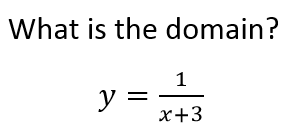
What is the domain?
a)
(-∞, ∞)
b)
(0, ∞)
c)
[1, ∞)
d)
(1, ∞)
102.
What is the range?
a)
(-∞, ∞)
b)
(0, ∞)
c)
[1, ∞)
d)
(1, ∞)
103.
As x --> 1, f(x) --> ____
a)
0
b)
c)
-∞
d)
1
104.
As x --> ∞, f(x) --> ____
a)
0
b)
c)
-∞
d)
1
105.
Determine the order of transformations
a)
left 1, reflected over x-axis
b)
up 1, reflected over y-axis
c)
right 1, reflected over x-axis
d)
left 1, reflected over y-axis
106.
What is the Horizontal Asymptote? 
a)
y= 5
b)
y= -6
c)
y= 1
d)
y= 5/-6
107.
What is the Horizontal Asymptote?
a)
y= 0
b)
y= 4
c)
y= 5
d)
y= -5
108.
What is the Horizontal Asymptote?
a)
y= 6
b)
y= 2
c)
y= 1
d)
y= 0
109.

What is the Vertical Asymptote?

a)

x= -5

b)

x= 5

c)

x= 6

d)

x= -6

110.
What is the domain and range?
a)
D : All real number x ≠ -3
R: All real number y≠ 1
b)
D : All real number x ≠ 1
R: All real number y≠ -3
c)
D : All real number x ≠ 3
R: All real number y≠ 1
d)
D : All real number x ≠ -1
R: All real number y≠ 3
111.

Find the horizontal asymptote:

a)

y = 0

b)

y = 1

c)

None

d)

y = 3/2

112.

The horizontal asymptote equals zero when:

a)

the degree of the numerator and denominator are equal

b)

the degree of the numerator is less than the degree of the denominator

c)

the degree of the numerator is greater than the degree of the denominator

d)

the numerator equals zero

113.
What is the X-Intercept?
a)
x= 0
b)
x= 4
c)
x= 5
d)
x= -5
114.
What are the x-intercepts?
a)
x= 2/3
b)
x= 4, x = -2
c)
x= -8, x = 1
d)
x= -4, x = 2
115.

What (if any) holes exist?

a)

x=2

b)

x=2 and x=3

c)

x=-3

d)

x=3

116.
What is/are the vertical asymptote(s)?
a)
x=-2
b)
x=2 and x=3
c)
x=-3
d)
x=3
117.
What is the horizontal asymptote?
a)
y = -4
b)
y = 1
c)
x = 1
d)
y = -6
118.
Which asymptote(s) are determined by looking at the denominator?
a)
vertical
b)
horizontal
c)
end behavior
d)
none
119.

Find the coordinates of the hole.

a)

(-3, -3)

b)

(-3, 3)

c)

(3, -3)

d)

(3, 3)

120.

What is the domain?

a)

All real numbers

b)

All real numbers except 4

c)

All real numbers except 2

d)

All real numbers except 2 and -2

121.
a)
All Reals Except 0
b)
All Reals
c)
All Reals Except -3
d)
All Reals Except 0 and -3
122.

What is the equation of the rational function graphed?

a)
b)
c)
d)
123.

Referring to f(x) =  1x\frac{1}{x}  which function shifts down 6 units?

a)

F(x) = 1x6\frac{1}{x-6}  

b)

F(x) = 1x6\frac{1}{x}-6  

c)

F(x) = 1x+6\frac{1}{x+6}  

d)

F(x) = 1x+6\frac{1}{x}+6  

124.

Referring to f(x) =  1x\frac{1}{x}  how does f(x) =   1x4+1\frac{1}{x-4}+1 Translate. 

a)

Shifts left 4 units and up 1 unit.

b)

Shifts left 4 units and down 1 unit.

c)

Shifts right 4 units and up 1 unit.

d)

Shifts right 4 units and down 1 unit.

125.

Referring to f(x)=  1x\frac{1}{x}  how does f(x) =  1x+3\frac{1}{x}+3  translate?

a)

Shifts right 3 units.

b)

Shifts up 3 units.

c)

Shifts left 3 units.

d)

Shifts down 3 units.

126.

Referring to f(x)=  1x\frac{1}{x}  how does f(x) =  1x+3\frac{1}{x+3}  translate?. 

a)

Shifts right 3

b)

Shifts up three

c)

Shifts left three

d)

Shifts down three

127.

What is an asymptote?

a)

an imaginary line that your function never touches

b)

a part of your function

c)

a point on your graph

d)

a type of fruit

128.

Describe the transformations from the parent function, f(x) = 1/x.

a)

Shift left 9 units, shift up 2 units

b)

Shift right 9 units, shift up 2 units

c)

Shift right 9 units, shift down 2 units

d)

Shift right 2 units, shift down 9 units

129.

Which is the graph of the rational equation:

a)
b)
c)
d)
130.

Which graph represents the function?

f(x)=1x4+3f\left(x\right)=\frac{1}{x-4}+3  

a)
b)
c)
d)
131.

Select all the even degree functions.

a)

A

b)

B

c)

C

d)

D

132.

Which functions have a negative leading coefficient?

a)

A

b)

B

c)

C

d)

D

133.

Which functions readily show the y-intercept of their graphs?

a)

y = 3x2 - 2

b)

y = 5 - 2x + 3x2 + 6x3

c)

y = 2x(x-4)(x+1)

d)

y = -3(x+1)(x-5)

134.

In which functions can you quickly find the x-intercepts of their graphs?

a)

y = 3x2 - 2

b)

y = 5 - 2x + 3x2 + 6x3

c)

y = 2x(x-4)(x+1)

d)

y = -3(x+1)(x-5)

135.
Describe the type of polynomial shown.
a)
Even degree, negative leading coefficient
b)
Even Function
c)
Odd degree, negative leading coefficient
d)
Even degree, positive leading coefficient
136.
What CANNOT be determined by the factors of a polynomial in factored form?
a)
y-intercept
b)
x-intercepts
c)
solutions
d)
degree of the polynomial
137.
Which of the following is NOT a solution to f(x)=3x(x-8)(2x+1)2?
a)
0
b)
-1/2
c)
1/2
d)
8
138.
Which equation MOST LIKELY matches the graph?
a)
y = x- x3 + 3x2 + 2
b)
y = -x4 + x3 + 5x + 2
c)
y = x3 - 2x2 + 1x + 3
d)
y = -x3 - 2x2 + 1x + 3
139.
Is the leading coefficient positive or negative
a)
positive
b)
negative
140.
Describe the end behavior of
f(x) = -5x4 - 2x2 + 8
a)
Left side: Rises  
 Right side: Rises
b)
Left Side:  Rises
Right side: Falls
c)
Left side: Falls
Right side: Rises
d)
Left side: Falls
Right side: Falls
141.
Describe the end behavior of
f(x) = 2x2 + 6x5 + 10x
a)
Left side:  Rises
Right side: Rises
b)
Left side: Falls
Right side: Rises
c)
Left side:Rises
Right side: Falls
d)
Left side: Falls
Right side: Falls
142.
Which standard form function matches the factored form:
y = (x + 1)(x - 3)
a)
y = x2 + x - 3
b)
y = x - 2
c)
y = x2 - 2x - 2
d)
y = x2 - 2x - 3
143.
a)
The function is Odd
b)
The function is Even
c)
The function has 5 real zeros
d)
The function is Positive
144.
Is the leading coefficient positive or negative?
a)
negative
b)
positive
145.
Is this function even or odd?
a)
even
b)
odd
146.
f(x)=(x+4)(x-3)(x-2)
List the zeros for this function.
a)
x= -4, x=3, x= -2
b)
x= -4, x=3, x=2
c)
x= -4, x=3, x=2
d)
x=4, x= -3, x= -2
147.
How many zeros does the polynomial function
 P(x) = 3x4+4x-8 have?
a)
1
b)
2
c)
3
d)
4
148.
Identify the zeros:
a)
x=-2, x=-1, x=0
b)
x=-2, x=0
c)
x=-1, x=0, x=2
d)
x=-2, x=0, x=1
149.
The polynomial
f(x) = 5x4 + 2x3 + 2x − 7 can have, at most, how many solutions?
a)
5
b)
4
c)
3
d)
2
150.
a)
The function has an Even degree
b)
The function has a Negative coefficient
c)
The function has an Odd degree
d)
The function has 3 real zeros
151.
a)
Positive Odd
b)
Positive Even
c)
Negative Odd
d)
Negative Even
152.
a)
y=-(x+1)(x-2)(x-4)
b)
y=(x+1)2(x-3)(x-1)3
c)
y = 3x3 – 2x + 1
d)
y=(x+1)3(x-3)(x-1)2
153.
a)
A
b)
B
c)
C
d)
D
154.
Over the interval (−1, 2), the graph of the polynomial shown could be described as
a)
decreasing
b)
increasing
c)
quadratic
d)
complex
155.
Determine the y-intercept 
f(x) = x3 - 5x2 - 25x + 125
a)
(0,0)
b)
(0,25)
c)
(0,125)
d)
(0,5)
156.

What is the relative maximum?

a)

(2,0)

b)

(4.67, -9.48)

157.

What is the relative minimum?

a)

(2,0)

b)

(4.67, -9.48)

158.

As 

x, f(x) x\rightarrow\infty,\ f\left(x\right)\ \rightarrow  

a)

\infty  

b)

-\infty  

159.

As 

x, f(x) x\rightarrow-\infty,\ f\left(x\right)\ \rightarrow  

a)

\infty  

b)

-\infty  

160.

Increasing Interval(s): (Choose all that apply)

a)

(, 2)\left(-\infty,\ 2\right)  

b)

(2, 4.67)\left(2,\ -4.67\right)  

c)

(4.67, )\left(-4.67,\ \infty\right)  

d)

(, 0)\left(-\infty,\ 0\right)  

e)

(0, 9.48)\left(0,\ -9.48\right)  

161.

Decreasing Interval(s): (Choose all that apply)

a)

(, 2)\left(-\infty,\ 2\right)  

b)

(2, 4.67)\left(2,\ -4.67\right)  

c)

(4.67, )\left(-4.67,\ \infty\right)  

d)

(, 0)\left(-\infty,\ 0\right)  

e)

(0, 9.48)\left(0,\ -9.48\right)  

162.

Choose all that apply:

a)

Even Degree

b)

Odd Degree

c)

Positive Leading Coefficient

d)

Negative Leading Coefficient

163.

Choose all that apply:

a)

Even Degree

b)

Odd Degree

c)

Positive Leading Coefficient

d)

Negative Leading Coefficient

164.

Choose all that apply:

a)

Even Degree

b)

Odd Degree

c)

Positive Leading Coefficient

d)

Negative Leading Coefficient

165.

Describe the end behavior of a 15th degree polynomial with a positive leading coefficient.  Choose all that apply.

a)


As x, f(x)As\ x\rightarrow\infty,\ f\left(x\right)\rightarrow\infty  

b)

As x, f(x)As\ x\rightarrow\infty,\ f\left(x\right)\rightarrow-\infty  

c)

As x, f(x)As\ x\rightarrow-\infty,\ f\left(x\right)\rightarrow\infty  

d)

As x, f(x)As\ x\rightarrow-\infty,\ f\left(x\right)\rightarrow-\infty  

166.

What is the relative maximum?

a)

(5, -4)

b)

(3, 0)

167.

What is the relative minimum?

a)

(5, -4)

b)

(3, 0)

168.

As x, f(x)As\ x\rightarrow-\infty,\ f\left(x\right)\rightarrow  

a)

\infty  

b)

-\infty  

169.

As x, f(x)As\ x\rightarrow\infty,\ f\left(x\right)\rightarrow  

a)

\infty  

b)

-\infty  

170.

Increasing Interval(s): (Choose all that apply)

a)

(, 0)\left(-\infty,\ 0\right)  

b)

(, 3)\left(-\infty,\ 3\right)  

c)

(3, 5)\left(3,\ 5\right)  

d)

(5, )\left(5,\ \infty\right)  

e)

(4, )\left(-4,\ \infty\right)  

171.

Decreasing Interval(s): (Choose all that apply)

a)

(, 0)\left(-\infty,\ 0\right)  

b)

(, 3)\left(-\infty,\ 3\right)  

c)

(3, 5)\left(3,\ 5\right)  

d)

(5, )\left(5,\ \infty\right)  

e)

(4, )\left(-4,\ \infty\right)  

172.

What is the relative maximum?

a)

(2,0)

b)

(4.67, -9.48)

173.

What is the relative minimum?

a)

(2,0)

b)

(4.67, -9.48)

174.

As 

x, f(x) x\rightarrow\infty,\ f\left(x\right)\ \rightarrow  

a)

\infty  

b)

-\infty  

175.

As 

x, f(x) x\rightarrow-\infty,\ f\left(x\right)\ \rightarrow  

a)

\infty  

b)

-\infty  

176.

Increasing Interval(s): (Choose all that apply)

a)

(, 2)\left(-\infty,\ 2\right)  

b)

(2, 4.67)\left(2,\ -4.67\right)  

c)

(4.67, )\left(-4.67,\ \infty\right)  

d)

(, 0)\left(-\infty,\ 0\right)  

e)

(0, 9.48)\left(0,\ -9.48\right)  

177.

Decreasing Interval(s): (Choose all that apply)

a)

(, 2)\left(-\infty,\ 2\right)  

b)

(2, 4.67)\left(2,\ -4.67\right)  

c)

(4.67, )\left(-4.67,\ \infty\right)  

d)

(, 0)\left(-\infty,\ 0\right)  

e)

(0, 9.48)\left(0,\ -9.48\right)  

178.

Choose all that apply:

a)

Even Degree

b)

Odd Degree

c)

Positive Leading Coefficient

d)

Negative Leading Coefficient

179.

Choose all that apply:

a)

Even Degree

b)

Odd Degree

c)

Positive Leading Coefficient

d)

Negative Leading Coefficient

180.

Choose all that apply:

a)

Even Degree

b)

Odd Degree

c)

Positive Leading Coefficient

d)

Negative Leading Coefficient

181.

Describe the end behavior of a 15th degree polynomial with a positive leading coefficient.  Choose all that apply.

a)


As x, f(x)As\ x\rightarrow\infty,\ f\left(x\right)\rightarrow\infty  

b)

As x, f(x)As\ x\rightarrow\infty,\ f\left(x\right)\rightarrow-\infty  

c)

As x, f(x)As\ x\rightarrow-\infty,\ f\left(x\right)\rightarrow\infty  

d)

As x, f(x)As\ x\rightarrow-\infty,\ f\left(x\right)\rightarrow-\infty  

182.

What is the relative maximum?

a)

(5, -4)

b)

(3, 0)

183.

What is the relative minimum?

a)

(5, -4)

b)

(3, 0)

184.

As x, f(x)As\ x\rightarrow-\infty,\ f\left(x\right)\rightarrow  

a)

\infty  

b)

-\infty  

185.

As x, f(x)As\ x\rightarrow\infty,\ f\left(x\right)\rightarrow  

a)

\infty  

b)

-\infty  

186.

Increasing Interval(s): (Choose all that apply)

a)

(, 0)\left(-\infty,\ 0\right)  

b)

(, 3)\left(-\infty,\ 3\right)  

c)

(3, 5)\left(3,\ 5\right)  

d)

(5, )\left(5,\ \infty\right)  

e)

(4, )\left(-4,\ \infty\right)  

187.

Decreasing Interval(s): (Choose all that apply)

a)

(, 0)\left(-\infty,\ 0\right)  

b)

(, 3)\left(-\infty,\ 3\right)  

c)

(3, 5)\left(3,\ 5\right)  

d)

(5, )\left(5,\ \infty\right)  

e)

(4, )\left(-4,\ \infty\right)  

188.

What is the degree of the following polynomial?

y = (x2)(x+4)2(x+8)4y\ =\ \left(x-2\right)\left(x+4\right)^2\left(x+8\right)^4  

a)

4

b)

6

c)

7

d)

2

189.

What is the degree of the following polynomial?

y = (x3)2(x+4)4(6x)3y\ =\ \left(x-3\right)^2\left(x+4\right)^4\left(6-x\right)^3  

a)

5

b)

6

c)

7

d)

9

190.

What is the degree of the following polynomial?

y = 6x3(x3)(x+4)4(6x)2y\ =\ 6x^3\left(x-3\right)\left(x+4\right)^4\left(6-x\right)^2  

a)

9

b)

10

c)

11

d)

12

191.

What is the degree of the following polynomial?

y = x5(3x)2(x+2)3(6x)y\ =\ x^5\left(3-x\right)^2\left(x+2\right)^3\left(6-x\right)  

a)

9

b)

10

c)

11

d)

12

192.

What is the degree of the following polynomial?

y =(3x)2(x+2)3(6x)(x+1)2(5x)4y\ =\left(3-x\right)^2\left(x+2\right)^3\left(6-x\right)\left(x+1\right)^2\left(5-x\right)^4  

a)

9

b)

10

c)

11

d)

12

193.

What is the sign of the leading coefficient?

y=3(x5)(4x)(x+3)2y=-3\left(x-5\right)\left(4-x\right)\left(x+3\right)^2  

a)

Negative

b)

Positive

194.

What is the sign of the leading coefficient?

y=2(x2)(4x)(1x)2y=2\left(x-2\right)\left(4-x\right)\left(1-x\right)^2  

a)

Negative

b)

Positive

195.

What is the sign of the leading coefficient?

y=2(x2)3(4x)(1x)2y=-2\left(x-2\right)^3\left(4-x\right)\left(1-x\right)^2  

a)

Negative

b)

Positive

196.

What is the sign of the leading coefficient?

y=2(x2)3(4x)3(1x)2(x+3)(2x)y=2\left(x-2\right)^3\left(4-x\right)^3\left(1-x\right)^2\left(x+3\right)\left(2-x\right)  

a)

Negative

b)

Positive

197.

What is the sign of the leading coefficient?

y=(x3)3(5x)(2x)2(x+9)(8x)y=-\left(x-3\right)^3\left(5-x\right)\left(2-x\right)^2\left(x+9\right)\left(8-x\right)  

a)

Negative

b)

Positive

198.

What are the roots of the following polynomial?

y=(x+4)(x3)(x8)y=\left(x+4\right)\left(x-3\right)\left(x-8\right)  

a)

4, -3, -8

b)

-4, -3, -8

c)

-4, 3, 8

d)

4, 3, 8

199.

What are the roots of the following polynomial?

y=(2x8)(x+5)(3x+12)y=\left(2x-8\right)\left(x+5\right)\left(3x+12\right)  

a)

4, -5, -4

b)

8, -5, -12

c)

-8, 5, 12

d)

4, 5, -4

200.

What are the roots of the following polynomial?

y=(7x)(x+3)(102x)(5x20)y=\left(7-x\right)\left(x+3\right)\left(10-2x\right)\left(5x-20\right)  

a)

-3, 4, -5, -7

b)

3, 4, -7, 10

c)

-3, 4, 5, 7

d)

3, -4, 7, -10

201.

What are the roots of the following polynomial?

y=2x(4x)(x10)(3x+18)(2x14)y=2x\left(4-x\right)\left(x-10\right)\left(3x+18\right)\left(2x-14\right)  

a)

0, 4, 10, 14, -18

b)

4, -6, 7, 10

c)

4, 10, 14, -18

d)

0, 4, -6, 7, 10

202.

What are the roots of the following polynomial?

y=(x+11)(3x9)(105x)(162x)y=\left(x+11\right)\left(3x-9\right)\left(10-5x\right)\left(16-2x\right)  

a)

-11, 9, 10, 16

b)

2, 3, 8, -11

c)

-2, -3, -8, 11

d)

11, -9, -10, -16

203.

Which root has the highest multiplicity?

y =(8x)2(x+1)(x2)3(x1)y\ =\left(8-x\right)^2\left(x+1\right)\left(x-2\right)^3\left(x-1\right)  

a)

8

b)

-1

c)

1

d)

2

204.

On which root will the graph "bounce"?

y = (x3)3(x+1)(4x)2(x9)y\ =\ \left(x-3\right)^3\left(x+1\right)\left(4-x\right)^2\left(x-9\right)  

a)

3

b)

-1

c)

4

d)

9

205.

On which root will the graph "pause and cross through"?

y = (x3)3(x+1)(4x)2(x9)y\ =\ \left(x-3\right)^3\left(x+1\right)\left(4-x\right)^2\left(x-9\right)  

a)

3

b)

-1

c)

4

d)

9

206.
What is the equation of graph? 
a)
y = sin 5x
b)
y =  cos 5x
c)
y = 5 sin x
d)
y = 5 cos x 
207.
What is the vertical shift? 
a)
Down 1
b)
Down 5
c)
Down 3
d)
Down 4
208.

Which is an equation of the cosine function with an amplitude of 2, period of π, phase shift of π/2?

a)

y= -2cos(x/2 - π/4)

b)

y= 2cos (x/2 + π)

c)

y= 2cos (2x - π)

d)

y= -2cos(2x - π/2)

209.
What is the equation of the graph?
a)
y = -2 cos x - 3
b)
y = 3 cos x - 2
c)
y = -7 cos x - 3
d)
y = -3 cos x - 4 
210.
What is the period?
a)
π/4
b)
π/2
c)
3π/4
d)
π
211.

Describe the horizontal and vertical shifts.

a)

left π , up 4

b)

left π , down 3

c)

right π , up 4

d)

right π , down 3

212.
Where is the midline for
y=2cos(1/3x +π/6) +2
a)
1/3
b)
-2
c)
+2
d)
4
213.

What is the period of the equation shown?

a)


b)

2π

c)

3π / 2

d)

2π / 3

214.

What is the equation of the graph shown?

a)

y = 3sin(θ + π/4) - 1

b)

y = 3cos(θ - π/4) -1

c)

y = 3sin(θ - π/4) + 1

d)

y = 3cos(θ + π/4) + 1

215.

What is the equation for the graph shown.

a)

y = 4sinθ - 2

b)

y = 3tcosθ - 1

c)

y = 2tanθ - 4

d)

y = 2-4tanθ + 2

216.

What is the equation of the graph shown?

a)

y = tanθ/2

b)

y = tan2θ

c)

y = tanθ/4

d)

y = tan4θ

217.

What is the equation of the graph shown?

a)

y = 4cosθ/2 - 6

b)

y = 4cosθ/2 - 2

c)

y = -2cosθ/4 - 2

d)

y = 4cosθ/4 + 2

218.

What is the equation of the graph shown?

a)

y = -sinθ -1

b)

y = -sinθ/2 -1

c)

y = -2sin2θ + 1

d)

y = sinθ/2 + 1

219.

What is the equation of the graph shown?

a)

y = -sinθ -1

b)

y = -sinθ/2 -1

c)

y = -2sin2θ + 1

d)

y = sinθ/2 + 1

220.

Describe the horizontal shift.

a)

left 3π / 4

b)

left 4π / 3

c)

right 3π

d)

right 3π / 4

221.
1.  Determine an equation for this graph:
a)
y=2csc(x)
b)
y=csc(x) + 1
c)
y=2csc(x) + 1
d)
y= csc(x) + 2
222.
2.  Determine an equation for this graph:
a)
y=sec(x)
b)
y=2sec(x)
c)
y=2csc(x)
d)
y= csc(2x)
223.
3.  Determine an equation for this graph:
a)
y=csc(x)
b)
y=sec(x)
c)
y=cot(x)
d)
y= tan(x)
224.
4.  Determine an equation for this graph:
a)
y=csc(x)
b)
y=sec(x)
c)
y=cot(x)
d)
y= tan(x)
225.
5.  Write an equation for the cosine function with amplitude 3, period 2pi, phase shift of pi, and vertical shift of 5.
a)
y = 5cos(x - pi) + 3
b)
y = 3cos(x - pi) + 5
c)
y = 3cos(2x - pi) + 5
d)
y = 5cos(2x - pi) + 3
226.
6.  What is the vertical shift for y = 4cos(1/2x +π) - 2?
a)
up 2
b)
left 2
c)
right 2
d)
down 2
227.
7.  What is the phase shift for y = 4cos(1/2x +π) - 2?
a)
left pi/2
b)
right pi/2
c)
right 2pi
d)
left 2pi
228.
8.  What is the period for y = 4cos(1/2x +π) - 2?
a)
pi/2
b)
pi
c)
3pi
d)
4pi
229.
9.  What is the amplitude for y = 4cos(1/2x +π) - 2?
a)
2
b)
pi/2
c)
pi
d)
4
230.
10.  What is the equation of the graph?
a)
 y = 2 cos x
b)
y = sin x
c)
y = 2 sin x
d)
y = sin 2x 
231.
11.  What is the equation of graph? 
a)
y = sin 5x
b)
y =  cos 5x
c)
y = 5 sin x
d)
y = 5 cos x 
232.
12.  What is the vertical shift? 
a)
Down 1
b)
Down 5
c)
Down 3
d)
Down 4
233.
13.  What is the equation of the graph?
a)
y = -2 cos x - 3
b)
y = 3 cos x - 2
c)
y = -7 cos x - 3
d)
y = -3 cos x - 4 
234.
14.  What is the amplitude of the graph? 
a)
1
b)
3
c)
6
d)
9
235.
15.  What is the amplitude and period of the function: y= 2/5sin9x
a)
Amplitude: 2/5 Period: 2π/9
b)
Amplitude: 2/5 Period: π/6
c)
Amplitude: 5/2 Period: 2π/9
d)
Amplitude: 5/2 Period: π/6
236.
16.  Which equation matches the graph?
a)
-tan(x-π/2)
b)
-tan(x+π/2)
c)
cot(x+π/2)
d)
-cot(x+π/2)
237.
17.  Determine the equation
a)
tan x
b)
cot x
c)
tan 2x
d)
cot 2x