
 Worksheets
ELECTRICITY
Total questions: 158
Worksheet time: 2hrs 7mins
What is the unit of measurement for resistance?
Voltage
Ampere
Watts
Ohms
If the current through a resistor is 2A and the voltage across it is 12V, what is the resistance
12Ω
6Ω
24Ω
0.167Ω
If a circuit has two resistors in series both are 4Ω, what is the total resistance of the circuit?
1Ω
2Ω
4Ω
8Ω
As the length of a wire increases, the resistance of the wire will
increase
decrease
stay the same
How do you calculate resistance?
Current x Voltage
Voltage x Power
Voltage ÷ Current
Current ÷ Voltage
How do you calculate current from voltage and resistance?
Current = voltage x resistance
Current = resistance x power
Current = voltage ÷ resistance
Current = resistance ÷ voltage
What is the resistance if the current is 2A and the voltage is 10V?
R = V / I
8 Ω
20 Ω
12 Ω
5 Ω
How many Volts would it take to push 1 Amp through a resistance of 1 Ohm
V = I x R
10 volts
1 volt
48 volts
5 volts
The resistance in a wire is 1.2kΩ. What is the resistance in Ω?
120 Ω
12 Ω
0.12 Ω
1200 Ω
The resistance in a wire is 2kΩ. What is the resistance in Ω?
20 Ω
2 Ω
0.2 Ω
2000Ω
The resistance in a wire is 0.5kΩ. What is the resistance in Ω?
50 Ω
5 Ω
0.5 Ω
500Ω
The resistance in a wire is 1000Ω. What is the resistance in kΩ?
10 kΩ
1 kΩ
0.1 kΩ
1kΩ
The resistance in a wire is 1MΩ. What is the resistance in Ω?
(M = mega = 1,000,000)0.0000001 Ω
1 Ω
0.1 Ω
1,000,000Ω
The resistance in a wire is 3MΩ. What is the resistance in Ω?
(M = mega = 1,000,000)0.0000003 Ω
3 Ω
0.3 Ω
3,000,000Ω

Can you guess for what the graph is plotted?
Ohmic materials
Non Ohmic materials.
A student uses a length of wire as a resistor. He makes a second resistor from the same material.
To be certain of making a second resistor of higher resistance, he should use a piece of wire that is:
longer and thicker.
longer and thinner.
shorter and thicker.
shorter and thinner.

The table describes four different resistance wires.
They are all made from the same metal.
Which wire has the smallest resistance?
A
B
C
D

The diagrams show four current-voltage graphs.
Which two graphs show the characteristics of an ohmic resistor and of a filament lamp?
ohmic resistor : W
filament lamp : Y
ohmic resistor : X
filament lamp : Y
ohmic resistor : W
filament lamp : Z
ohmic resistor : X
filament lamp : Z
Which two changes to a metal wire both increase resistance?
decreasing its length and increasing its temperature
increasing its length and decreasing its temperature
decreasing its thickness and increasing its temperature
increasing its thickness and decreasing its temperature

16. Which of the following I-V graph represents ohmic conductors?
(a) A
(b) B
(c) C
(d) D

Identify the component represented in this graph
Ohmic conductor
LDR
Filament Bulb
Fixed Resistor

Identify the component represented by this graph:
Diode
Fixed Resistor
Filament Bulb
Cell

Based on the graph above, the device is ohmic
True
False

Based on the graph above, the device is ohmic
True
False
Identical resistors in series will cause...
the resistance to double
the resistance to halve
no affect on the resistance
Identical resistors in parallel will cause...
the resistance to double
the resistance to halve
no affect on the resistance

What is the equivalent or total resistance (Re) across this circuit?
3 kΩ
10 kΩ
13 kΩ
18 kΩ
0.5 kilo-ohms

The total resistance in this circuit is
9V

What effect does a hotter temperature have on resistance?
No effect
Increases resistance
Decreases resistance
Stays the same

in which circuit is the lamp brightest
1
2
3
All the same

in which circuit is the lamp brightest
1
2
3
All the same
As the diameter of a wire increases, the resistance of the wire will
increase
decrease
stay the same

Which wire will have the least resistance?
10 cm
20 cm
30 cm
40 cm
How do you calculate resistance?
Divide voltage by current
Divide charge by current
Multiply current by voltage
Multiply voltage and current
Which resistor will let the most current flow?
0.5 kilo-ohms

What is the unit for energy?
J
j
E
e
kg
If a wire has 50 amps of current running through it, how many coulombs of charge would you expect to pass through it in 5 seconds?
10
45
250
0.1
If 300 coulombs of charge pass through a wire in 10 seconds, what amperage would the current have?
310
3000
0.03
30
If a wire has 28 amps of current running through it how many seconds would it take for 84 coulombs of charge to pass through it?
Q = I x t
(you must rearrange this equation)
3
56
2352
112
What is the unit of measurement for resistance?
Voltage
Ampere
Watts
Ohms
If the current through a resistor is 2A and the voltage across it is 12V, what is the resistance
12Ω
6Ω
24Ω
0.167Ω
If a circuit has two resistors in series both are 4Ω, what is the total resistance of the circuit?
1Ω
2Ω
4Ω
8Ω
How do you calculate resistance?
Current x Voltage
Voltage x Power
Voltage ÷ Current
Current ÷ Voltage
What is the resistance if the current is 2A and the voltage is 10V?
R = V / I
8 Ω
20 Ω
12 Ω
5 Ω
How many Volts would it take to push 1 Amp through a resistance of 1 Ohm
V = I x R
10 volts
1 volt
48 volts
5 volts
What is the equation for power?
Ep = m x h x g
Ek= ½ x m x v2
Ee = ½ x k x e2
P = E / t
Watts are a unit of .....
power
energy
time
mass
extension
Select the correct calculations: (2 marks)
P =
I x V
I / V
V / I
I2 x R
R2 x I
A hairdryer uses a current of 10A and has a voltage of 3V. How much power does it use?
30W
30w
0.3 W
3.3W

What is the electrical power when a voltage of 110 V drives a 5 A current through an electrical gadget?
550 W
22 W
55 W
220 W
What is the current when a 600 W AC connected to a 120 V voltage?
P = I X V
3 A
4 A
5 A
6 A
The current transferred by a circuit is 1A and there is a total resistance of 10 Ohms. What is the power rating for the circuit?
P = I2 X R
10A
10a
10 V
20A
The current transferred by a circuit is 2A and there is a total resistance of 7 Ohms. What is the power rating for the circuit?
P = I2 X R
28W
28V
28A
14W
14V
A printer uses a current of 4.2A and has a voltage of 12V. How much power does it use?
Pick the right equation to use:
P = E/t
P = I x V
P = I2 x R
50.4W
0.35W
211.68W
2.86W
The current transferred by a circuit is 0.23A and there is a total resistance of 105 Ohms. What is the power rating for the circuit?
Pick the right equation to use:
P = E/t
P = I x V
P = I2 x R
5.6W
24.2W
2,536W
2.86W
What does the m stand for in the eqn to calculate gravitational potential energy: Ep = m x h x g
mass (g)
mass (kg)
gravitational field strength (N/kg)
height (m)
What is the gravitational field strength on Earth?
9.8N/kg
98N/kg
0.98N/kg
9.8kg
A student drops a piece of apparatus with a mass of 5kg from a height of 2m to the floor on Earth which has a gravitational field strength of 9.8N/kg. What is the change of GPE?
Ep = m x h x g
10J
9.8J
98j
98J
A pupil walks slowly up a flight of stairs through a height of 4m carrying a rucksack of mass 5kg. Earth has a gravitational field strength of 9.8N/kg.What is the GPE gained by the rucksack?
Ep = m x h x g
20J
1.96J
196j
196J
What is the equation for gravitational potential energy?
Ep = m x h x g
EK= ½ x m x v2
Ee = ½ x k x e2
P = E / t
What is the equation for kinetic energy?
Ep = m x h x g
Ek= ½ x m x v2
Ee = ½ x k x e2
P = E / t
Calculate the kinetic energy of an object of mass 2kg moving with a speed of 3m/s?
Ek = ½ x m x (v2)
9j
9J
6J
24J
A spring has a spring constant, (k), of 3 N/m. It is stretched until it is extended by 0.50m. Calculate the elastic potential energy stored by the spring.
Ee= ½ x k x e2
0.375j
0.5625J
0.375J
0.75J
What is the equation for elastic potential energy?
Ep = m x h x g
Ek= ½ x m x v2
Ee = ½ x k x e2
P = E / t
Calculate the power of a device that transfers 500J of energy in 300s
P = E / t
0.6J
0.6W
1.7J
1.7W
What is the unit for energy?
J
j
E
e
kg


What does an ammeter do?
Measures the current flowing in a circuit.
Measures the difference in electrical potential energy (potential difference) between 2 points
Makes it harder for current to flow in a circuit.
Converts electrical energy into light energy.
Provides the circuit with electrical energy.
What does an voltmeter do?
Measures the current flowing in a circuit.
Measures the difference in electrical potential energy (potential difference) between 2 points
Makes it harder for current to flow in a circuit.
Converts electrical energy into light energy.
Provides the circuit with electrical energy.
What does a resistor do?
Measures the current flowing in a circuit.
Measures the difference in electrical potential energy (potential difference) between 2 points
Makes it harder for current to flow in a circuit.
Converts electrical energy into light energy.
Provides the circuit with electrical energy.
What does a lamp do?
Measures the current flowing in a circuit.
Measures the difference in electrical potential energy (potential difference) between 2 points
Makes it harder for current to flow in a circuit.
Converts electrical energy into light energy.
Provides the circuit with electrical energy.
Batteries convert what type of energy into electricity?
Chemical energy
Nuclear energy
Electrical energy
Kinetic energy
Light energy

Which switch or switches must be closed to make only lamp B light up?
Only switch a
Switches a and b
Switches a and c
Switches a, b and c
Switches b and c

The diagram shows a circuit including a lamp, an electric bell and three switches S1, S2 and S3.
The bell is ringing but the lamp is not lit. Which switches are closed?
S1 only
S1 and S2 only
S1 and S3 only
S1, S2 and S3
S2 and S3 only
Which statements are incorrect about an ammeter? (2 marks)
It measures in Amps
It is placed in parallel to the component
It measures the flow of current
It is placed in series to the components
It measures in Volts
Which statements are incorrect about an voltmeter? (2 marks)
It measures in Amps
It is placed in parallel to the component
A device for measuring potential difference across a component
It is placed in series to the components
It measures in Volts
What is the function of a battery?
Measures the difference in electrical potential energy (potential difference) between 2 points.
Converts electrical energy into light energy.
Makes it harder for current to flow in a circuit.
Converts electrical energy into kinetic energy.
Converts chemical energy into electrical energy


What is the current on the other ammeter?
0.15A
0.15a
0.3A
0.3a
0.075A

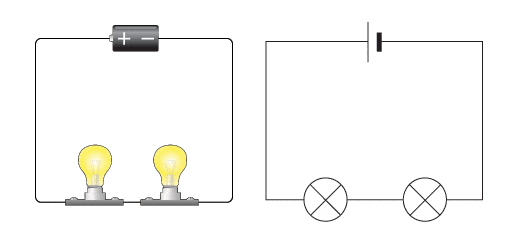
This is a series circuit. What value will be shown on the other ammeter?
0.3A
0.3a
0.15A
0.6A
0.6a

What is the current?
0.3A
0.15A
0.6A
0.15a
0.3a

What is the voltage of the 2 cells?
3V
1.5V
6V
3v
1.5v

What is the potential difference over the second bulb?
4.5V
9V
1V
3V
0V

The cell provides a voltage of 1.5V to this parallel circuit. If the bulbs both have the same resistance, what will be correct voltage for each of the bulbs? (2 marks)
middle bulb = 1.5V
middle bulb = 3V
bottom bulb = 3V
bottom bulb = 1.5V
both bulbs have a voltage of 0.75V

What is the voltage shown on V1?
3V
1.5V
6V
0.75V
1V
What is the voltage shown on V2?
3V
1.5V
6V
0.75V
1V
What is the current shown on A1?
0.2V
0.2A
0.4A
0.1A
3V
What is the current shown on A2?
0.2V
0.2A
0.4A
0.1A
3V
If a wire has 50 amps of current running through it, how many coulombs of charge would you expect to pass through it in 5 seconds?
10
45
250
0.1
If 300 coulombs of charge pass through a wire in 10 seconds, what amperage would the current have?
310
3000
0.03
30
If a wire has 28 amps of current running through it how many seconds would it take for 84 coulombs of charge to pass through it?
Q = I x t
(you must rearrange this equation)
3
56
2352
112
Is there are 44 amps of current, and it runs through a wire for 11 seconds, how many coulombs of charge will pass through the wire?
Q = I x t
4
0.24
484
33
A current of 0.5 A flows in a circuit. Calculate the charge flowing through the circuit in one minute.
0.5 C
30 C
120 C
What is the unit of measurement for resistance?
Voltage
Ampere
Watts
Ohms
If the current through a resistor is 2A and the voltage across it is 12V, what is the resistance
12Ω
6Ω
24Ω
0.167Ω
If a circuit has two resistors in series both are 4Ω, what is the total resistance of the circuit?
1Ω
2Ω
4Ω
8Ω
As the length of a wire increases, the resistance of the wire will
increase
decrease
stay the same
How do you calculate resistance?
Current x Voltage
Voltage x Power
Voltage ÷ Current
Current ÷ Voltage
How do you calculate current from voltage and resistance?
Current = voltage x resistance
Current = resistance x power
Current = voltage ÷ resistance
Current = resistance ÷ voltage
What is the resistance if the current is 2A and the voltage is 10V?
R = V / I
8 Ω
20 Ω
12 Ω
5 Ω
How many Volts would it take to push 1 Amp through a resistance of 1 Ohm
V = I x R
10 volts
1 volt
48 volts
5 volts
The current in a wire is 1.2kA. What is the current in Amps?
120A
12A
0.12A
1200A
What is the equation for power?
Ep = m x h x g
Ek= ½ x m x v2
Ee = ½ x k x e2
P = E / t
P = E / t.
What is does the symbol t mean?
power
energy
temperature
time
Watts are a unit of .....
power
energy
time
mass
extension
Calculate the power of a device that transfers 500J of energy in 300s
P = E / t
0.6J
0.6W
1.7J
1.7W
Calculate the power of a device that transfers 1790J of energy in 226s
P = E / t
0.13J
0.13W
7.9J
7.9W
Calculate the energy transferred in a device that is turned on for 60s that has a power rating of 100W
P = E / t
1.7J
0.6J
6000W
6000J
Select the correct calculations: (2 marks)
P =
I x V
I / V
V / I
I2 x R
R2 x I
A hairdryer uses a current of 10A and has a voltage of 3V. How much power does it use?
30W
30w
0.3 W
3.3W

The unit of electrical current is
Watt (W)
Volt (V)
Ampere (A)
Ohm (Ω)
The unit of electrical resistance is
Watt (W)
Volt (V)
Ampere (A)
Ohm (Ω)
What is the electrical power when a voltage of 110 V drives a 5 A current through an electrical gadget?
550 W
22 W
55 W
220 W
What is the current when a 600 W AC connected to a 120 V voltage?
P = I X V
3 A
4 A
5 A
6 A
If an electric circuit dissipates energy for 15 W when it draws a current of 3 A, then how much voltage does it have?
P = I X V
45 V
12 V
18 V
5 V
The current transferred by a circuit is 1A and there is a total resistance of 10 Ohms. What is the power rating for the circuit?
P = I2 X R
10A
10a
10 V
20A
The current transferred by a circuit is 2A and there is a total resistance of 7 Ohms. What is the power rating for the circuit?
P = I2 X R
28W
28V
28A
14W
14V
A printer uses a current of 4.2A and has a voltage of 12V. How much power does it use?
Pick the right equation to use:
P = E/t
P = I x V
P = I2 x R
50.4W
0.35W
211.68W
2.86W
The current transferred by a circuit is 0.23A and there is a total resistance of 105 Ohms. What is the power rating for the circuit?
Pick the right equation to use:
P = E/t
P = I x V
P = I2 x R
5.6W
24.2W
2,536W
2.86W

