
 Worksheets
Formation of Planetary Systems Review
Total questions: 85
Worksheet time: 48mins

The major steps in the formation of the Solar System based on the Nebular Theory are: Cloud collapse, formation of the protoplanetary disk, and ______________________
growth of planets
birth of star
galaxy formation
supernova
What is the fuel for the sun's energy?
The fusion of hydrogen atoms into helium
The gravitational pull on the planets
Solar wind
The nebulae
Where in our solar system would you expect to find a planet that is mostly made of gas?
very close to the sun
outside of the sun's gravitational pull
very far from the sun
very close to other planets
What process created the plantesimals (the young version of our planets)?
Accretion of particles in the solar nebula
Gravitational pull between the sun and the planets
The solar wind that blew dust to the outer edge of the solar system
Nuclear fusion
Where would you expect to find a planet that is small, dense, and rocky?
close to the sun
outside of the sun's gravitational pull
far away from the sun
close to the gas planets

Which letter in this diagram shows our modern solar system with planets orbiting around the sun?
a
b
c
d
e
What word can we use to describe planets that are in the process of forming through accretion?
planetesimals
dwarf planets
asteroids
meteors
When the sun formed, it blew most of the gasses towards the edges of the solar system. What evidence of this do we see today?
the gas planets are very close to the sun
the gas planets are very far from the sun
there is no gas at all on planets close to the sun
there is a huge nebula of gas on the edge of our solar system

Arrange the following distances in order from smallest to largest.
Kilometer
Light-year
Yard
Astronomical unit
Yard, Astronomical unit, light year, Kilometer
Yard, light year, Kilometer, Astronomical unit
Yard, Kilometer, Astronomical unit, light year
A light year is the ______________ light travels in a ____________. It is used to measure _____________ in space.
Distance, Year, Distances
Year, Distance, Distances
Distance, Distance, Year
Which unit of measurement is used to measure distances within our solar system?
inches
kilometers
miles
Astronomical units
The distance light can travel in one year is ______________
15,000 kilometers
1 light-year
15 Astronomical Units
6,000 miles
What unit of measurement is used to calculate distance in our universe?
astronomical units
kilometers
light years
parsecs
True or False: The universe is expanding.
True
False
True or False: Scientist still consider the sun the center of the universe
True
False
Which graph shows the object starting near 0 or at home?


Which graph shows the object changing directions?


Which graph (if any) shows the object moving at a constant speed, stopping, and then continuing to movie in the same direction?


none of these

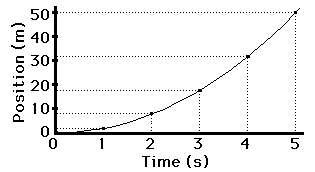
What is a plausible description of this graph?
The object began moving away quickly at a constant speed. It stopped. It then turned to return at a constant speed.
The object changed diections three times.
The object began walking away slowly then began running away. Both were at constant speeds. It then turned and walked back to where it started.
The object began moving away at a constant speed. It continued moving away, but slowed its speed. It then turned around and returned home at a speed that was probably in between the first two speeds.

What is a plausible story for this graph?
A student was jogging from school to home. She stopped to tie her shoe and take a drink from her water bottle, then continued at the same pace as before.
A student was jogging from school to home. She walked for a while, then continued jogging.
A sled rider was going down a hill. The hill was steep at first, then kind of flat. At the end, it was steep again.
A car was slowing down, then contued moving at a constant rate. Finally, it slowed to a stop,
All of the following graphs indicate a change in direction. Which graph show the object resting the most?


Which graph shows the object moving the fastest when it first begins moving?


Which of these graphs do not show the object staying still?


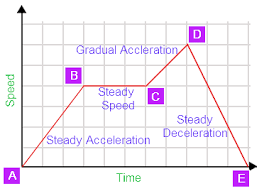
At what point is the speed the greatest?
C-D
B-C
A-B
D-E
A negative acceleration means that your object is _____.
doing nothing
moving in circles
speeding up
slowing down

What is happening during point A to B?
not moving
increasing speed at a constant rate
moving at a constant speed
moving at 10 m/s2 acceleration

What is happening during point C to D?
not moving
increasing speed at a constant rate
moving at a constant speed
moving at 0 m/s2 acceleration
Match the graph to the description:
"The car is traveling at a constant speed."
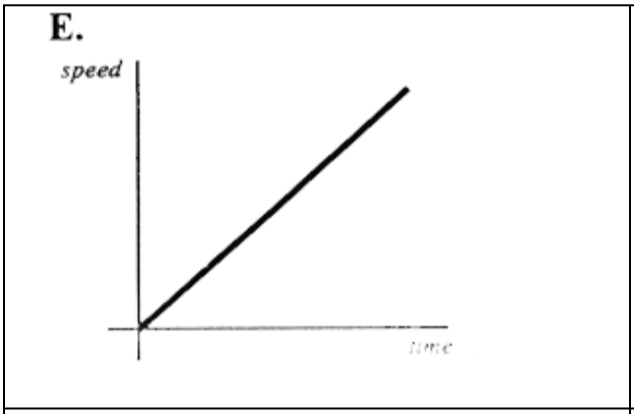
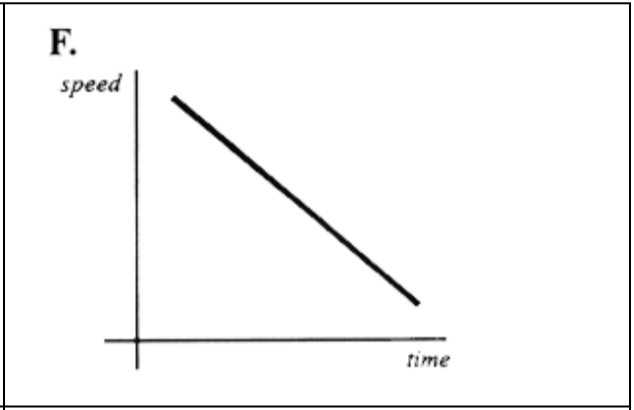
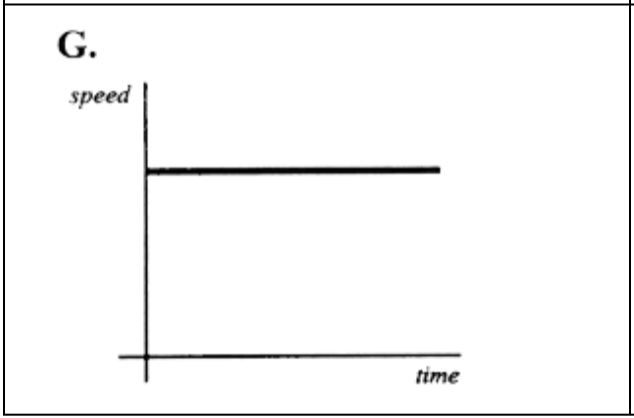
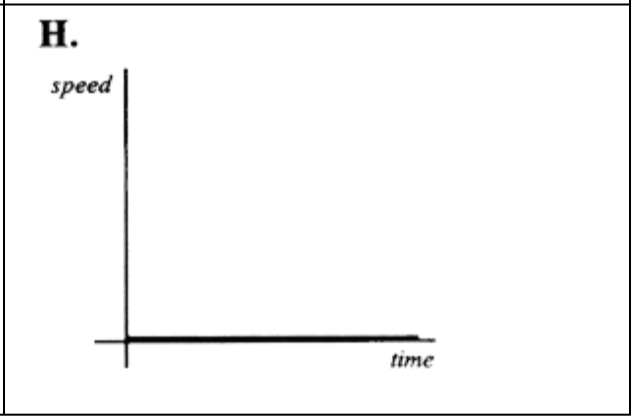
Match the graph to the description:
"The car is accelerating."

What is happening to the car between 3-8 seconds?
The car is stopped
The car is traveling at a constant velocity of 0.5 m/s.
The car has an acceleration of 0.5 m/s2.
The car is going in the other direction.
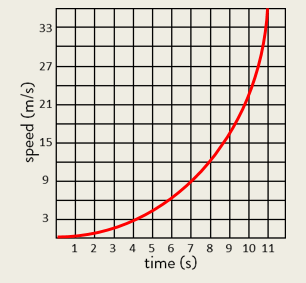
What is this graph showing?
Gradually slowing down
Gradually speeding up
Constant speed
Stopped

What is this graph showing?
At rest
Acceleration
Constant speed of 1 m/s
Gradually speeding up

What is this graph showing?
Constant speed
Gradually speeding up
Gradually slowing down
At rest

What is this graph showing?
Fast constant speed
Slow constant speed
At rest
Accelerating

What is the graph showing?
Slowing down moving toward start
Speeding up moving toward start
Slowing down moving away from start
Speed up moving away from start

What is the graph showing?
Speeding up moving away from start
Speeding up moving towards start
Slowing down moving towards start
Slowing down moving away from start

What is the graph showing?
Constant speed towards start
Constant speed away from start
Acceleration away from start
Acceleration towards start
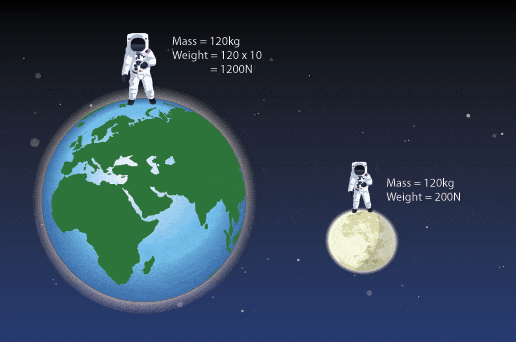
What two things determine the gravity of an object?
mass & weight
mass & distance
density & mass
volume & distance
When will the forces of gravity between two objects be the GREATEST?
when the masses of both objects are small and the objects are far apart
when the masses of both objects are large and the objects are close together
when the masses of both objects are small and the objects are close together
when the masses of both objects are large and the objects are far apart
When will the gravity between two objects be the LEAST?
when the masses of both objects is small and the objects are close together
when the masses of both objects is small and the objects are far apart
when the masses of both objects is large and the objects are close together
when the masses of both objects is large and the objects are far apart
Which statement about gravity is true?
gravity causes objects to pull towards one another
gravity causes objects to push away from each other
gravity only takes place between planets
the moon doesn't have any gravity

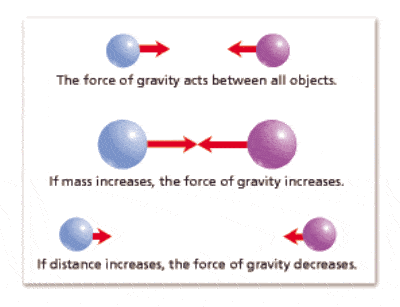

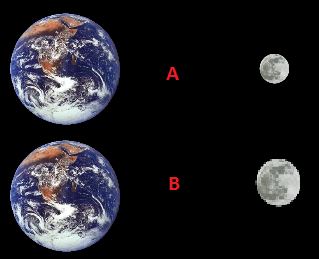
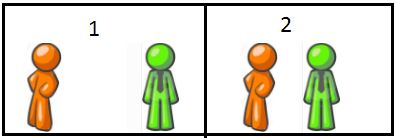
More mass equals:
less gravity
less distance
more gravity
more distance
Less mass equals:
less gravity
less distance
more gravity
more distance
A brick and a pencil are dropped at the same time from the same height. Which one would hit the ground first?
brick
pencil
both would hit at the same time
When will the forces of gravity between two objects be the GREATEST?
when the masses of both objects are small and the objects are far apart
when the masses of both objects are large and the objects are close together
when the masses of both objects are small and the objects are close together
when the masses of both objects are large and the objects are far apart

