wayground logo

Free Printable Worksheets

NEW

Font size

S
M
L
XL
Worksheets

Chemical Bonding Unit Review

Total questions: 30

Worksheet time: 22mins

Name
Class
Date
1.
What elements generally make an ionic bond?
a)
metal and nonmetal
b)
2 nonmetals
c)
metal
d)
none of the above
2.
What elements generally make a covalent bond?
a)
metal and nonmetal
b)
2 nonmetals
c)
metal
d)
none of the above
3.
In chemical compounds, covalent bonds form when
a)
the electronegativity difference between two atoms is very large.
b)
electrons are completely transferred between two metals.
c)
pairs of electrons are shared between two nonmetal atoms.
d)
two nonmetal atoms are attracted to each other by opposite charges.
4.
What happens when an atom loses an electron?
a)
It becomes Negatively Charged
b)
It remains neutral because the proton also leaves.
c)
It becomes Positively Charged
d)
It stays the same.
5.
The number of _____ is most important in determining how an atoms will bond. 
a)
Neutrons
b)
Protons
c)
Valence Electrons
d)
Electron sin the innermost shell
6.
High Melting & Boiling Points
a)
Ionic
b)
Covalent
7.

Ionic bonds happen when valence electrons are

a)

shared

b)

too heavy

c)

transferred

8.

How many valence electrons does Oxygen have?

a)

0

b)

16

c)

6

d)

8

9.

Typically, atoms are more stable when they are

a)

bonded together

b)

apart from each other

10.

Why do atoms bond?

a)

They typically don't bond

b)

To add or take away energy levels

c)

To have a full valance shell.

d)

To have a full inner shell

11.

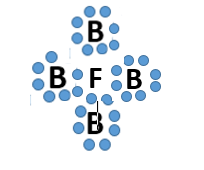
What is the correct Lewis structure for BF3?

a)
b)
c)
d)

BF3 (The formula is the Lewis Structure)

12.

What is the chemical formula for Lithium Nitride?

a)

Li3N

b)

LiN3

c)

NLi3

d)

N3Li

13.

What is the ionic formula for a bond between Calcium and Phosphorus?

a)

Ca2P3

b)

Ca3P2

c)

Ca2P5

d)

P5Ca2

14.

What category of element usually forms a positive ion?

a)

Metals

b)

Nonmetals

c)

metalloids

d)

Noble gases

15.

Which category of elements usually form negative ions?

a)

metals

b)

nonmetals

c)

metalloids

d)

noble gases

16.
A substance which has a high melting point, conducts electricity when dissolved in water, and has a crystalline structure probably has what type of bond?
a)
Ionic
b)
Metallic
c)
Covalent
d)
Crystalline
17.
What type of bond is illustrated above?
a)
Metallic
b)
Ionic
c)
Covalent
d)
Wiggly
18.

A solid substance is very malleable. The chemical bonds in this substance are most likely?

a)
ionic, because the valence electrons are shared between atoms
b)
covalent, because the valence electrons are mobile
c)
metallic, because the valence electrons are stationary
d)
metallic, because the valence electrons are mobile
19.

A compound that is a poor conductor and has low melting and boiling points is most likely

a)

ionic

b)

metallic

c)

covalent

20.

Which of the following compounds is likely to occur as a solid at room temperature?

a)

H2OH_2O  

b)

CH4CH_4  

c)

CaBr2CaBr_2  

d)

CO2CO_2  

21.

Which of the following is a characteristic of a polar compound?

a)

symmetrical

b)

asymmetrical

22.
What is the VSEPR theory used to predict?
a)
Bond Strength
b)
Polarity
c)
Molecular Shape
d)
Electronegativity
23.
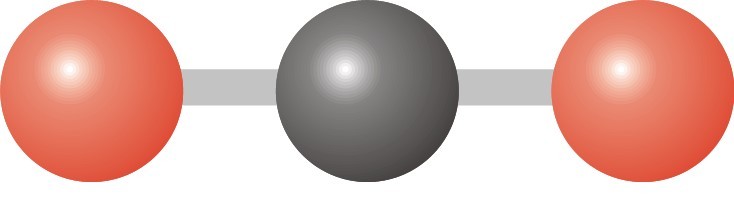
Which molecule would have this molecular geometry?
a)
BF3
b)
CH4
c)
PCl5
d)
CO2
24.
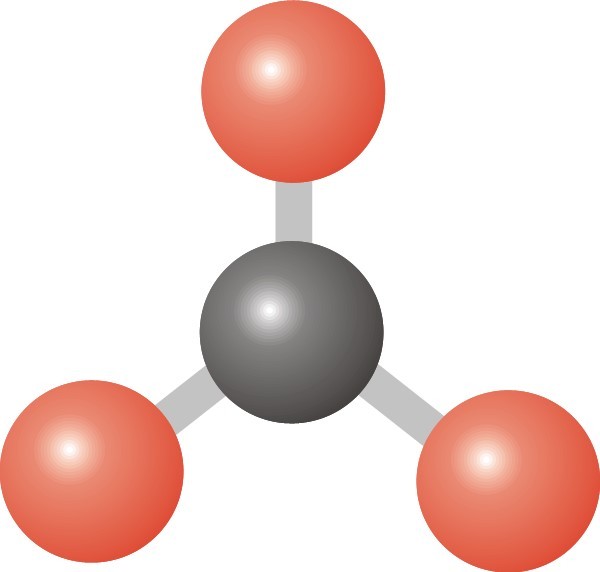
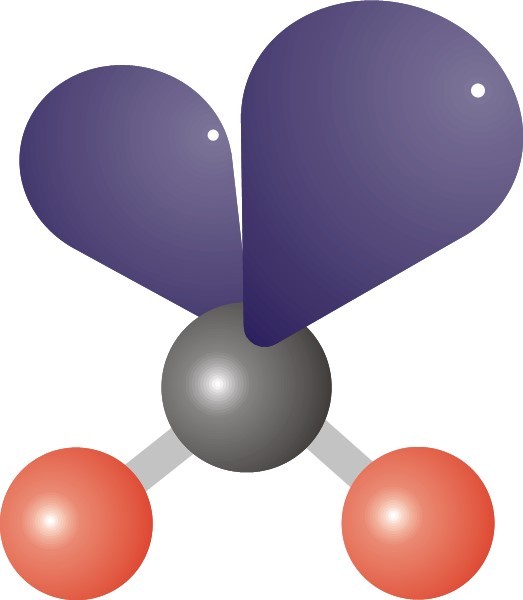
What molecule could this be? 
a)
BF3
b)
CH4
c)
H2O
d)
CO2
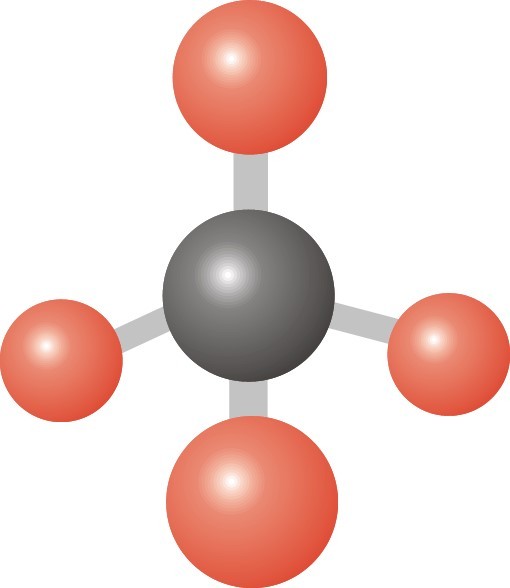
25.
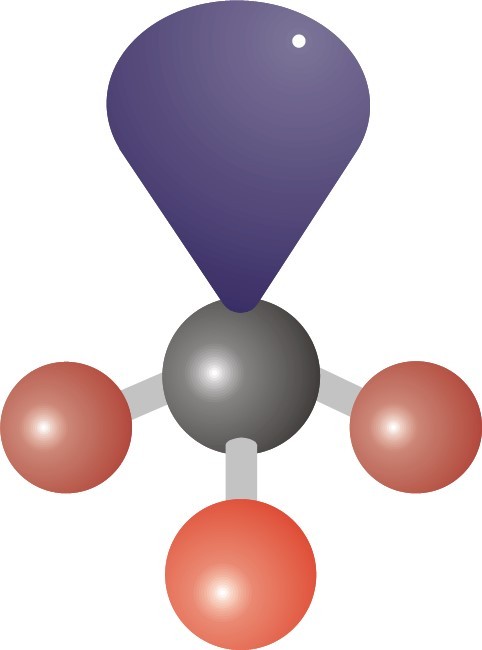
Who could this molecule be?
a)
CH4
b)
CO2
c)
PCl5
d)
BF3
26.
Who could this be? 
a)
CO2
b)
NH3
c)
H2S
d)
CH4
27.
According to VSEPR, molecules adjust their shapes to keep which of the following as far away as possible?
a)
Pairs of valence electrons
b)
Inner shell electrons
c)
Mobile Electrons
d)
Electrons closest to the nucleus
28.
 A lone pair is defined as
a)
A pair of bonding electrons
b)
One non-bonding electron
c)
A pair of non-bonding electrons
d)
A pair of electrons on the central atom
29.
Who could this be?
a)
H2O
b)
NH3
c)
CO2
d)
CH4
30.
According to the octet rule most elements need _______ valence electrons.
a)
2
b)
8
c)
6
d)
18