wayground logo

Free Printable Worksheets

Font size

S
M
L
XL
Worksheets

GEOMORPHOLOGY

Total questions: 25

Worksheet time: 50mins

Name
Class
Date
1.
What is the correct layers of the earth starting with the surface?
a)
crust, outer core, inner core, mantle
b)
mantle, outer core, inner core ,crust
c)
crust, mantle, outer core, inner core
d)
outer core, inner core , crust, mantle
2.
What are the two types of crust?
a)
top crust,bottom crust
b)
oceanic crust, continental crust
c)
water,land
d)
none of the above 
3.

In what layer does convection occur?

a)

Crust

b)

Mantle

c)

Inner core

d)

Shell

4.

Sedimentary rocks are formed by

a)

the cooling of molten material

b)

increased temperature and pressure

c)

the addition of loss of fluids

d)

the compaction and cementation of sediments

5.

Identify the type of rock that forms from molten material

a)

Igneous

b)

Sedimentary

c)

Metamorphic

6.

Metamorphic rocks are formed from (select all that apply)

a)

compaction and cementation

b)

increased pressure

c)

increased temperature

d)

the addition or loss of fluids

e)

the cooling of molten material

7.

This is the continuous process of rock changing from one type to another.

a)

Igneous rocks

b)

Sedimentary rocks

c)

Metamorphic rocks

d)

Rock Cycle

8.

Igneous rocks that form underground are called ______________.

a)

intrusive

b)

extrusive

9.
According to Wegener's hypothesis of continental drift, 
a)
Earth's surface is made up of seven major landmasses
b)
the continents DO NOT move
c)
Earth is slowly cooling and shrinking
d)
the continents were once joined together in a single landmass
10.
Which of the following is evidence that supports continental drift?
a)
the presence of penguins at both the equator and Antarctica
b)
fossils of the same plant have been found on several continents
c)
the presence of glacial features in Antarctica
d)
the presence of volcanic rock in Antarctica
11.
In Seafloor Spreading, molten material rises from the mantle and erupts or flows out 
a)
along the edges of all the continents
b)
along mid-ocean ridges
c)
in the deep ocean trenches
d)
in the north and south poles
12.
Earth's crust is broken up into several large rocky pieces called ...
a)
plates
b)
faults
c)
fossils
d)
puzzle pieces
13.
The type of plate boundary where two plates come together is a .....
a)
Convergent Boundary
b)
Divergent Boundary
c)
Transform Boundary
d)
Plate Boundary
14.
A divergent boundary occurs when plates ....
a)
Pull apart
b)
Come together
c)
Slide past each other
d)
subducting
15.
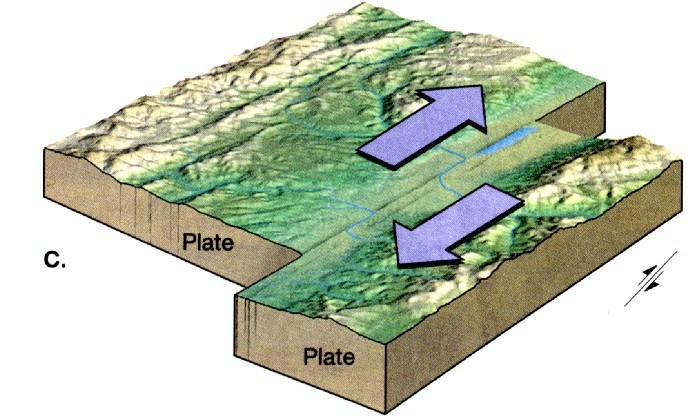
What type of plate boundary is this?
a)
Transform
b)
Convergent
c)
Divergent
d)
Plate
16.

How does folding affect Earth's surface?

a)

Folding causes the crust to buckle, and over time, to rise up and form mountains.

b)

Folding causes the crust to sink.

c)

Folding causes the crust to bend in half.

d)

Folding has no effect on Earth's surface.

17.

In Earth Science, what is a fault?

a)

It is who is to blame.

b)

It is a fracture where pieces of earth move up, down and sideways.

c)

It is a break in Earth's crust where pieces don't move.

18.
A sudden release of energy from plate movement creating shaking and trembling is known as:
a)
seismic wave
b)
earthquake
c)
focus
d)
epicenter
19.
The built up movement of plates is released as energy and is carried by these:
a)
earthquakes
b)
seismic waves
c)
focus
d)
epicenter
20.
The point on the surface directly above the focus:
a)
earthquake
b)
seismic waves
c)
seismographic station
d)
epicenter
21.

Where is the point at which the first movement occurs during an earthquake?

a)

Epicenter

b)

Focus

c)

Fault

d)

Plate

22.

The Richter scale is used to measure the magnitude of a seismograph during the event of an earthquake. Since the Richter scale is logarithmic, each whole number increase correlates to...

a)

3 times greater magnitude

b)

5 times greater magnitude

c)

10 times greater magnitude

d)

12 times greater magnitude

23.
Which of the following is an opening through which molten rock and gas leave a volcano
a)
pipe
b)
magma chamber
c)
crater
d)
vent
24.
Volcanoes that are made of basalt lava flows are called _____.
a)
shield volcanoes
b)
composite volcanoes
c)
stratovolcanoes
d)
cone volcanoes
25.
A huge hole that is left behind when a volcano collapses is called a
a)
Batholith
b)
Caldera
c)
Geyser