
 Worksheets
PHYSICS F4
Total questions: 50
Worksheet time: 28mins
Which of the following quantity is base quantity?
Antara berikut, yang manakah adalah kuantiti asas?
Potential difference / Beza keupayaan
Mass / Jisim
Momentum
Electric power / Kuasa elektrik
Which is equal to 500 MW?
Nilai yang manakah sama dengan 500 MW?
5.0 ×10⁸ W
5.0 ×10⁶ W
5.0 ×10⁻⁸ W
5.0 ×10⁻⁶ W

Which action increases the inertia?
Tindakan yang manakah meningkatkan inersia?
Use a rougher card /
Guna kad yang lebih kasar
Use a smooth card /
Guna kad yang lebih licin
Pull the card with greater force /
Tarik kad dengan daya yang lebih besar
Change the coin to a heavier coin /
Ganti syiling itu dengan syiling yang lebih berat

Impulsive force is produced when .....
Daya impuls dihasilkan apabila .....
The racket is swung at high velocity /
Raket dihayun dengan halaju tinggi
The racket is being pulled back /
Raket dihayun ke belakang
The racket hits the shuttlecock /
Raket menghentam bulu tangkis
What is the function of the air bag when accident happen?
Apakah fungsi beg udara apabila berlaku kemalangan?
To reduce the time of impact on the passengers /
Untuk mengurangkan masa impak kepada penumpang
To increase the time of impact on the passengers /
Untuk menambahkan masa impak kepada penumpang
To increase the change in the momentum of the passengers /
Untuk menambahkan perubahan momentum penumpang
The specific latent heat of fusion for water is the heat absorbed by ....
Haba pendam tentu pelakuran bagi air ialah haba yang diserap oleh ....
1 kg of water to increase its temperature by 1° C
1 kg air untuk menaikkan suhunya sebanyak 1° C
1m3 of water to increase its temperature by 1° C
1m3 air untuk menaikkan suhunya sebanyak 1° C
1 kg of ice during melting at constant temperature
1 kg ais semasa peleburan pada suhu tetap

The latent heat of vaporization is absorbed at
Haba pendam pengewapan diserap pada
RS
PQ
QR
ST

The characteristics of image formed are
Ciri-ciri imej yang terbentuk adalah
vitual, upright, magnified
maya, tegak, dibesarkan
real, inverted, diminished
nyata, songsang, dikecilkan
real, inverted, magnified
nyata, songsang, dibesarkan
real, inverted, same size
nyata, songsang, sama saiz

Diagram shows graph of volume, V against temperature, T.
Which statement is correct about the graph?
Volume increases linearly to temperature
Volume is directly proportional to temperature
Volume increases linearly to absolute temperature
Volume is inversely proportional to absolute temperature
Which of the following physical quantities is a derived quantity?
Weight
Temperature
Electric current
Mass

Which graph shows T2 is inversely proportional to k?
A
B
C
D

A
B
C
D

A
B
C
D

A
B
C
D

A
B
C
D
[SPM2015]
Hot soup is poured into a bowl. Which statement is correct about the heat flow?
Net heat flow is from the hot soup to the bowl
Heat flows only from the bowl to the hot soup
Heat flows only from the hot soup to the bowl
Net heat flow is zero

[SPM2016] Diagram shows a cup of hot coffee is left to cool until it achieves room temperature. Which statement is correct about the coffee at room temperature?
Heat loss by hot coffee is equal to heat loss by the surrounding
Heat loss by hot coffee is less than heat gain by the surrounding
Heat loss by hot coffee is greater than heat gain the surrounding
Heat loss by hot coffee is equal to heat gain by the surrounding

[SPM2017] Diagram shows a pan is used to fry pancakes. What is the suitable characteristic of the material used as the bottom surface of the pan?
Low melting point
Low boiling point
Low specific heat capacity
Low heat conductivity

[SPM2019] Diagram shows a balloon filled with water is brought to the burning candle. The balloon does not blow up even when it touches the flame. Which statement is correct to explain this situation?
Water is a good heat conductor
Balloon is a good heat conductor
Water has high specific heat capacity
Balloon has low specific heat capacity

[SPM2017] Diagram shows a bubbles wrap which is normally used for packing fragile glassware. Air bubbles expand when the surrounding temperature increases.
Boyle's Law
Charles's Law
Pressure Law
What is specific heat?
the amount of energy needed to raise the temp of 1 g of a substance by 1 deg C
the amount of energy needed for an object to reach its boiling point
the amount of energy needed for an object to reach its melting point

Which substance requires more energy to cool.
Aluminum
Water
Concrete
What is a medium?
The lowest point of a transverse wave
The size of a wave
The middle of a wave
Matter through which a wave travels
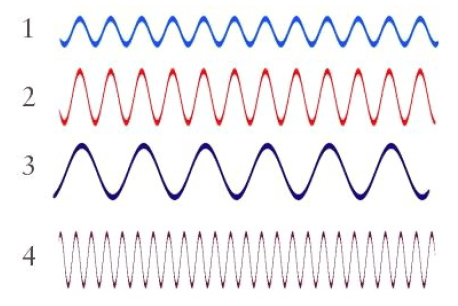

What type of interference is represented in this diagram?
Constructive
Destructive
Which of the following is the speed of a wave traveling with a wavelength λ, frequency f, and period T?
v=fλ
v=λf
v=λ⋅f
v=f⋅T
v=Tf
Which wave phenomenon makes it possible for a player to hear sound from a referee's whistle in an open field even when standing behind the referee?
diffraction
Doppler effect
reflection
refraction
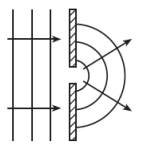
Which diagram best represents the shape and direction of a series of wave fronts after they have passed through a small opening in a barrier?
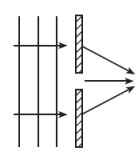
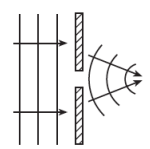
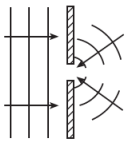
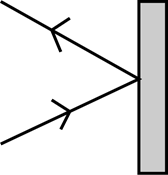
In the illustration, the light ray striking the object is-

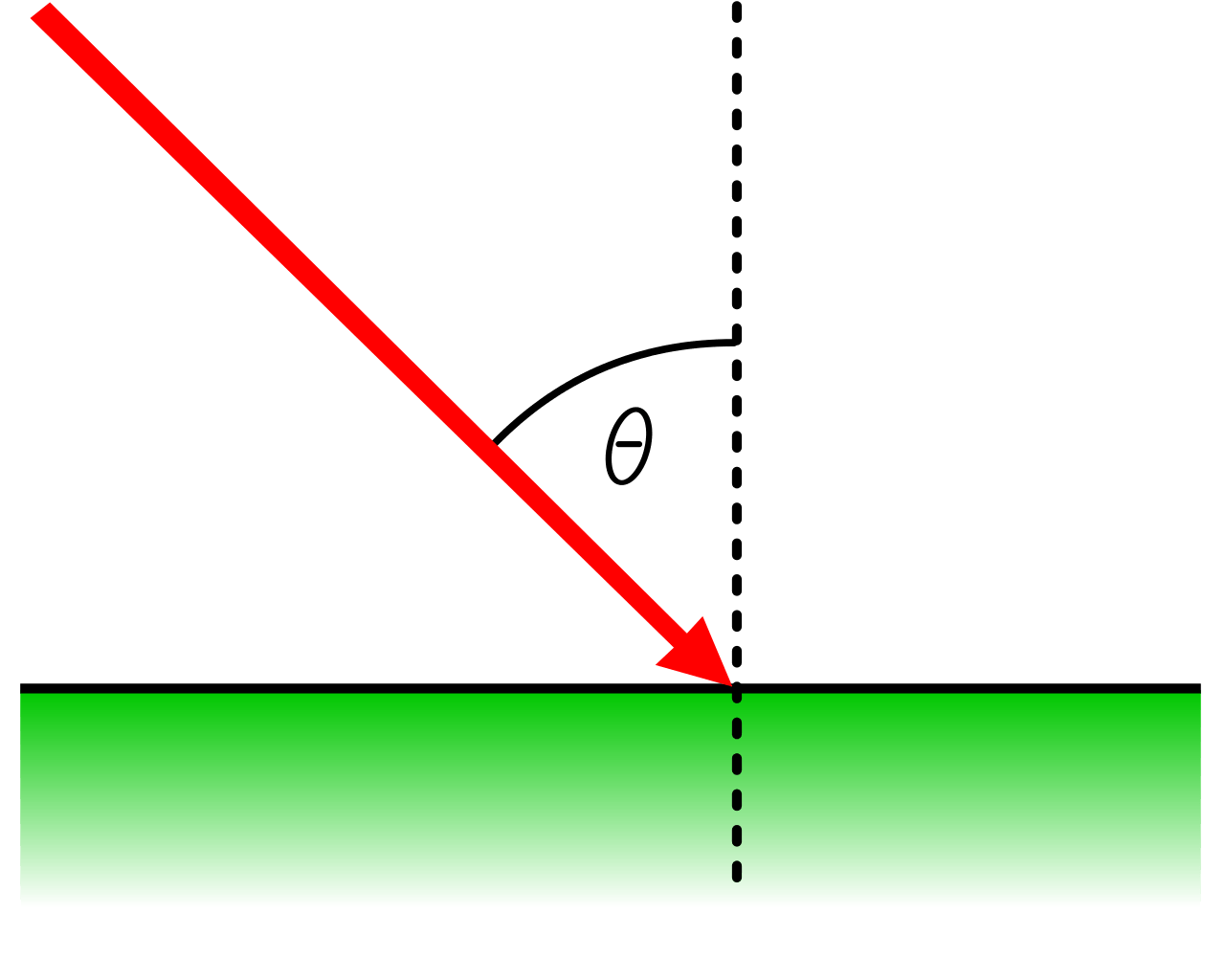

Diagram shows a displacement-time graph of an oscillating spring. The oscillating spring undergoes
Damping
Resonance
Interference
Forced Oscillation

Diagram shows a stretched steel wire produces a sound when the wire id plucked. The loudness of sound is increased when the wire is plucked with
High Speed
Large Amplitude
High Frequency
Large Wavelength

Diagram shows a fisherman used sonar to determine the position of a shoal of fish in the sea water. The wave phenomenon involved is:
reflection
interference
diffraction
refraction
A boy can hear the sound from a television in another room but is unable to see the television. What is the phenomenon involved in the situation ?
Reflection of sound
Refraction of sound
Diffraction of sound
Interference of sound

Diagram shows the ripples produced by water droplets onto the river surface. Which statements is correct about the movement of particles in the water ?
The particle moves outward from the center of water droplets
The particles vibrates parallel to the direction of propagation of the wave
The particles remain stationary
The particles vibrates perpendicular to the direction of propagation of the waves
Which of the diagram shows the phenomenon of wave reflection ?


When angle of incident (i) equals to critical angle (c) if light is traveled from a denser medium to a less dense medium,
total internal reflection occurs.
angle of refraction is equal to 90 degree.
light is refracted out
light travel in straight line
What happens to the speed of light in a more optically dense medium?
it slows down
it speeds up
stays the same because all light travels at the speed of light
When will total internal reflection occur?
When light travels from a less dense to a more dense medium
When the angle of incidence is smaller than the critical angle
When the angle of incidence is greater than the critical angle
When the light cannot pass through a medium

A concave lens has an inward curved shape. It refracts light outward from the lens. They light rays spread apart as they exit the lens. Which represents a concave lens?
A
B
A and B
neither A or B


Diagram shows a displacement-time graph of an oscillating spring. The oscillating spring undergoes
Damping
Resonance
Interference
Forced Oscillation

