
 Worksheets
3rd Checkpoint Review Quiz
Total questions: 27
Worksheet time: 25mins


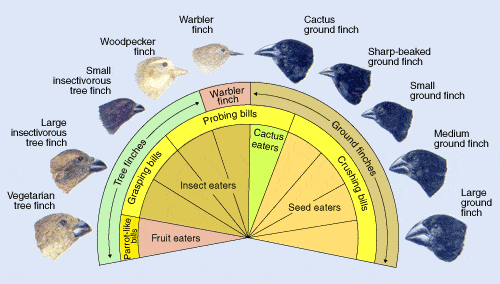
Which of the birds would most likely have the biggest advantage if the food supply suddenly changed from seeds to nectar?
Bird W with its larger size, as could visit fewer flowers and get more nectar.
Bird X with its larger eyes, could locate more flowers to get nectar.
Bird Y with its slender beak, as it could reach further inside flowers to get nectar.
Bird Z with its long legs, as it could reach taller flowers to get nectar.
A population of rabbits grows rapidly from one year to the next. Then one year, a disease strikes approximately one fourth of the adult rabbits. The disease remains with the population in the years that follow.
As explained by Darwin’s theory, which of these conditions allows the rabbit population to evolve by natural selection?
The disease affects adult and juvenile rabbits equally.
The disease reduces the ability of the rabbits to reproduce.
Some rabbits are resistant to the disease, and they pass the resistance to their offspring.
No rabbits are resistant to the disease, and all die when the disease strikes them.

Which of these are possible traits of a rattle snake?
Select all that apply
venom
rattle
hair
legs
scales
What must organisms do when an environment changes?
Adapt
Camoflauge
become common
fight
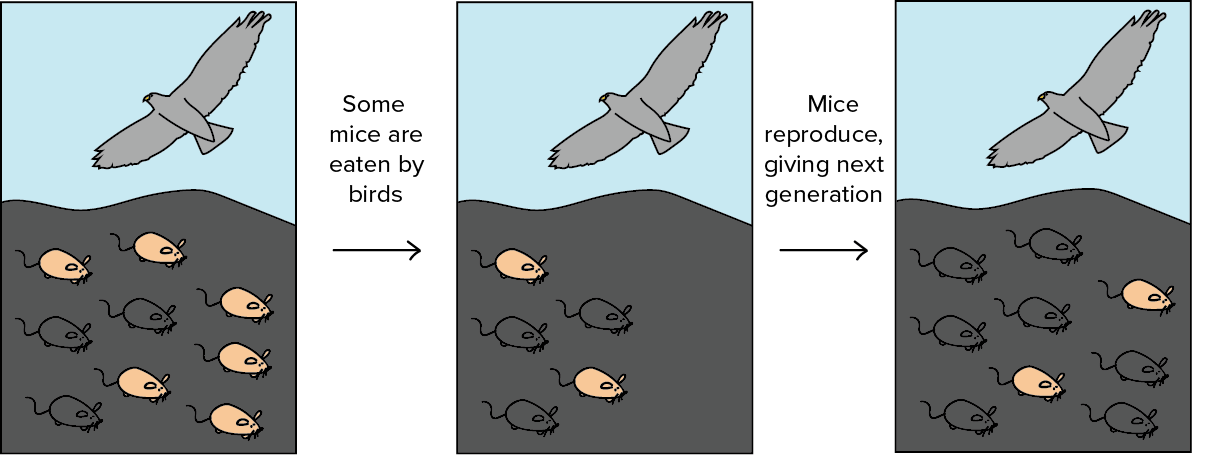
A species could go extinct if:
food becomes more plentiful.
members of the species have adaptations to enhance survival.
the environment changes drastically and no one can adapt.
there is less competition for resources.

The Mayfly is a food source for which 3 organisms?


Which of the following would be the most likely effect, if there were a sudden increase in the cricket population?
There would be a decrease in the small bird population.
There would be a decrease in the grass/flowers population.
There would be a decrease in the mice population.
There would be an increase in the grass/flowers population.


If fish were poisoned which organism would be affected?
algae
phytoplankton
clams
octopus
How does biodiversity contribute to the sustainability of an ecosystem?
The presence of more species with different adaptations makes it more likely that some organisms will survive an ecological disaster
Greater genetic variation within species makes it more likely that some individuals will survive disease outbreak
The presence of a variety of herbivore species that can feed on a large number of different producer species helps ensure abundant prey for predators in the ecosystem.
all the above

Using the following Energy Pyramid: The organisms at the second trophic level get food by taking in —
Sugars are produced when light energy is converted into chemical energy during photosynthesis.
Light is produced when sunlight shines on them so they can make their own energy.
Sugars are produced when the digestive systems of organisms in the first trophic level undergo respiration.
Meat is produced when the digestive system of organisms in the third trophic level break down food.

Mammals use their lungs to provide oxygen for themselves from the air. Fish spend
a majority of their time in the water, and instead, developed gills. What is the
function of gills?
Gills break down water into hydrogen and oxygen so the fish can use the
oxygen.
Gills allow the fish to breathe oxygen in the water and the air.
Gills allow the fish to use the oxygen that is dissolved in the water.
Gills allow the fish to use the oxygen in the air, but use it more slowly so they
can live in water.

Describe the flow of energy in an artic ecosystem. Be sure to include the following in
your description:
– The source of energy for the ecosystem
– The role of producers
– The role of consumers

