Wayground logo

Free Printable Worksheets

Font size

S
M
L
XL
Worksheets

biodiversity

Total questions: 50

Worksheet time: 52mins

Name
Class
Date
1.
How do Amphibians breath?
a)
Gills
b)
Blow Hole
c)
Gills and Lungs
d)
Lungs
2.
What is a vertabrate?
a)
An animal that has a spinal cord or backbone
b)
An animal that has lungs
c)
A human that can play Soccer
d)
An animal that has bones
3.
Body covering of a mammal?
a)
Fur
b)
Scales
c)
Fur and skin
d)
Skin and Scales
4.
Where does the energy from an ecosystem come from?
a)
Trees
b)
Sun
c)
Plants
d)
Water
5.
What does cold blooded mean?
a)
They are always cold blooded
b)
They switch there blood temperature in different seasons
c)
Is warm blooded
d)
Has no blood
6.
Which of these animals have a back bone or spinal cord?
a)
Scorpions
b)
Snakes
c)
Jelly Fish
d)
Krill
7.
Some mammals such as Moose, Deer, and Water Buffalos have defensive adaptations such as horns or antlers to fight predators. Males also use them to fight other males during mating season.
Select the choice that correctly describes the adaptations described in the narrative above. 
a)
The antlers and horns are structural adaptations, and the fighting is a behavioral adaptation.
b)
 These mammals are carnivores that use their antlers to attack and kill their prey.
c)
Antlers are examples of behavioral adaptations used by Moose and Deer
d)
Deer and Moose antlers are structural adaptations, but horns are not. 
8.
Organisms need all of the following things EXCEPT
a)
Food
b)
Water
c)
Shelter
d)
Ability to hunt
9.
Why is biodiversity important in fighting disease in food crops?
a)
It prevents one disease from wiping out an entire food crop.
b)
It prevents habitat loss of native species.
c)
It provides different foods for different populations.
d)
It prevents fungal disease from wiping out corn crops.
10.
Forests are often preserved to protect biodiversity. This helps preserve the unique characteristics of the organisms that live there. Sometimes these forests are divided into separate sections that are spread out instead of one continuous forest. This is known as forest fragmentation. Which types of organisms will be the least likely to be affected by forest fragmentation?
a)
herbivorous birds that are able to migrate great distances
b)
omnivores that hibernate in winter in order to conserve energy
c)
omnivores that burrow underground deep in to the soil.
d)
herbivorous mammals that are dependent upon specific plants for food
11.

A population is

a)

a group of similar species in different areas

b)

a group of the same species in the same geographic area.

c)

a group of several species in the same geographic area

d)

a group of several species along with their abiotic factors in a small area.

12.
Which of the following will increase the size of a population?
a)
emigration and births
b)
immigration and deaths
c)
immigration and births
d)
emigration and deaths
13.
What 2 factors decrease population size?
a)
Immigration, Births
b)
Emigration, Births
c)
Emigration, Deaths
d)
Immigration, Deaths
14.

Identify which image below is showing a population:

a)
b)
c)
d)
15.
Cattle egrets forage (feed) in fields among cattle. The egret gets easy access to flying insects stirred up by the cattle, and the cattle don't care if they are there or not.
a)
mutualism
b)
commensalism
c)
competition
d)
parasitism
16.
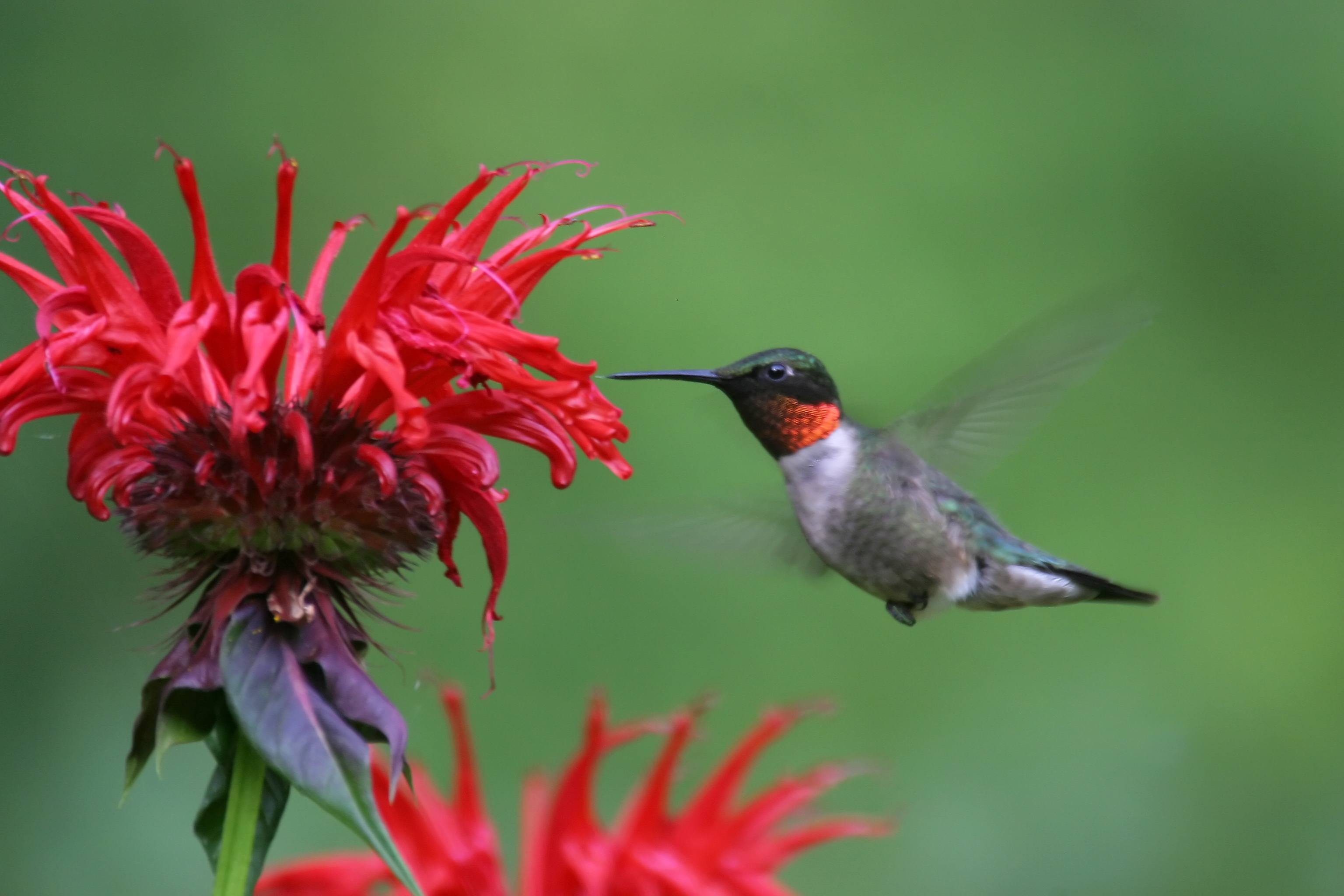
What type of symbiosis?  Hummingbirds feed on nectar from flowers.  The flowers are pollinated by hummingbirds as they move from flower to flower.
a)
commensalism
b)
mutualism
c)
parasitism
d)
predation
17.
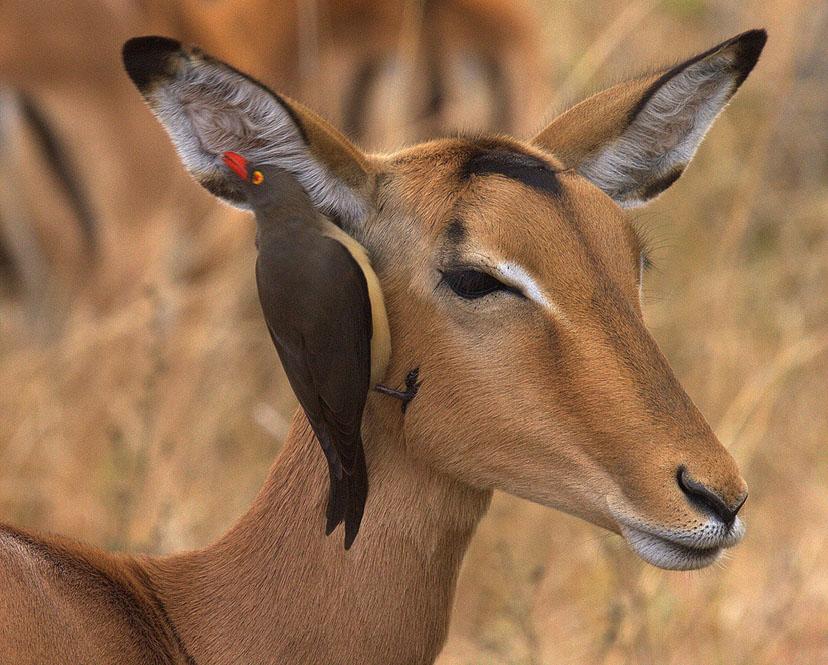
Red-billed oxpeckers are birds that often feed on parasites that infest impala.  This is an example of _______.
a)
commensalism
b)
mutualism
c)
neutralism
d)
competition
18.

Aphids are tiny insects that live on and eat the leaves of plants, removing vital nutrients from the plants.

a)

Predation

b)

Parasitism

c)

Commensalism

d)

Mutualism

19.
What does biodiversity mean?
a)
Only one species in an area.
b)
The different amount of species in an area
c)
All abiotic life
d)
Nitrogen fixation
20.
A drought has hit this grassland biome. How will this effect the rabbit population?
a)
The rabbits will increase in number.
b)
The rabbit population will stay the same.
c)
The rabbit population will decrease.
d)
The rabbit population will become extinct immediately.
21.
Competition can occur between organisms for both biotic and abiotic resources.  Competition for biotic resources can be illustrated by organisms fighting for a limited amount of –
a)
air to breath
b)
mates for breeding
c)
water to drink
d)
space for nesting
22.
All living and nonliving things in an environment and the many ways they interact are called ______
a)
ecosystem
b)
community
23.
Which organisms in the food web shown to the right are predators that compete for the same prey in this environment?
a)
Coyotes and rabbits
b)
White-tailed deer and rabbits
c)
Leafy weeds and cotton rats
d)
Bobcats and coyotes
24.
The struggle between organisms to survive as they attempt to use the same resource
a)
Predator
b)
Prey
c)
Competition
d)
Adaptation
25.
On a safari at night, a lion hunts and feeds on an antelope. In this relationship, the lion is the ____________________ and the antelope is the _________________.
a)
Parasite/host
b)
Predator/prey
c)
Prey/Predator
26.

What does the root "bio" mean...

a)

living

b)

nonliving

c)

toxic

d)

variety

27.

What does the root "diversity" mean...

a)

living

b)

nonliving

c)

toxic

d)

variety

28.
Which of the following situations is MOST HARMFUL to an ecosystem's food web or food chain?
a)
introduction of a similar producer
b)
loss of one of the top consumers
c)
increase in the population of producers
d)
disease killing the producers
29.
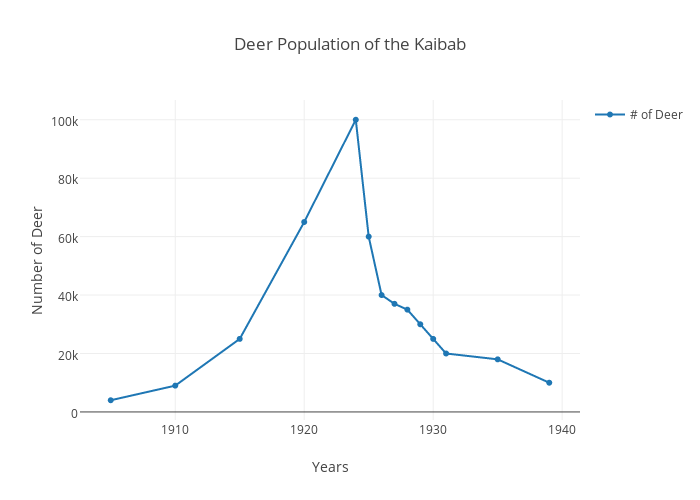
The graph above shows the variation in the deer population in the Kaibab Plateau from 1905 to 1939. Between 1907 and 1923, the natural predators of deer were eliminated from the area by hunters. What was the most likely reason for the decline in the deer population after 1924?
a)
The deer stopped competing for resources because they had no predators.
b)
The increased number of deer led to increased competition for resources.
c)
A large number of deer left the region in search of new predators.
d)
The removal of predators caused fewer resources to be available to the deer.
30.
In a particular habitat, owls eat mice and mice eat grass. If the owl population suddenly grows, then most likely
a)
the number of mice will decrease and the amount of grass will not change.
b)
the number of mice will increase and the amount of grass will increase.
c)
the number of mice will increase and the amount of grass will not change.
d)
the number of mice will decrease and the amount of grass will increase.
31.
What is the MOST likely consequence if a fungal disease killed the grass in this WOODLAND ECOSYSTEM?
a)
Only the rabbits would be affected, because they are the ones who eat the grass.
b)
The blueberry bush would begin to grow wild, because it would have more space to grow.
c)
Nothing would happen; the animals would eat something else.
d)
The ecosystem would most likely be disrupted, because the grass is one of its primary producers
32.
Currently sharks are on a rapid decline due to overfishing. If sharks go extinct will this affect the biodiversity of the ocean?
a)
No, sharks are not important.
b)
No, sharks will only affect the seal populations.
c)
Yes, it will disrupt the entire food chain in the ocean.
d)
Yes, but only a little.
33.
How can humans best help an endangered species avoid extinction?
a)
they can feed the animals
b)
they can put the animals in a zoo
c)
they can protect the animal’s habitat
d)
they can take the animal to new habitats
34.
Why is biodiversity so important?
a)
Because all species depend on each other to survive, so if one becomes extinct another species that relies on it could go extinct as well
b)
Because it’s better to have only one variation of each species.
c)
Because it better to only have a few species on Earth.
d)
Honestly, I have no idea what biodiversity is!
35.
What factor does NOT affect biodiversity?
a)
Urbanization
b)
Planting Native Plants
c)
Overfishing
d)
Pollution
36.
A Wildlife Biologist is photographing only the deer in the meadow. Another way of saying this would be that the Wildlife Biologist is photographing the deer____________________ in the meadow.
a)
Organism
b)
Ecosystem
c)
Community
d)
Population
37.
Which of the following describes the importance of biodiversity to an ecosystem?
a)
a. People like to be able to see all the different plants and animals
b)
b. If there aren�t all the different species, there will be resources that aren�t being used
c)
c. Biodiversity is not as important as many people think
d)
d. Biodiversity can help minimize the effects of losing a species.
38.
If global warming continues, which of the following will most likely NOT happen?
a)
a. Increased intensity of storms
b)
b. Rises in ocean levels
c)
c. Loss of biodiversity
d)
d. Increase in available resources
39.
Which human activity would be most destructive to the biodiversity of the biosphere?
a)
a. The burning of wood and coal in rural areas
b)
b. The release of species of freshwater trout in lakes
c)
c. The removal of plants from the food webs they support
d)
d. The removal of erosion barriers from forest boundaries
40.

which of the following is a dicotyledon plant?

a)
b)
c)
d)
41.
Ferns do not have seeds, they reproduce with,
a)
root
b)
spores
c)
flowers
d)
cones
42.

What is NOT a characteristic of a monocot plant?

a)

parallel veins

b)

flowers in multiples of three

c)

Fibrous Roots

d)

Taproots

43.

The vascular structure of a dicotyledons plant is:

a)

vascular bundles in a ring

b)

vascular bundles are scattered

c)

no noticeable vascular pattern

d)

vascular pattern varies by species

44.

Fibrous roots, scattered vascular structures, parallel leaf veins, & a single cotyledon embryo are all examples of a ______________.

a)

Monocotyledon plant

b)

Dicotyledon plant

c)

Tricotyledon plant

d)

angiosperm

45.

Which is an example of an invertebrate animal that has three pairs of legs?

a)

ant

b)

dragonfly

c)

Centipede

d)

Spider

46.
How do plants get their energy?
a)
through a reaction called chlorophyll 
b)
by a process called photosynthesis 
c)
by absorbing mineral nutrients from soil 
d)
by eating other organisms 
47.
What two materials are used in photosynthesis?
a)
carbon monoxide and water 
b)
carbon dioxide and soil 
c)
carbon dioxide and oxygen
d)
carbon dioxide and water 
48.

Examine this seed. Would you expect it to produce a dicot or monocot plant?

a)

monocot

b)

dicot

49.
Examine the leaf. Would you expect this plant to be classified as a dicot or monocot?
a)
monocot
b)
dicot
c)
Neither
d)
Both
50.

Plant can be useful and harmful. How can Roots useful for human ?

a)

Use for Soil Protectors and fertilisers

b)

as source of food

c)

Biodiesel

d)

Use as air filter