
 Worksheets
Toxonomy
Total questions: 38
Worksheet time: 3hrs 10mins
Name
Class
Date
1.
Which organisms are most closely related?
a)
Equus caballas (Horse) & Equus burchellii (Zebra)
b)
Cyanea artica (Jellyfish) &
Ctenodiscus crispatus (Mud Starfish)
Ctenodiscus crispatus (Mud Starfish)
c)
Naja naja (cobra) & Glycine max (soya bean)
d)
Ophiocomina nigra (black brittle star) & Brassica nigra (black mustard)
2.
The science of describing, classifying, and naming living things is called:
a)
Geology
b)
Biology
c)
Taxonomy
d)
Chemistry
3.
The 8 levels of classification, broadest to most specific.
a)
Domain, Genus, Family, Order, Class, Phylum, Kingdom, Species
b)
Domain, Species, Kingdom, Genus, Phylum, Family, Class, Order
c)
Domain, Kingdom, Phylum, Class, Order, Family, Genus, Species
d)
Order, Kingdom, Species, Domain, Phylum, Family, Class, Genus
4.
An organism made up of more than one cell would be called:
a)
multicellular
b)
unicellular
c)
heterotroph
d)
autotroph
5.
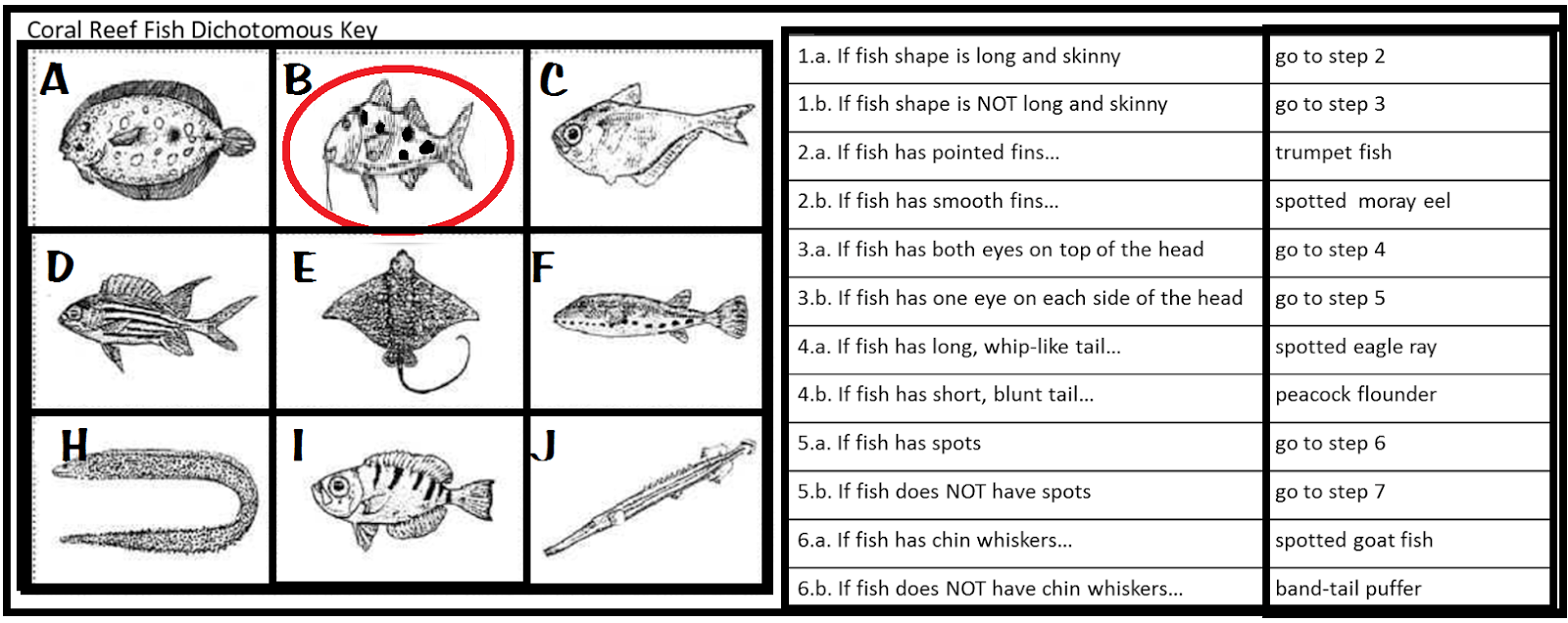
Using this dichotomous key, identity the name of the circled fish.
a)
band-tail puffer
b)
spotted goat fish
c)
peacock flounder
d)
trumpet fish
6.
What two parts of the classification system are used for the naming of organisms?
a)
Domain and Kingdom
b)
Genus and Species
c)
Class and Family
d)
Kingdom and Phylum
7.
Which kingdom contains mushrooms, yeast, and toadstools?
a)
Plants
b)
Animals
c)
Bacteria
d)
Fungi
8.
What is a species?
a)
A specific animal
b)
A group of organisms that can interbred to produce viable offspring
c)
A genus
d)
Another name for a hybrid
9.
Which of the following organisms would likely make its own energy based upon the prefix on the front of the word?
a)
Heterotroph
b)
Autotroph
10.
What is another name for grouping and classifying items by their similarities or differences.
a)
Morphology
b)
Biology
c)
Taxonomy
d)
Ecology
11.
What is the most broad way life could be grouped according to the classification system?
a)
Kingdom
b)
Domain
c)
Class
d)
Family
12.

Use the phylogenetic tree. Which hypothetical organism is the most recent ancestor for Organisms A and G?
a)
1
b)
2
c)
3
d)
4
13.
What can a classification system show about an organism?
a)
absolute age of an organism
b)
what an organism is made of
c)
its relationship to other organisms
d)
which organisms are the strongest
14.
Which domain includes all multicellular plants and animals?
a)
Archaea
b)
Eukarya
c)
Eubacteria
d)
Protista
15.
Which taxonomic category is higher than the others?
a)
class
b)
genus
c)
order
d)
phylum
16.
Use the phylogenetic tree. Which hypothetical organism is the most recent ancestor for Organisms A and G?
a)
1
b)
2
c)
3
d)
4
17.
What can a classification system show about an organism?
a)
absolute age of an organism
b)
what an organism is made of
c)
its relationship to other organisms
d)
which organisms are the strongest
18.
Which domain includes all multicellular plants and animals?
a)
Archaea
b)
Eukarya
c)
Eubacteria
d)
Protista
19.
Panthera leo, the scientific name for a lion, is a member of which species?
a)
leo
b)
Animalia
c)
Panthera
d)
mammalia
20.
Which taxonomic category is higher than the others?
a)
class
b)
genus
c)
order
d)
phylum
21.
An organism identified with binomial nomenclature includes which two taxa?
a)
class and order
b)
family and genus
c)
genus and species
d)
kingdom and phylum
22.
Canis lupus, the scientific name for a wolf, is in which genus?
a)
Canis
b)
lupus
c)
Animalia
d)
mammalia
23.
What role did Linnaeus play in classification of organisms?
a)
He classified all life into plants and animals.
b)
He classified all life by where organisms lived.
c)
He started naming organisms using binomial nomenclature.
d)
He utilized DNA technology to form the modern system of naming.
24.
Which two organisms are least closely related?
a)
two organisms from the same kingdom
b)
two organisms from the same order
c)
two organisms from the same family
d)
two organisms from the same genus
25.

The table shows some characteristics of four kingdoms.
Which characteristics would a taxonomist use to classify organisms as Archaebacteria or as Eubacteria?
Which characteristics would a taxonomist use to classify organisms as Archaebacteria or as Eubacteria?
a)
the internal organization of the cell
b)
the number of cells in an individual
c)
the chemical composition of the cell wall
d)
the nutritional requirements of the organism
26.
Which is used most to determine a true common ancestor for a group of organisms?
a)
karyotype
b)
dichotomous key
c)
phylogenetic tree
d)
mRNA codon chart
27.
How would a dichotomous key be used?
a)
by inserting it into a chamber at a 45 degree angle
b)
by observing specimens and then answering questions about them
c)
by comparing the colors on a strip to the colors obtained during testing
d)
by analyzing a gel agar and recording the distance each fragment had traveled
28.

Examine the phylogenetic tree.
Which two organisms are most closely related?
Which two organisms are most closely related?
a)
wolves and sharks
b)
starfish and sharks
c)
protists and sharks
d)
gorillas and sharks
29.
Which can be inferred by viewing a phylogenetic tree?
a)
ancestral lineages
b)
color variation in species
c)
food choice of an organism
d)
probability of extinction in a population
30.
Which is used to classify and name an organism?
a)
karyotype
b)
cladogram
c)
dichotomous key
d)
phylogenetic tree
31.

Examine the dichotomous key.
What features does a Platyspiza have?
What features does a Platyspiza have?
a)
stout and heavy beak with a curved lower beak
b)
long, slender beak with a flat and straight lower beak
c)
flat and straight beak with a bend in the lower edge of the upper beak
d)
long and slender beak with the lower edge of the upper beak being flat
32.
What goal does Taxonomy accomplish?
a)
explains the differences between living organisms
b)
classifies living organisms into groups
c)
predicts the types of undiscovered organisms
d)
establishes relationships of organisms with their habitat
33.
Use the data in the table to answer the question.
Which sequence of organisms best represents the relationship between them?
Which sequence of organisms best represents the relationship between them?
a)
lancelet-lamprey-turtle-tuna-salamander-leopard
b)
lamprey-lancelet-salamander-tuna-turtle-leopard
c)
lancelet-lamprey-tuna-salamander-turtle-leopard
d)
lamprey-tuna-lancelet-turtle-salamander-leopard
34.
Which of the following is an example or organisms with the most recent common ancestor?
a)
a butterfly & a bluebird
b)
a wolf & a mountain lion
c)
an ostrich & a penguin
d)
a moose & an elephant
35.
Which of the following shows the taxa in the correct order?
a)
kingdom-phylum-order-class-family-genus-species
b)
kingdom-class-order-family-phylum-genus-species
c)
kingdom-phylum-class-order-family-genus-species
d)
kingdom-phylum-family-order-class-genus-species
36.
What role did Linnaeus play in classification of organisms?
a)
He classified all life into plants and animals.
b)
He classified all life by where organisms lived.
c)
He started naming organisms using binomial nomenclature.
d)
He utilized DNA technology to form the modern system of naming.
37.
Which is used most to determine a true common ancestor for a group of organisms?
a)
karyotype
b)
dichotomous key
c)
phylogenetic tree
d)
mRNA codon chart
38.
Examine the phylogenetic tree.
Which two organisms are most closely related?
Which two organisms are most closely related?
a)
wolves and sharks
b)
starfish and sharks
c)
protists and sharks
d)
gorillas and sharks
100 %

