
 Worksheets
Exponential graphs practice quiz
Total questions: 25
Worksheet time: 24mins
What does the a represent in the equation
f(x)=a(b)xSlope
Y-intercept
Rate of Change
Common ratio
Identify which functions are exponential.
f(x) = 2x - 5
g(x) = 3x
k(x) = 3x4 - 6x + 9
Determine which function models exponential growth.
g(x)=3⋅2x
k(x)=(31)x
m(x)=3⋅(32)x
p(x)=4x2+5x−9
Determine which functions model exponential decay.
g(x)=3⋅2x
k(x)=(31)x
m(x)=3⋅(32)x
p(x)=4x2+5x−9

Which equation corresponds to the graph below.
k(x)=3⋅(21)x+4
f(x)=3⋅2x+4
f(x)=3⋅2x−4
m(x)=3(21)2−4
Does the equation below represent exponential growth or decay?
g(x)=5(34)x−2−5
(a)
Given the equation below determine the y-intercept.
y=3x(0, 1)
(0, 3)
x= 0
y = 0
Given the equation below determine the asymptote.
y=3x(0, 1)
(0, 3)
x= 0
y = 0
Determine the asymptote of the equation below:
g(x)=4⋅2x+3y = 4
y = 2
y = 3
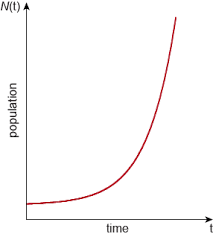
Does the graph represent growth, decay, linear or none?
Exponential Growth
Exponential Decay
Linear
None
Evaluate the exponential function
f(x) = 3x ; x = - 2
-81
-9
1/9
-1/81
What is the definition of an asymptote?
a curved line
a curve at the origin
a line that continually approaches a given curve but does not meet it at any finite distance
Which of the below exponential graphs shows decay?


Which of the below exponential graphs shows growth?


Which of the below functions represents exponential growth?
y=21⋅10x
f(x)=2⋅21x
y=10⋅21x
g(x)=5⋅51x

Which graph matches this equation?


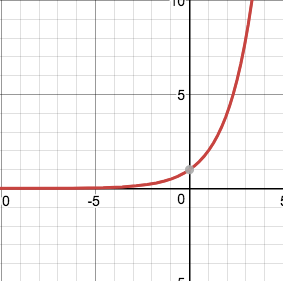
What is the asymptote of y = 2x ?
y = 0
x = 0
x = 0
x = 1

What is the asymptote of y = 2x - 3
y = 0
y = -3
x = 0
x = -3
What type of function is f(x)=2(41)x ?
exponential growth (increasing)
exponential decay (decreasing)
both growth and decay
Pick the equation that represents exponential growth (is increasing).
y=2(0.5)x
y = 0.5(2)x
Which the following graphs represents an exponential decay function?


Which equation matches the graph?
y = 4x + 3
y = 4x - 3
y = 4(x + 3)
y = 4(x - 3)

Which equation matches this graph?



