
 Worksheets
Unit 2 Part 3 Notes 4: Molecular Geometry
Total questions: 15
Worksheet time: 11mins
Name
Class
Date
1.
What is the VSEPR theory used to predict?
a)
Bond Strength
b)
Polarity
c)
Molecular Shape
d)
Electronegativity
2.
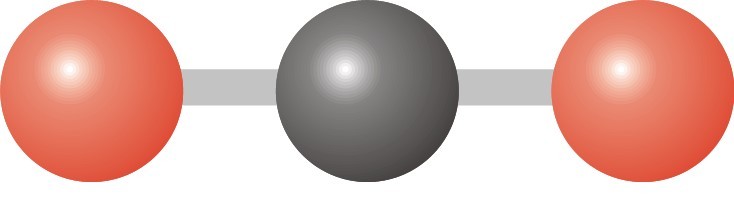
Which molecule would have this molecular geometry?
a)
BF3
b)
CH4
c)
PCl5
d)
CO2
3.
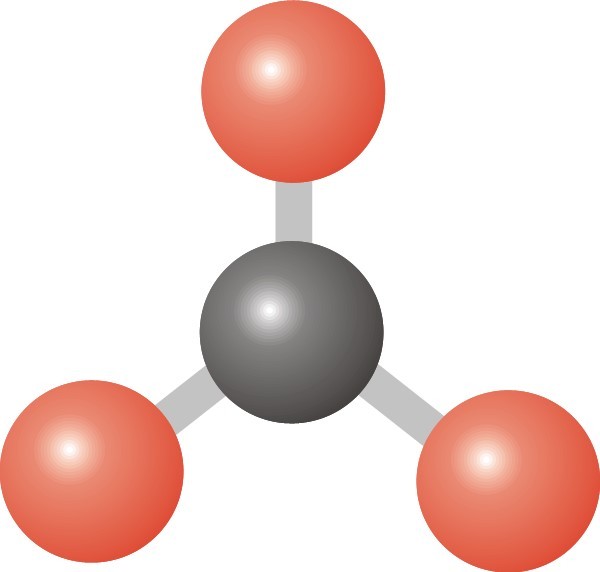
What molecule could this be?
a)
BF3
b)
CH4
c)
H2O
d)
CO2
4.
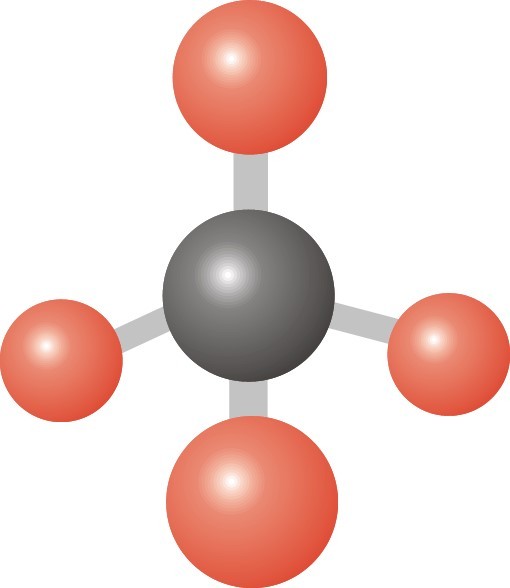
Who could this molecule be?
a)
CH4
b)
CO2
c)
PCl5
d)
BF3
5.
According to VSEPR, molecules adjust their shapes to keep which of the following as far away as possible?
a)
Pairs of valence electrons
b)
Inner shell electrons
c)
Mobile Electrons
d)
Electrons closest to the nucleus
6.
The bond angle for a trigonal planar molecule is
a)
90 Degrees
b)
109.5 Degrees
c)
120 Degrees
d)
180 Degrees
7.

What molecular shape is the structure shown here? (H2O)
a)
tetrahedral
b)
trigonal planar
c)
bent
d)
trigonal pyramidal
8.
A lone pair is defined as
a)
A pair of bonding electrons
b)
One non-bonding electron
c)
A pair of non-bonding electrons
d)
A pair of electrons on the central atom
9.
What is the measure of a tetrahedral bond angle?
a)
90 Degrees
b)
109.5 Degrees
c)
120 Degrees
d)
180 Degrees
10.
Any molecule with only two atoms must be linear. Three-atom molecules such as BeCl2 can also be linear. For linear molecules, the bond angle is
a)
360°
b)
180°
c)
120°
d)
90°
11.
What molecular geometry would PH3 have?
a)
Trigonal Pyramidal
b)
Trigonal Bipyramidal
c)
Bent
d)
Linear
12.

What is the MOLECULAR geometry of the molecule?
a)
Linear
b)
Bent
c)
Trigonal Planar
d)
Seesaw
13.
How many unshared pairs of electrons will a pyramidal molecule have?
a)
1
b)
2
c)
3
d)
4
14.
What two types of atoms make a covalent bond?
a)
2 Nonmetals
b)
1 Nonmetal and 1 Metal
c)
2 Metals
d)
2 Noble Gases
15.
The acronym VSEPR stand for
a)
very strong electron pair repulsion.
b)
varied symmetry electrostatic proton reaction.
c)
venomous snakes enjoy pink ribbons.
d)
valence shell electron pair repulsion.
100 %

