wayground logo

Free Printable Worksheets

NEW

Font size

S
M
L
XL
Worksheets

Physics: Electricity Unit Test

Total questions: 50

Worksheet time: 4hrs 10mins

Name
Class
Date
1.
A material in which electrons are able to move easily
a)
Circuit
b)
Insulator 
c)
Resistance 
d)
Conductor 
2.
A material in which electrons are not able to move easily 
a)
Circuit 
b)
Insulator 
c)
Resistance 
d)
Conductor
3.
Electric current that flows in only one direction. 
a)
Voltage 
b)
Direct Current 
c)
Alternating Current
d)
Series Circuit 
4.
Electric current that reverses its direction of flow in a regular pattern  
a)
Voltage 
b)
Direct Current 
c)
Alternating Current 
d)
Parallel Circuit 
5.
The flow/movement of electric charges 
a)
Voltage
b)
Resistance 
c)
Current 
d)
Circuit 
6.
A closed path that electric current follows 
a)
Voltage
b)
Current
c)
Resistance 
d)
Circuit
7.
The tendency for a material to oppose the flow of electrons, changing electrical energy into thermal energy and light.
a)
Voltage
b)
Current
c)
Resistance
d)
Circuit 
8.
According to this law, the current in a circuit equals the voltage difference divided by the resistance. 
a)
Law of Conservation of Energy 
b)
Ohm's Law 
c)
Law of Conservation of Charges
d)
Newton's First Law 
9.
This circuit contains two or more branches for current to move through. 
a)
Series Circuit 
b)
Parallel Circuit 
10.
The accumulation of excess electric charge on an object is called
a)
Static electricity 
b)
Electric discharge
c)
Resistance
d)
Circuit 
11.

Which of the following substances is the best conductor of electricity?

a)

Glass

b)

Wood

c)

Water

d)

Tin

12.

Which of the following is the SI unit for electric current?

a)

Ohm

b)

Watt

c)

Ampere

d)

Volt

13.

A higher resistance in a circuit causes a _____________.

a)

higher voltage

b)

larger current

c)

smaller current

d)

lower voltage

14.
Lightning is an example of _________.
a)
static electricity
b)
current electricity
c)
watts
d)
voltage
15.
Identify the insulator below.
a)
aluminum foil
b)
paperclip
c)
rubber eraser
16.
Identify the conductor below.
a)
cloth rag
b)
plastic bottle
c)
gold ring
17.
Thicker wires have _______ resistance than thinner wires.
a)
more
b)
less
c)
the same
18.
Electric current is measured in ______.
a)
Watts
b)
Volts
c)
Amperes
19.
As the resistance in a circuit increases, the electric current __________.
a)
increases
b)
decreases
c)
stays the same
20.
Which formulas represents Ohm's law?
a)
V=IR
b)
R=IV
c)
I=RV
21.
Which subatomic particles have a positive charge?
a)
neutrons
b)
electrons
c)
protons
22.

What is the unit for measuring the electric potential energy per unit charge in a circuit?

a)
Volts
b)
Amperes
c)
Ohms
23.
How many volts are in a circuit with a battery that has a resistance of 10 Ohms and a current of 2 Amps? 
a)
.5 Volts
b)
5 Volts
c)
20 Volts
24.
Electricity is the flow of _________.
a)
protons
b)
neutrons
c)
electrons
25.

Direct currents always flow from a ___ terminal to a ___ terminal.

a)

positive to negative

b)

negative to positive

26.
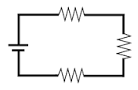
What kind of circuit is this?
a)
Series
b)
Consecutive
c)
Parallel
d)
Training
27.
What type of circuit is pictured?
a)
series
b)
parallel
28.
If the battery produced 12.6 Volts and what would be the current flow be for a 6 Ohm resistor
a)
2.1 Amps
b)
2.4 Amps
c)
1.71 Amps
d)
15 Amps
29.
What voltage is needed to cause a 2A current flow through a 10Ω resistor?
a)
5V
b)
0.2V
c)
20V
d)
200V
30.
What resistance is needed to cause a 20A current flow because of a 100V battery?
a)
0.2Ώ
b)
2000Ώ
c)
120Ώ
d)
31.
What is the power of a 20V bulb with 5A through it?
a)
100W
b)
100V
c)
6.3W
d)
6.3A
32.
What is the current through a 11V bulb with a power of 99W?
a)
9W
b)
9A
c)
60V
d)
60A
33.

What voltage is needed to cause a 50A current flow through a 10Ω resistor?

a)

15V

b)

500V

c)

500 kV

d)

0.2V

34.
If the battery produced 12.6 Volts and what would be the current flow be for a 6 Ohm resistor
a)
2.1 Amps
b)
2.4 Amps
c)
1.71 Amps
d)
15 Amps
35.
What would the circuit resistance be if a 7.5 Amp draw was present with the engine running and the charging system producing 15 Volts
a)
15 Ohms
b)
4 Ohms
c)
0.3333 Ohms
d)
2 Ohms
36.
What is resistance measured in?
a)
Ω (Ohms)
b)
V (Volts)
c)
A (Amps)
d)
W (Watts)
37.
What is Resistance?
a)
The flow of electrons
b)
Electric potential difference
c)
A battery
d)
The ability to reduce the flow of electrons
38.
What types of charges attract?
a)
Positive and Positive
b)
Positive and Neutral
c)
Negative and Neutral
d)
Positive and Negative
39.
The mathematical relationship among Voltage, Current, and Resistance
a)
Faraday's Law
b)
Tesla's Law
c)
Edison's Law
d)
Ohm's Law
40.

Voltage divided by Resistance

(V / R)

a)

Current

b)

Power

c)

Ohms

d)

Watts

41.

Voltage divided by Current

(V / I)

a)

Current

b)

Power

c)

Resistance

d)

Watts

42.
If the Voltage is increased and the resistance stays the same, Current will
a)
Increase
b)
Decrease
c)
Stay the same
d)
X
43.
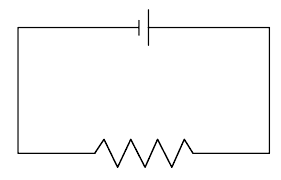
This circuit has a 24 volt battery and the resistor is 8 ohms. How many amps are running through the circuit?
a)
3 Amps
b)
192 Amps
c)
2 Amps
d)
4 Amps
44.
To complete a circuit the switch must be
a)
unattached
b)
open
c)
closed
d)
It depends
45.
When distance increases, electrostatic force ____________; we call this relationship ____________ proportional
a)
decreases;directly
b)
decreases;inversely
c)
increases;inversely
d)
increases;directly
46.
What variable is a Coulomb the unit for?
a)
Charge
b)
Force
c)
Distance
d)
Mass
47.

The graph shows the relationship between the force of interaction and the magnitude of charge. What type of relationship is this?

a)

Direct

b)

Indirect

c)

Inverse

d)

Reverse

48.

Coulomb’s law states that the force between two charged objects will __________ when the magnitude of the object’s charge increases.

Coulomb’s law also states that the force between two charged objects will __________ when the distance between objects increases.

a)

increase; increase

b)

increase; decrease

c)

decrease; increase

d)

decrease; decrease

49.
The plastic covering is there to:
a)
Provide a conductor for electrical energy to flow.
b)
Provide an insulator so that electrical energy will not pass outside of the wires.
c)
Provide a conductor so that electrical energy can NOT flow.
d)
Provide an insulator so that electrical energy can flow.
50.

Longer wires have more resistance than shorter wires.

a)

True

b)

False