
Font size
 Worksheets
U10 Gas Laws
Total questions: 28
Worksheet time: 42mins
What formula would you use to solve this problem? A gas that has a pressure of 2 atm and a volume of 10 L. What would be the new volume if the pressure was changed to 1 atm?
What formula would you use to solve this problem? A sample of a gas has a volume of 852 mL at 298 K. What temperature is necessary for the gas to have a volume of 945 mL?
P1/n1 = P2/n2 ...
PV=nRT
What formula would you use to solve this problem? What would be the pressure inside a 2.00 L container with 2.00 mol of gas at 20 C?
P1V1/n1T1 = P2V2/n2T2
PV=nRT
constantly and randomly in straight lines until the collide with something
randomly until they collide, then then they stop
in a circular motion, constantly floating in space
If you have a sealed glass container and you remove 1/2 the moles of gas and lower the temperature to 1/2 the original temperature. how will the pressure change?
It will be 6x greater than the original pressure
It will be 1/3 the original pressure
It will be 3x the original pressure
It will be 1/6 the original pressure
What type of relationship do pressure and volume have?
direct: If P increases, V increases
inverse: If P increase, V decreases
inverse: If P increases, V increases
direct: If P increases, V decreases
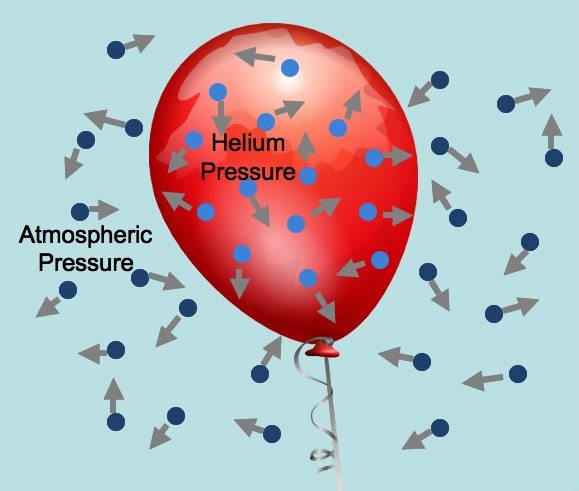
Collisions of particles with each other
The vacuum in the container
The collisions of the particles with the walls of the container
Atmospheric pressure acting on the outside walls
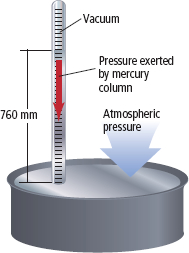
What determines the height of the mercury in the barometer?
The height is when the pressure in the space above the mercury column is equal to air pressure
The height is when the weight of the mercury column is equal to the force of air pushing down on the pool
The height is determined by the air pressure in the tube pulling up on the column of mercury
The height is equal to the mass of mercury in the pool
A gas of volume V is place in a balloon. The pressure is reduced to 1/5 of the original pressure as the balloon floats higher into the sky. The volume will be _____ what it was originally.
the same as
1/5
9 times
5 times
A gas of volume V is placed in a balloon. Determine the new volume of the balloon if the outside air pressure is tripled. The new volume will be ____ what it was originally.
1/3 of
3 times
1/9 of
9 times
If I initially have 4.0 L of a gas at a pressure of 1.1 atm, what will the volume be if I increase the pressure to 3.4 atm?
1.29 L
12.36 L
1.29 atm
12.36 atm
A sample of sulfur dioxide occupies a volume of 652 mL at 313 K and 150 kPa. What volume will the sulfur dioxide occupy at STP?
STP = 273 K, 101.3 kPa
1682.6 mL
20.7 mL
492.3 mL
842.1 mL
What is the initial volume of methane gas at 273 K and 101.33 kPa when the volume is decreased to 0.50 L, with a temperature of 300 K and a pressure of 151.99 kPa.
0.68 L
0.82 L
0.50 L
0.37 L
What is the density of Helium (4.00 g/mol) at STP?
5.6 g/L
89.6 g/L
0.179 g/L
0.0893 g/L


If you lowered the pressure to less than 1.00 atm what would happen to the boiling point?
it would increase
it would decrease
it would stay the same
I have no idea!!
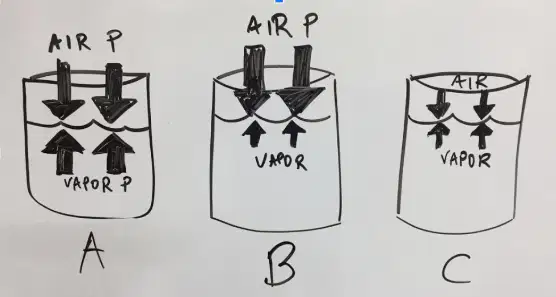
Which of these situations would the water be boiling at standard atmospheric pressure (by adding heat to make it boil)?
A
B
C
None of these are boiling
Which of these situations would the water be boiling at room temperature? (AKA inside a bell jar attached to a vacuum pump?)
A
B
C
None of these are boiling
What would be happening in situation B
Nothing at all
Evaporation, but no boiling
Boiling rapidly
It is impossible to tell
What is the lowest possible temperature (select all that are correct)
O C
O K
-273 K
-273 C
0 F
During the "can crusher" and "birthday candle" demonstrations. When the gas in the container was initially heated, what happened
Pressure increased
Pressure Decreased
Volume Increased
Moles of Gas Decreased (air or steam escaped)

