
Font size
 Worksheets
Diffusion and osmosis
Total questions: 19
Worksheet time: 12mins
Osmosis is the movement of ________ molecules from a ___________ to a _____________ solution across a partially permeable membrane. (type the 3 words below each separated by a space)
(a)
A membrane that lets smaller molecules pass through by not larger molecules is said to be ____________ ______________. (2 words)
(a)
A solution that has a high concentration of water is said to be (a) .
A concentrated solution has a __________ concentration of ____________________.
High. Dissolved substances.
Low. Dissolved substances.
High. Water.
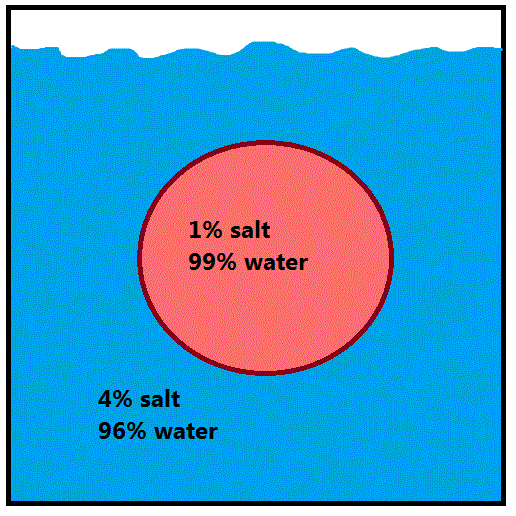
Where will the water go?
Into the cell
Out of the cell
Equally in & out - it's isotonic
There is no water
What happens to a plant cell when it is placed in a solution with a high water concentration?
The cell swells up and bursts.
The cell shrivels up.
The cell becomes plasmolysed.
The cell becomes turgid.
Which structure can prevent a plant cell from bursting when it gains water by osmosis?
Cell membrane
Cell wall
Vacuole
What could cause a plant cell to become plasmolysed?
Gain of water
Loss of water
Vacuole swelling up
A student noticed that placing wilted lettuce in a bowl of cool water caused the lettuce to become more crisp and firm. What is the best explanation for his observation?
water was absorbed into the lettuce cells
water moved into the lettuce cells by osmosis
salt moved out of the lettuce cells by diffusion
water moved out of the lettuce cells by osmosis
Diffusion is the movement of particles from a __________ to a ___________ concentration.
Higher. Lower.
Lower.Higher.
A high concentration gradient results in a __________ rate of diffusion/osmosis.
faster
slower
unchanged
A ________ surface area to volume ratio results in __________ diffusion.
large
small
faster
From fastest to slowest rate of diffusion, which of the following is in the correct sequence?
Solids, liquids, gases
Liquids, gases, solids
Gases, liquids, solids
Gases, solids, liquids
Diffusion requires energy
True
False
The movement of particles is __________, resulting in the particles being spread throughout the container
Structured
In a straight line
Random
In curved, way motions
What does a 'region with high concentration' mean?
An area with a SMALL number of particles
An area with a LARGE number of particles
An area with an UNEVEN number of particles
An area with no particles

