
 Worksheets
Separation of mixtures
Total questions: 24
Worksheet time: 22mins
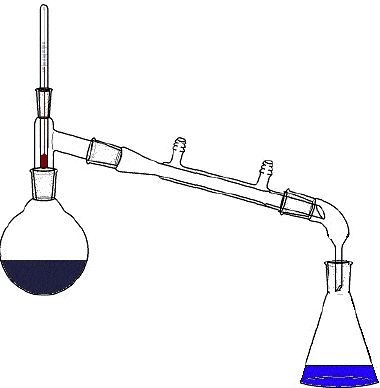
Which of the following methods of separation are we going to use to separate two liquids with different boiling points?
Filtration
Evaporation
Distillation
Decantation
Which of the following can be separated by Distillation?


Which of the following is the correct set-up of Filtration?


Which of the following mixtures can be separated by Evaporation?


What happens when salty water is boiled?
The salt becomes a new compound and water evaporates as it has a low boiling point
The water evaporates and the salt remains in the beaker as it has a high melting point
The water becomes a new compound and evaporates while salt remains in the beaker
The water will disappear and the salt remains in the beaker as it is a solid
What happens when sugar is mixed with water?
The sugar and water become a new compound that can be separated by crystallization
The sugar dissolves as it is a solid and can be separated by crystallization
The sugar and water become a mixture that can be separated by crystallization
The sugar and water become a mixture that can be separated by filtration
Which of the following is a correct statement about distillation
The components of the mixture have different densities
The components of the mixture have different melting points
The components of the mixture have different boiling points
The components of the mixture form a heterogeneous mixture
What is the correct order for obtaining salt from a mixture of sand and salt?
Dissolving in water - filtration – evaporation
Evaporation - filtration - dissolving in water
Filtration - dissolving in water - evaporation
Dissolving in water – evaporation - filtration
The formation of pure solid particles of a substance from a solution is called
filtration
crystallization
distillation
chromatography
THE SUBSTANCE THAT CAN BE SEPARATED BY PHYSICAL METHODS
ELEMENTS
COMPOUNDS
MIXTURES

When the solute dissolves into a solvent and disappears it is called a _____________.
mixture
solution
element
A substance made by mixing other substances together.
mixture
solution
solute
solvent
A substance that is being dissolved in a solvent.
mixture
solution
solute
solvent

Chromatography method
Floatation method
Distillation method
Filtration method
Which mixture can be separated using a filtration method?
oil and water
sand and iron powder
sand and water
water and ethanol
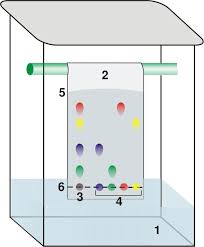
Dyes in water soluble markers may be separated by means of..
crystallization
sublimation
chromatography
sedimentation

The diagram shows the chromatogram for three colouring dyes and that for a brown marker. What dye(s) are contained in the marker's ink?
purple and green
purple and yellow
purple only
green and yellow

A mixture is a combination of elements where no ___________ reaction takes place
physical
chemical

