wayground logo

Free Printable Worksheets

Font size

S
M
L
XL
Worksheets

Chapter 7: Congruence and Similarity

Total questions: 35

Worksheet time: 2hrs 48mins

Name
Class
Date
1.

Given

ΔCDEΔFGH\Delta CDE\cong\Delta FGH  

which is true?

a)

DEFG\overline{DE}\cong\overline{FG}  

b)

CEFH\overline{CE}\cong\overline{FH}  

c)

CDGH\overline{CD}\cong\overline{GH}  

d)

DEFH\overline{DE}\cong\overline{FH}  

2.

Using the picture above, JL ?\overline{JL}\ \cong?  


a)

QR\overline{QR}  

b)

RS\overline{RS}  

c)

QS\overline{QS}  

d)

none of the above

3.

Using the picture above, what is the length of  BP\overline{BP}  ?

a)

7 m

b)

8 m

c)

10.6 m

d)

48°48\degree  

4.
∆ABC ≅ ∆LMN. Which statement is NOT true?
a)
LM ≅ AB
b)
∆CAB ≅ ∆NLM
c)
∠C ≅ ∠N
d)
BC ≅ ML
5.

6.) What is the scale factor of the dilation from A to B ?

a)

8

b)

2

c)

1/6

d)

1/3

6.

Which series of transformations were performed in the figure?

a)

Translation 5 units down, reflection over the y-axis

b)

Reflection over the x-axis, translation 6 units right

c)

Rotation 90o clockwise, reflection over the x-axis

d)

Rotation 180o clockwise, reflection over the y-axis

7.
One side of a triangle on the coordinate plane is 4 units long. If it undergoes a dilation about the origin with a scale factor of 2, what will the length be?
a)
2
b)
4
c)
8
d)
16
8.
Suppose a triangle with the vertices A(–2, 4), B(–1, –3), and C(4, –2) were dilated, with the center of dilation at the origin and with a scale factor of 2. What will be the coordinates of C'?
a)
(2, -1)
b)
(8, -4)
c)
(8, 4)
d)
(2, 1)
9.
Which of the statements is true about the graphed triangles?
a)
They are similar, because one can be obtained by dilating the other about the origin with a scale factor of 2.
b)
They are similar, because one can be obtained by dilating the other about the origin with a scale factor of 1/2.
c)
They are not similar, because one can be obtained by dilating the other about the origin with a scale factor of 2.
d)
They are not similar, because one can be obtained by dilating the other about the origin with a scale factor of 1/2.
10.

If you were to rotate ABCD 90° counterclockwise about the origin, what would the coordinate of A' be?

a)

(-5, 5)

b)

(-3, 5)

c)

(-5, 3)

d)

(-3, 3)

11.

Which transformations keep figures congruent?

a)

translation, reflection, and dilation

b)

reflection, rotation, and dilation

c)

dilation, translation, reflection, and rotation

d)

translation, reflection, and rotation

12.

What is the scale factor from MNOP to ABCD?

a)

2/3

b)

1/2

c)

3/2

d)

2

13.
Two objects that are the same shape but not the same size are _______.
a)
Congruent
b)
Vertical
c)
Similar
d)
Complementary 
14.

Two shapes that are the same size and same shape are

a)

Similar

b)

Congruent

c)

Corresponding

d)

Identical twins

15.

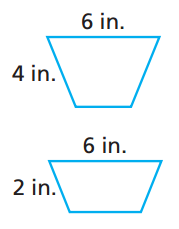
Are the following similar? Why or why not?

a)

Yes, they are both trapezoids

b)

No, they have different sizes

c)

No, the ratios of the corresponding sides are not equal.

d)

Yes, they have the same base and 4 angles

16.

The pair of figures is similar. Find the missing side.

a)

x = 20

b)

x = 12

c)

x = 5

d)

x = 4

17.
All corresponding sides are congruent in any similar figure.
a)
True
b)
False
18.
a)
Yes, similar
b)
No, not similar
19.
Name the series of transformations that maps ABC onto DEF
a)
reflect over x then translate left 6 up 1
b)
reflect over y then translate down 6 left 1
c)
translate right 6 down 1, then reflect over x
d)
rotate 90 clockwise then reflect over y
20.
Which transformation(s) create(s) similar figures?
a)
Dilation
b)
Translation, Reflection, and Rotation
c)
Translation and Reflection
d)
Reflection and Rotation
21.
Tell whether the two figures are similar. Explain your reasoning.
a)
Yes, similar because they are the same shape and side lengths are proportional.
b)
No, not similar because they are the same shape, but side lengths are not proportional.
c)
Yes, same shape
d)
No, different sizes
22.

Are the triangles similar? If so, what is the scale factor from ΔDEF to ΔABC?

a)

Yes. 1.5

b)

Yes. ⅔

c)

Yes. 2

d)

No.

23.

Select ALL the true statements about an image after a dilation.

a)

The image is a different shape than the preimage.

b)

The image is a different size than the preimage.

c)

The image has the same angle measures as the preimage.

d)

The image is similar to the preimage.

e)

The image has the same side lengths as the preimage.

24.

Triangle PQR is the image of triangle JKL after a dilation. Is the dilation an enlargement or a reduction? Explain.

a)

Enlargement, because the image is larger than the original figure.
b)

Enlargement, because the image is smaller than the original figure.

c)

Reduction, because the image is smaller than the original figure.

d)

Reduction, because the image is larger than the original figure.

25.

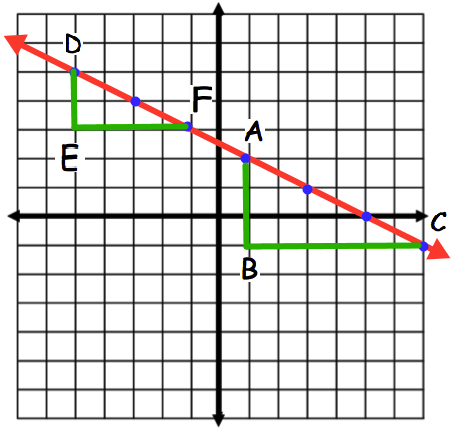
Identify the slope (AC) of triangle ABC.

a)

2

b)

1/2

c)

-2

d)

-1/2

26.

Triangles ABC and DEF are similar. The slope of triangle ABC is...

a)

1 which is the same as the slope of triangle DEF.

b)

3/4 which is the slope of hypotenuse of triangle DEF.

c)

4/3 which is the slope of triangle DEF.

d)

-1 which is the same as the slope of triangle DEF.

27.
What is the slope in the picture?
a)
Positive
b)
Negative
c)
Zero
d)
Undefined
28.
What is the slope in the picture?
a)
Positive
b)
Negative
c)
Zero
d)
Undefined
29.
What type of slope?
a)
undefined
b)
positive slope
c)
negative slope
d)
zero slope
30.
What type of slope?
a)
negative
b)
steep
c)
undefined
d)
zero slope
31.

Identify the type of slope.

a)

Positive

b)

Negative

c)

Zero

d)

Undefined

32.
Find the ratio (red to blue) of the area.
a)
11/6
b)
6/11
c)
121/36
d)
36/121
33.
Find the ratio (blue to red) of the perimeter.
a)
4/7
b)
7/4
c)
49/16
d)
16/49
34.

Two hexagons are similar with a scale factor of 4/5. If the area of the larger hexagon is 20, what is the area of the smaller hexagon?

a)

10.24

b)

12.8

c)

16

d)

25

35.

A figure is dilated by a scale factor of 4. Which of the following statements about the figure must be true?

a)

The perimeter and area are both multiplied by 4.

b)

The perimeter is multiplied by 4 and the area is multiplied by 16.

c)

The perimeter and area are both divided by 4.

d)

The perimeter is multiplied by 16 and the area is multiplied by 4.