wayground logo

Free Printable Worksheets

Font size

S
M
L
XL
Worksheets

Oceans and Landforms

Total questions: 51

Worksheet time: 47mins

Name
Class
Date
1.
Surface currents are mainly caused by
a)
The Coriolis Effect
b)
Cold and Warm Water
c)
Convection
d)
Wind
2.
What is represented at point 1?
a)
wave height
b)
wavelength
c)
crest
d)
trough
3.
What is represented at point 2?
a)
wave height
b)
wavelength
c)
crest
d)
trough
4.
What is represented at point 3?
a)
wave height
b)
wavelength
c)
crest
d)
trough
5.
What is represented at point 4?
a)
wave height
b)
wavelength
c)
crest
d)
trough
6.
What is the primary source of energy that generates most ocean waves?
a)
earthquakes
b)
wind
c)
asteriods falling in the ocean
d)
volcanic eruptions
7.
What is a trough?
a)
highest point on a wave
b)
lowest point on a wave
c)
longest point on a wave
d)
shortest point on a wave
8.
What is a crest?
a)
lowest point of a wave
b)
longest part of a wave
c)
shortest part of a wave
d)
highest point of a wave
9.
What is the distance between two waves?
a)
wave period
b)
wave frequency
c)
wave length
d)
wave height
10.
Stronger winds create __________ waves.
a)
larger
b)
smaller
11.

Valleys cut deep into the ocean floor

a)

Plankton

b)

Salinity

c)

Surface Current

d)

Ocean Trench

12.

Flat, deep, and smooth part of the ocean floor. Cold temperatures are found here.

a)

Continental Shelf

b)

Abyssal Plain

c)

Continental Slope

d)

Seamounts

13.

Amount of salt found in water

a)

Photic Zone

b)

Gulf Stream

c)

Photosynthesis

d)

Salinity

14.

Underwater Volcanoes and Mountains?

a)

Seamounts or Mid- Ocean Ridge

b)

Mountain Ridge

c)

Coastal Plains

d)

Abyssal Plains

15.

gently sloping shelf of land extending from the shoreline to the continental edge

a)

Continental Slope

b)

Continental Shelf

c)

Continental Rise

d)

Abyssal Plain

16.

Sharp underwater hill connecting the continent to the ocean floor?

a)

Ocean

b)

Coral Reef

c)

Plankton

d)

Continental Slope

17.
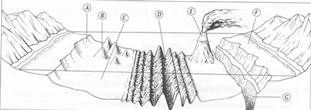
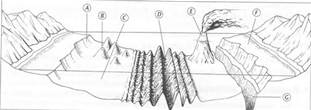
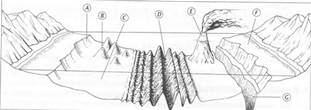
What is letter C pointing to? 
a)
abyssal plain
b)
seamount
c)
mid-ocean ridge
d)
continental shelf
18.
Letter D is pointing to the...
a)
continental slope
b)
continental shelf
c)
trench
d)
mid-ocean ridge
19.
Which letter is pointing to a trench?
a)
A
b)
D
c)
G
d)
B
20.
Letter A is pointing to the _______________________.
a)
Continental shelf
b)
Mid-ocean ridge
c)
Continental slope
d)
Trench
21.
Which letter is pointing to a volcanic island? 
a)
G
b)
F
c)
A
d)
E
22.

What is letter F pointing to?

a)

continental slope

b)

continental shelf

c)

abyssal plain

d)

sea mount

23.
What is letter C?
a)
Mid-Ocean Ridge
b)
Cont. Shelf
c)
Cont. Slope
d)
Abyssal Plain
24.
What is letter G?
a)
Mid-Ocean Ridge
b)
Rift
c)
Trench
d)
Cont. Shelf
25.
What is letter D?
a)
Cont. Shelf
b)
Mid-Ocean Ridge
c)
Volcanic Island
d)
Seamount
26.
What is the deepest part of the ocean basin?
a)
abyssal plains
b)
trenches
c)
rift zones
d)
mid-ocean ridge
27.
Mountains with openings in Earth's crust through which magma, gases, and ash reach Earth's surface
a)
volcano
b)
flood
c)
mountain
d)
weathering
28.
The process by which water, ice, wind or gravity moves weathered rock and soil from one place to another.
a)
weathering
b)
erosion
c)
deposition
d)
dumptruck
29.

The process of breaking up rocks on Earth's surface is known as what?

a)

sediment

b)

erosion

c)

weathering

d)

deposition

30.

Florida is a state with water on 3 sides. Florida is a....

a)

island

b)

ocean

c)

hill

d)

peninsula

31.

Shorelines don't change

a)

true

b)

false

32.

If waves reach the beach at an angle, the sand is moved along the coast.

a)

true

b)

false

33.

sponges are plants

a)

true

b)

false

34.

Which of the following does the most to change the shape of a barrier island?

a)

The growth of plants on the island.

b)

The rise in the temperature of the water during the summer.

c)

The high and low tides each day

d)

Waves hitting the island

35.

All ocean currents are found at the surface of the ocean.

a)

true

b)

false

36.
What are ocean tides?
a)
Long waves due to the gravitational pull of the moon only.
b)
Long period waves caused by wind.
c)
Short period waves caused by wind. 
d)
Long waves due to the gravitational pull between the Earth,sun and the moon
37.

A river of water that flows through the ocean is called a __________.

a)

current

b)

stream

c)

tide

d)

slope

38.

The regular, alternating rise and fall of the ocean’s surface level is _________.

a)

current

b)

tide

c)

slope

d)

stream

39.

The open space between barrier islands where water flows is called a(n) ______________.

a)

stream

b)

basin

c)

shelf

d)

inlet

40.

This is where the ocean meets the land.

a)

continental shelf

b)

continental slope

c)

coast

d)

abyssal plain

41.

As a wave gets closer to the shore, the bottom of the wave begins to slow down while the top continues to move at its original speed causing the top of the wave to topple over. This is called a/an __________.

a)

anchor

b)

breaker

c)

crest

d)

trough

42.

Which of these landforms are raised higher than the land around them (choose 2 answers)

a)

plains

b)

mountains

c)

hills

d)

valley

43.

Deep valley with high steep sides is usually formed by a river

a)

canyon

b)

hill

c)

mountain

d)

plain

44.

What is a valley?

a)

a very high piece of land

b)

land that has water all around it

c)

an area of flat land

d)

low land between mountains or hills

45.

What is a mountain?

a)

a very high piece of land

b)

an area of flat land

c)

low land between mountains or hills

d)

land that borders the sea or ocean

46.

What is an island?

a)

land that borders the sea or ocean

b)

land that has water all around it

c)

land with water touching 3 sides

d)

a body of water surrounded by land

47.

What is a plain?

a)

land that borders the sea or ocean

b)

low land between mountains or hills

c)

an area of flat land

d)

land with water touching 3 sides

48.

What is a river?

a)

a long body of water that flows across land

b)

a body of water surrounded by land

c)

a large body of salt water

d)

a sheltered area where ships can anchor safely

49.
A deep valley with steep sides eroded by a river.
a)
mountains
b)
hills
c)
canyon
50.
A small mountain, lower and less steep than a mountain.
a)
mountain
b)
hill
c)
earthquake
51.
A high, uplifted area with steep slopes.
a)
hills
b)
floodplain
c)
mountain