
NEW
Font size
 Worksheets
Lithosphere Test
Total questions: 52
Worksheet time: 4hrs 20mins

What is the correct order (starting from the surface) of Earth’s layers?
crust, outer core, inner core, mantle
mantle, outer core, inner core, crust
crust, mantle, outer core, inner core
outer core, inner core, crust, mantle
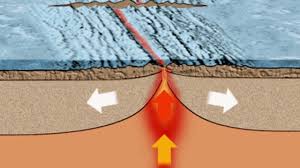
In sea-floor spreading, molten material rises from the mantle and erupts
along the edges of all the continents.
along mid-ocean ridges.
in deep-ocean trenches.
at the north and south poles.

The process by which the ocean floor sinks beneath a deep-ocean trench and back into the mantle is known as _______
convection.
continental drift.
subduction.
conduction.

Most geologists think that the movement of Earth’s plates is caused by _______
convection.
continental drift.
subduction.
conduction.
The geological theory of _______ states that pieces of Earth’s lithosphere are in constant, slow motion.
subduction
plate tectonics
deep-ocean trenches
sea-floor spreading
A place where two plates slip past each other, moving in opposite directions, is known as a _______
transform boundary
divergent boundary.
convergent boundary.
rift valley.

The place where two plates come together is known as a _______
transform boundary.
divergent boundary.
convergent boundary.
rift valley.

Below is a picture of sea-floor spreading. How are the ocean crusts moving?
Converging
Diverging
Sliding
No movement


What type of boundary is shown in the diagram?
Divergent
Convergent
Slide/Transform
The three types of plate boundaries are
Convergent, divergent, change
Divergent, allegiant, insurgent
Convergent, divergent, transform
Push, pull, slide
Hot fluid or semi-fluid material below or within the earth's crust from which lava and other igneous rock is formed on cooling.
Convection Current
Lithosphere
Core
Magma


Which arrow correctly shows the motion of the Juan de Fuca Plate? (HINT zoom in and use ESRT p5.)
1
2
3
4

Which location is a mantel hot spot? HINT (zoom in and use ESRT p5.)
A
B
C
D


The softest mineral on the Moh's Hardness Scale is:
talc
calcite
gypsum
corundum
Which type of rock is most likely to contain fossils?
granite
shale
gneiss
metaconglomerate

The rock shown above has a foliated texture and contains the minerals amphibole, quartz, and feldspar arranged in coarse-grained bands. Which rock is shown?
slate
dunite
gneiss
quartzite
Which physical characteristic best describes the rock phyllite?
glassy texture with gas pockets
clastic texture with angular fragments
bioclastic texture with cemented shell fragments
foliated texture with microscopic mica crystals
Slate is formed by the
foliation of schist
metamorphism of shale
deposition of chlorite and mica
folding and faulting of gneiss
Which rock was subjected to intense heat and pressure but did not solidify from magma?
sandstone
schist
gabbro
rhyolite

Gold, silver and copper are examples of minerals that have ______________________ luster.
metallic
nonmetallic
Which igneous rock is an extrusive rock?
porphyry
rhyolite
pegmatite
granite
Igneous rocks form from
Heat and Pressure
Melting and Solidification
Compaction and Cementation
Weathering and Erosion
Sedimentary rocks form from
Compaction and Cementation
Melting and Solidifcation
Weathering and Erosion
Heat and Pressure
Metamorphic rocks form from
Heat and Pressure
Weathering and Erosion
Compaction and Cementation
Melting and Solidification
Sediments are formed from
Compaction and Cementation
Weathering and Erosion
Melting and Solification
Heat and Pressure
The transformation of existing rock types, in a process called ____________.
sediments
Remnant
metamorphism
weathering

Which minerals will bubble with acid?
Calcite and Halite
Halite and Olivine
Calcite and Dolomite
Talc and Garnet

Which mineral has a metallic luster?
galena
sulfur
talc
biotite mica

