
 Worksheets
UNIT 1 ECOLOGY (REVIEW)
Total questions: 50
Worksheet time: 38mins
New fuels are being produced by converting corn and grass into compounds containing alcohol that can be broken down for energy in various engines. The purpose of this research is to
reduce the use of nonrenewable resources.
increase the rate of air pollution.
reduce the rate of homeostasis in organisms.
cause a loss of biodiversity in the rain forests.

The original source of energy for a food web is...
plants
sun
producers
decomposers

Decomposers get energy from...
the sun
eating plants
eating animals
dead things and waste

Producers are ...
plants
able to do photosynthesis
also called autotrophs
all of these are true
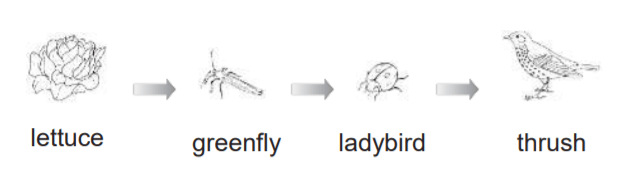
Who is the producer?
lettuce
greenfly
ladybird
thrush

Which of the following is NOT a consumer
grass
dog
shark
fish


If there is 2000 kcal of energy in this particular ecosystem, how many kcal of energy will be available for hawk?
(a)
The amount of organisms that an ecosystem can support is known as (a)

What is the carrying capacity of this graph?
1-15 years
2300
21 years
500

What happened to the animal's population?
It decreased and they are at a lower carrying capacity
They evolved to be smaller and need less food
The are extinct
They went to a lower area where there was no competition

When a population grows past the ecosystem's carrying capacity, what happens to the population?
Continues to grow
The population starts to die off to return to carrying capcity
The population will go extinct due to lack of resources
The population grows then finds a new carrying capacity
In this aquatic biome, salt and freshwater mix.
salt water
sea
ocean
estuary
Which type of consumer is primarily located in trophic levels 3 & 4?
carnivore
omnivore
herbivore
scavenger
Which organism is the base of the food chain and supports the whole ecosystem?
Producer
Consumer
Heterotrophs
Carnivore
What is the carrying capacity of an ecosystem?
The number of organisms that the ecosystem can support and all their needs will be met. The line on the graph where it levels out and stays straight.
A chain of organisms in which each link feeds on the one ahead and is eaten by the one behind.
The non-living factors which affect the system - for example weather, natural disasters, drought
A symbiotic relationship in which one member is benefited and the second is neither harmed nor benefited.

What is the correct order for this food chain?
Owl, Mouse, Grasshopper, Grass
Grass, Mouse, Owl, Grasshopper
Grass, Owl, Grasshopper, Mouse
Grass, Grasshopper, Mouse, Owl

What is the hawk in the food web?
Producer
Primary consumer
Secondary consumer
Tertiary consumer

What would happen to the bird if the green fish died out?
the bird population would grow
the bird population would die out
the smaller fish will die out
What would happen if their were no producers?
Every population would grow larger
Everything would die out
The animals would make their own food
Where do producers get their energy from?
The sky
The sun
The ground
Area in a body of water where it is cool and dark and bottom-feeders are located.
Littoral Zone
Benthic Zone
Limnetic Zone
In order for population to grow
death rate must be higher than birth rate
heart rate must be lower than death rate
birth rate must equal death rate
birth rate must be higher than death rate

What is a Biotic Factor?
The carrying capacity of an ecosystem
A NON-living factor that can affect an ecosystem
A living factor that can affect an ecosystem
What is an Abiotic Factor?
A NON-living factor that can affect an ecosystem
A living factor that can affect an ecosystem
The carrying capacity of an ecosystem

What is the DEPENDENT variable (effect) in this experiment?
"Does eating breakfast improve test scores?"
eating breakfast or not
the grade you got on the test
what time you get up in the morning
how tasty the breakfast is

A student wants to test the hypothesis of "If salt is added to water then the boiling point of water will decrease (go down)." What is the independent variable?
Whether salt is added or not
Boiling Point
Amount of water


Plants use ____________ to make their own food
Water
Sunlight
Carbon dioxide
All of these

How much did you like UNIT 1 content?
What is it called when rainwater contributes to the flow of rivers and streams?
Transformation
Runoff
Irrigation
Desertification


The process where water soaks into soil or porous rock.
runoff
percolation
transpiration
evaporation



