
 Worksheets
Chem II/AP Unit 6 Review
Total questions: 23
Worksheet time: 56mins
Which of the following statements is held true about the common-ion effect on the equilibrium of solubility of salt ?
(you may choose more than one answer)
Adding common-ion to the solution containing dissolved salt cause the solubility equilibrium shifts to the formation of undissolved salt
Adding common-ion to the solution containing dissolved salt cause the numerical value of Ksp of corresponding salt changes
Solubility of salt in solution containing common-ion is greater than that of pure water.
Consider a beaker containing 100 ml of water, with solid AgCl on the bottom.
Which of the following statements is held true if NaCl is added to the solution?
(you may choose more than one answer)
The amount of AgCl solid at the bottom of the beaker increases
The amount of AgCl solid at the bottom of the beaker decreases
The concentration of dissolved Ag+ ion in the solution stays the same
The concentration of dissolved Ag+ ion in the solution changes
Which of the following effect increase the solubility of Ca(OH)2 ?
Ca(OH)2(s) ↔ Ca2+(aq) + 2OH-(aq)
(you may choose more than one answer)
Adding solid NaOH
Adding an acid solution
The pH of solution is adjusted to be below 7
Adding solid CaCl2
At which solution will AgBr have the lowest molar solubility ?
(Ksp AgBr =5 x 10-13)
AgBr(s) ↔ Ag+(aq) + Br-(aq)
0.5 M AgNO3 solution
0.5 M NaBr solution
0.5 M AgClO4 solution
0.5 M MgBr2 solution
At which solution will Al(OH)3 have the highest molar solubility ?
(Ksp Al(OH)3 =1.3 x 10⁻³³)
Al(OH)3(s) ↔ Al3+(aq) + 3OH-(aq)
buffered solution of pH 9
0.01 M NaOH solution
0.01 M Sr(OH)2 solution
0.01 M AlCl3 solution
At which solution will Zn(OH)2 have the lowest molar solubility ?
(Ksp Zn(OH)2 =1.2 x 10⁻²⁷)
Al(OH)3(s) ↔ Al3+(aq) + 3OH-(aq)
buffered solution of pH 12
10-3 M KOH solution
10-3 M ZnCl2 solution
10-2 M ZnSO4 solution

A
B
C
D
E

A
B
C
D
Ascorbic acid, H2C6H6O6(s), is a diprotic acid with K1 = 7.9 × 10⁻⁵ and K2 = 1.6 × 10⁻¹². In a 0.005 M aqueous solution of ascorbic acid, which of the following species is present in the lowest concentration?
H3O+(aq)
H2C6H6O6(aq)
HC6H6O6-(aq)
C6H6O62-(aq)
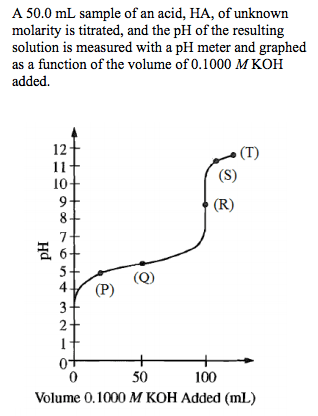
Which point on the titration curve corresponds to the point at which the moles of the added strong base are equal to the moles of the weak acid initially present?
Q
R
S
T
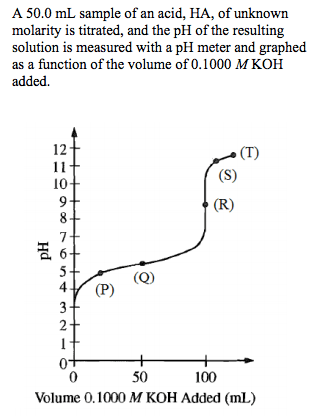
At point P in the titration, which of the following species has the highest concentration?
HA
A–
H3O+
OH–
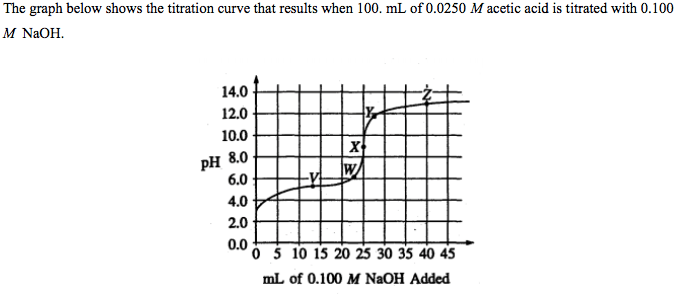
What part of the curve corresponds to the optimum buffer action for the acetic acid/acetate ion pair?
Point V
Point Z
Along all of section WY
Along all of section YZ
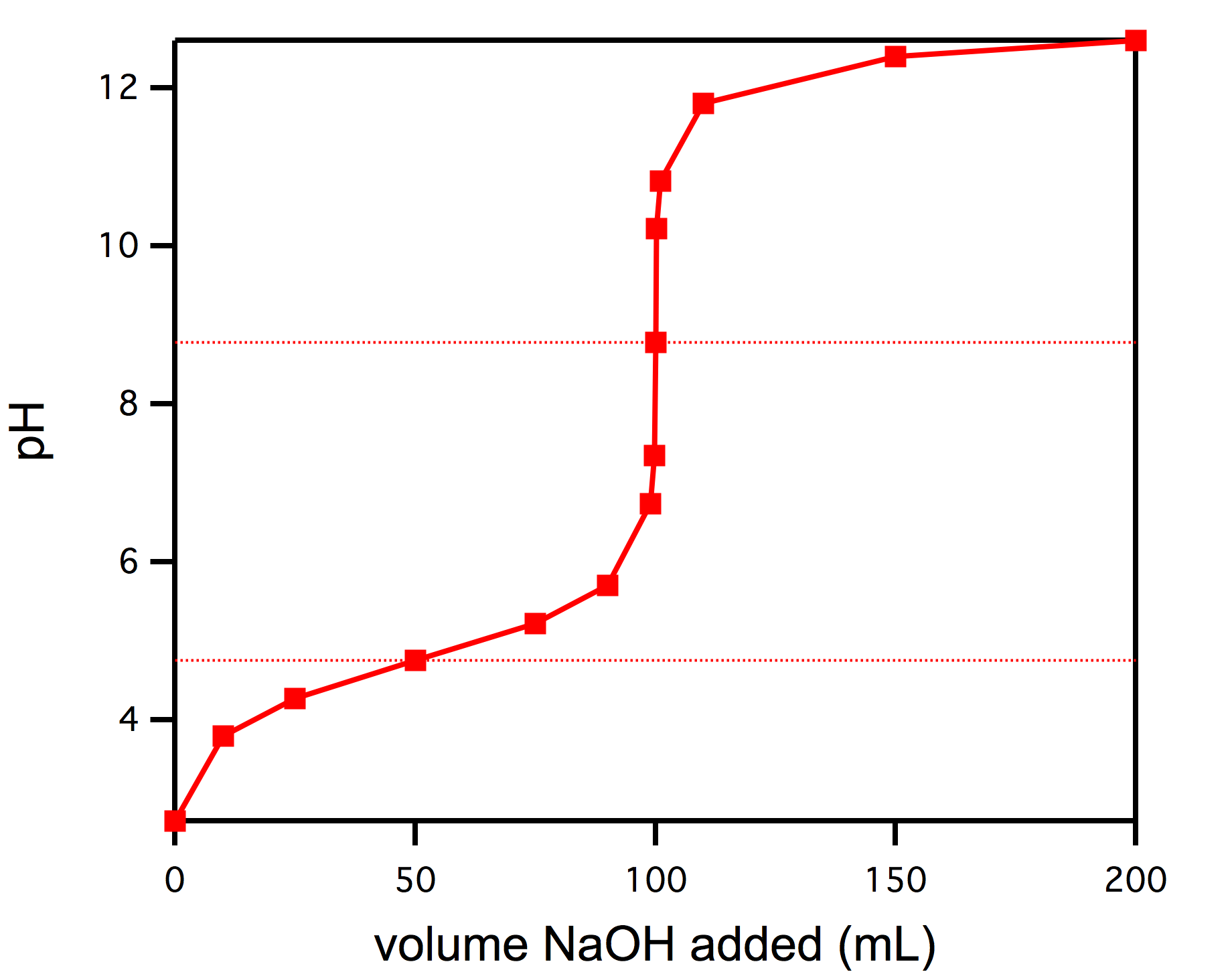
What is the pH at the equivalence point.
The pH is approximately 5
The pH is approximately 6
The pH is approximately 8
The pH is approximately 9
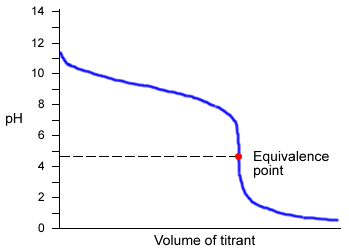


Which of the following statements ARE TRUE about buffer solution?
(you may choose more than one answer)
pH of buffer solution will never change despite addition of small amount of base or acid
Buffer can be made by mixing weak acid and salt of its conjugate base or by mixing weak base with salt of its conjugate acid
Buffer has acid and base components that can work specifically to resist pH change
the closer the concentration of weak acid to the concentration of it is conjugate base, the less effective the buffer to resist pH change
What is the role of an indicator in a reaction?
To help reactants react successfully.
To bind to the analyte to form a products.
To show when the reaction has reached or past the equivalence point.
To provide a surface for the reaction to occur.
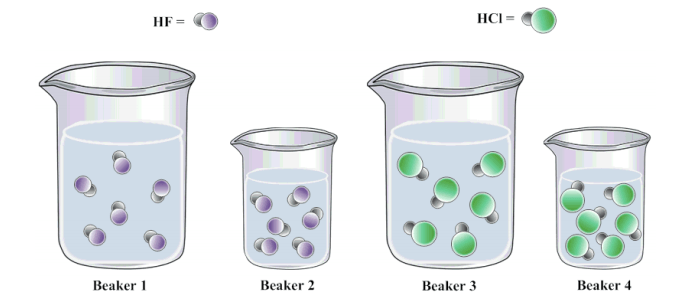
Equal moles of the indicated acids are dissolved in the amounts of water shown in the beakers below. In which solution will the percent ionization of the acid be the lowest?
Beaker 1
Beaker 2
Beaker 3
Beaker 4

