wayground logo

Free Printable Worksheets

Font size

S
M
L
XL
Worksheets

Evolution Practice Quiz

Total questions: 45

Worksheet time: 42mins

Name
Class
Date
1.
The gradual change in a species over time is called
a)
mutation.
b)
evolution.
c)
migration.
d)
variation.
2.
Which term refers to the process by which individuals that are better adapted to their environment are more likely to survive and reproduce?
a)
natural selection
b)
overproduction
c)
competition
d)
variation
3.

How does natural selection lead to evolution?

a)

Stronger offspring kill weaker members of the species.

b)

Helpful variations accumulate among surviving members of the species.

c)

Overproduction provides food for stronger members of the species.

d)

Environmental changes favor weaker members of the species.

4.

What is a change in an organism that allows for it to survive in its environment?

a)

homologous

b)

vestigial

c)

variation

d)

adaptation

5.
Which of the following is NOT an example of natural selection? 
a)
People selectively breeding hamsters.
b)
Insect populations developing resistance to certain pesticides.
c)
Bacteria becoming resistant to antibiotics.
d)
Male birds of certain species developing colorful feathers to attract female mates.
6.
Who was the naturalist that traveled the world to study plants and animals?
a)
Albert Einstein
b)
Charles Darwin
c)
Charles Barkley
d)
Isaac Newton
7.
What increases genetic variation when animals move  from one population to another
a)
genetic drift
b)
sexual selection
c)
bottleneck effect
d)
gene flow
8.

Two organisms are considered to be different species if —

a)

they have different body colorings

b)

they live in different locations

c)

they cannot interbreed and produce fertile offspring

d)

are different in size

9.

Members of the same species that live in the same area and compete for resources is referred to as a —

a)

population

b)

genus

c)

community

d)

pack

10.

What effect can bottleneck events have on populations that have nearly become extinct?

a)

Bottleneck events lead to increased gene flow and genetic diversity.

b)

Bottleneck events have no impact on populations that have nearly become extinct.

c)

Bottleneck events lead to the founder effect and eventually increase genetic diversity.

d)

Bottleneck events reduce the size of the population and greatly reduce genetic variation.
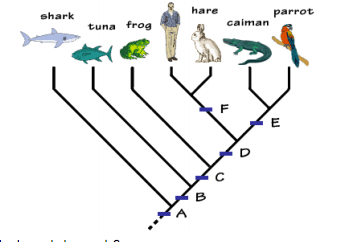
11.
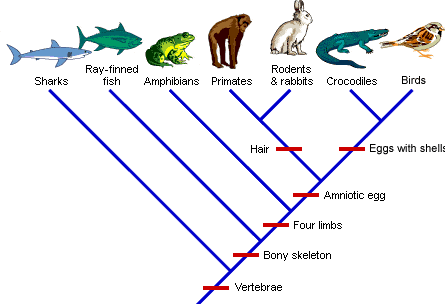
On the cladogram, which organism is the closest relative of the human?
a)
Frog
b)
Hare
c)
Caiman
d)
Parrot
12.
According to this cladogram, birds are LEAST related to: 
a)
Amphibians
b)
Sharks
c)
Ray Finned Fish
d)
Crocodiles
13.

Sexual selection is when the male and female of the same species evolve different traits. Which below is NOT an example of sexual selection?

a)

Peacocks have large and colorful tails to attract mates.

b)

Animals have specific colors that signal that they are dangerous.

c)

Male deer have antlers to show their health and compete for females.

d)

Many male birds are colorful and have funny dances to attract mates.

14.

Which is NOT one of the 5 mechanisms of evolution?

a)

Mimicry

b)

Gene Flow

c)

Genetic Drift

d)

Mutation

15.

In the moth mimicry video and activity. What did the moths do to avoid being eaten by bats?

a)

Used camouflage

b)

Were only active during the day

c)

Gave off a bad smell

d)

Made sound

16.

Which is NOT a recent human adaptation?

a)

Lactase persistance

b)

Resistance to HIV

c)

Sickle Cell making resistance to malaria.

d)

All are recent human adaptations

17.

In the rock pocket mouse example. What two mechanisms of evolution are at work to change the brown mice to black on the lava flows?

a)

Gene Flow and Mutation

b)

Natural Selection and Genetic Drift

c)

Mutation and Natural Selection

d)

Sexual Selection and Mutation

18.

Which below are considered evidence that evolution has and continues to occur.

a)

The fossil record

b)

Homologous structures

c)

DNA and protein evidence

d)

All of the above

19.

Which statement below is true related to evidence for evolution?

a)

The fossil record is really old and not complete so cannot be used to measure evolution.

b)

There is no current studies or evidence that evolution is continuing

c)

Mutation occurs in all living things and can cause changes in species, even viruses.

d)

Natural selection happens too slow and cannot be measured.

20.
The table shows the survival rate of two types of beetles in the same environment over a period of three years.  

Which statement about the beetles in this environment is best supported by the data?
a)
Brown beetles have a shorter life cycle than green beetles have
b)
Green beetles are more fit for their environment than brown beetles
c)
 brown beetles are undergo more unfavorable mutations than green beetles
21.
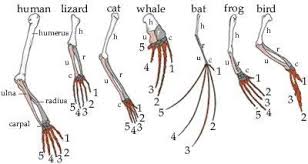
The similarities of the bones in the diagram provide evidence that---
a)
The organisms shown lived in the same natural envionrment
b)
The organisms shown may have developed from a common ancestor
c)
The organisms shown have the same genetic diseases
d)
All vertebrate species have identical forelimbs
22.
What is a Vestigial Structure?
a)
Structures that have a common function and suggest common ancestry
b)
The traits of organisms that result from sharing a common ancestor: such traits often have similar embryological origins
c)
genetically determined structures or attributes that have apparently lost most or all of their ancestral function in a given species
d)
I don't know :(
23.
Which two species are most related?
a)
B&C
b)
A&B
c)
A&C
d)
C&B
24.

How does the adaptation of mimicry help organisms to survive?

a)

They are less likely to be attacked by a predator

b)

They look prettier than other organisms

c)

They can find food more easily

d)

They can have more offspring

25.
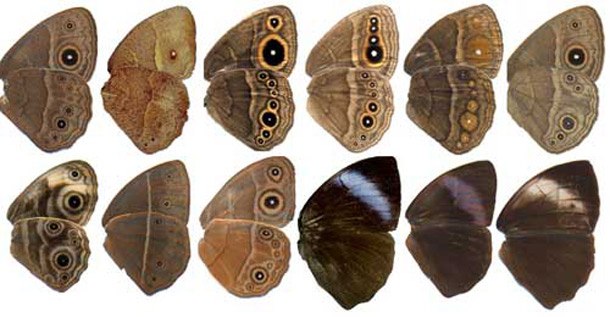
These moths are all the same species. The differences between their wings is an example of ________________
a)
Natural Selection
b)
Variation
c)
Homeostasis
d)
Extinction
26.
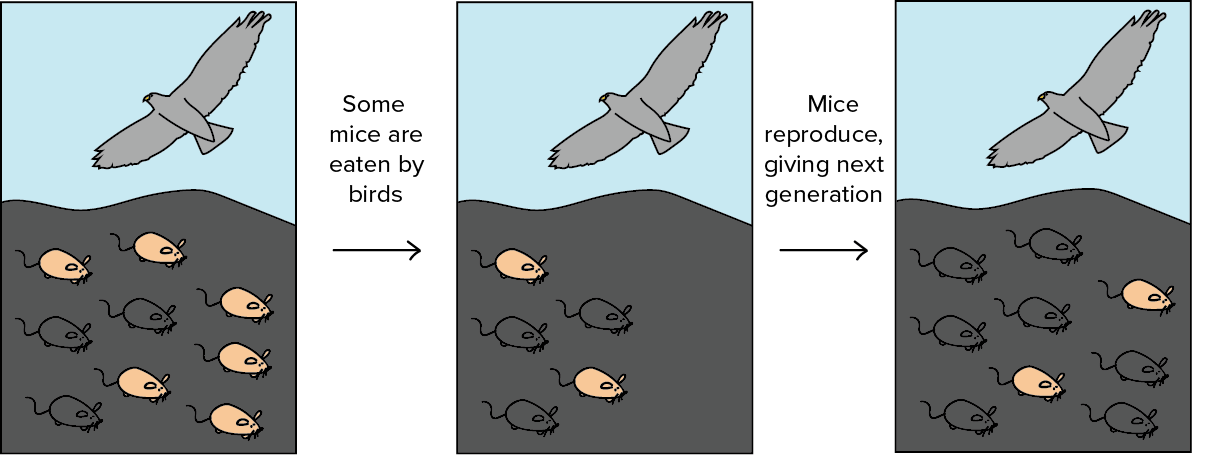
Why is the mouse population changing over time?
a)
The light mice can reproduce more successfully than the dark mice
b)
The hawks eat more dark mice than light mice because the dark mice taste better
c)
The hawks eat more light mice than dark mice because they can see the light mice more easily
d)
The hawks eat more dark mice than light mice because they can see the dark mice more easily
27.

What concepts are involved in natural selection? Select all that apply.

a)

Overproduction of offspring

b)

Variation

c)

Struggle for survival

d)

Differential survival and

reproduction

28.

In natural selection, _________ choose(s) the best traits. In artificial selection, __________ choose(s) the best traits.

a)

the environment; humans

b)

humans; the environment

29.

What is true about the finches of the Galapagos and the graphs?

a)

The beak of the finch get's larger in 1978.

b)

This is an example of directional selection.

c)

The beaks changed due to natural selection.

d)

All are true.

30.

Which of the following graphs shows Disruptive Section?

a)

1

b)

2

c)

3

31.

What evidence of evolution involves the study of rock layers?

a)

Fossils

b)

Comparative anatomy

c)

Comparative embryology

d)

Comparative biochemistry

32.
What is this an example of?
a)
vestigial structures
b)
embryology
c)
homologous structures
d)
fossil record
33.
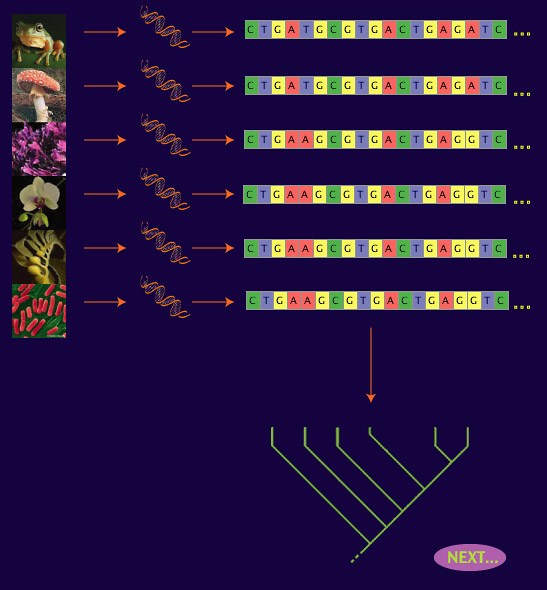
Two organisms that are closely related would have
a)
very similar DNA sequence
b)
exactly the same DNA sequences
c)
no proteins in common
d)
completely different DNA sequence
34.
The opossum and kangaroo both incubate their young in a pouch. This provides evidence that they---
a)
are descended from a common ancestor
b)
Have very similar skeletal structures
c)
belong to the same species
d)
must range great distances to eat
35.
The similarities of the bones in the diagram provide evidence that---
a)
The organisms shown lived in the same natural envionrment
b)
The organisms shown may have developed from a common ancestor
c)
The organisms shown have the same genetic diseases
d)
All vertebrate species have identical forelimbs
36.
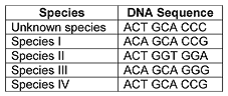
According to this data, the unknown bacterial species is most closely related to: 
a)
Species I
b)
Species II
c)
Species III
d)
Species IV
37.

The fossil record help scientists

a)

better understand the kinds of organisms that lived in the past

b)

better understand how the environment has changed over time

c)

better understand how organisms have evolved over time

d)

all of the above

38.
How do fossils provide evidence that evolution has happened on Earth?
a)
Fossils show how the sizes of certain animals has changed drastically over millions of years
b)
Fossils show that some species have gone extinct
c)
Fossils show how life forms present today are different than those from the past
d)
Different sedimentary rock layers provide evidence for how the environment has changed over time
39.
The diagram illustrates an embryonic stage of two organisms.

Which of the following can be determined by observing the embryos shown in the diagram
a)
The organisms share a common ancestry.
b)
The organisms belong to the same genus.
c)
The organisms are native to the same geographic areas.
d)
The organisms will grow into anatomically similar adults.
40.

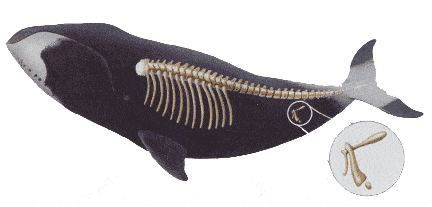
What best describes the hind leg bones seen in the whale?

a)

The bones are analogous structures to the fins of living fish.

b)

The bones are vestigial structures that had a function in an ancestor.

c)

The bones are homologous structures to the wings of butterflies.

d)

The bones are fossil structures from an extinct ancestor.

41.

_______________ occurs when a population declines to a very small number then goes back up but results in a permanent loss of genetic diversity in the population (example: the Cheetah population)

a)

coevolution

b)

bottleneck

c)

archaeopteryz

d)

mutation

42.
A few deer wander out of their native woods into a completely new park where no deer had ever been before. They go on to create an entirely new population.
a)
Genetic Drift
b)
Natural Selection
c)
Non-random mating
d)
Mutation
43.
Which of the following is true?
a)
Gene pool frequencies do not change as a result of migration in or out of a population.
b)
Gene flow occurs only as a result of isolation of a small population.
c)
Gene flow can cause new alleles to enter a population's gene pool.
d)
Gene flow is due the the selection of the most favorable traits.
44.

All the possible gene combinations in a population.

a)

allele

b)

gene pool

c)

genome

d)

mitosis

45.

A population of salamanders, 50% of whom were spotted, decreased from 500 to only 100 in just a few months when a drought dried up much of the lake they inhabit. The remaining population had a much higher frequency of spotted than non-spotted salamanders compared with the original population. The most likely cause for this change is -- 

a)

Natural Selection

b)

Gene Flow

c)

Mutation

d)

Genetic Drift