
NEW
Font size
 Worksheets
Energy test
Total questions: 25
Worksheet time: 12mins
The force at the top of a roller coaster hill, before it starts to descend is:
gravitational velocity
gravitational kinetic energy
gravitational potential energy

Where is potential energy the GREATEST on a roller coaster?
At the bottom of the first hill
At the top of the first hill (letter A)
Half way down the first hill (letter B)
At the very bottom of the track (letter E)
Somewhere in the middle (letter D)

What type of energy is being described?
As the speed of an object increases, this energy is increasing.
Kinetic Energy (energy of movement/motion)
Potential Energy (energy due to position)
Radiant Energy (light)
Nuclear Energy (atomic level)

When the roller coaster car starts rolling down the first hill, the energy transformation is ______.
Elastic potential to kinetic
Kinetic to gravitational potential
Gravitational potential to kinetic
Chemical potential to kinetic

Which of the following BEST describes the change in energy that occurs as a roller coaster travels from position X to position Y?
Kinetic energy increases while potential energy decreases.
Kinetic energy decreases while potential energy increases.
Kinetic energy increases and potential energy increases.
There is no change in energy.
Radiation is a method of thermal energy transfer. It refers to the transfer of heat energy that moves–
through empty space.
when objects touch.
only through solids.
in the motion of fluids.
Which of the following is an example of a situation in which an egg is receiving thermal energy through convection?
Which of the following is an example of a situation in which an egg is receiving thermal energy through convection?
An egg is fried in a metal pan on the stove.
An egg cracked on a hot sidewalk starts to cook.
The egg is cooked in a pot of water on the stove.

A student is melting a sugar cube over a flame, as shown in the picture provided. What energy transfer is causing the sugar cube to melt?
Candle to spoon – conduction
Spoon to sugar cube – conduction
Candle to spoon – radiation
Spoon to sugar cube – conduction
Candle to spoon – conduction
Spoon to sugar cube – convection
Candle to spoon – convection
Spoon to sugar cube – conduction
Transfer of energy through circular motion caused by heating and cooling in fluids (liquids and gases).
Conduction
Convection
Radiation
Conductors
When ice cubes melt in a glass of water, a current forms in which heat moves from particles with more heat to particles with __________________ heat.
more
equal
less
What do you need to add to kinetic energy in order to find an object’s mechanical energy?
Initial Energy
Gravitational Energy
Thermal Energy
Potential Energy

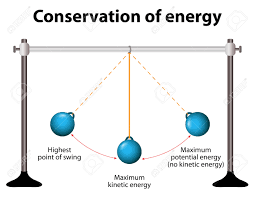
What happens when the ball goes from the highest position to the lowest position
PE and KE increases and decreases together
Impossible to know without knowing the mass of the object
the PE decreases while KE increases
This is the standard unit for measuring energy.
Joules
Newtons
Matter
Mass
If two marbles are rolled down a ramp from some height towards a container the _______ marble will move the container farther because it possess more _________ energy as it approaches the end of the ramp.
heavier, kinetic
heavier, potential
lighter, kinetic
lighter, potential

Within the alarm clock seen here, energy is transformed. It is time to get up! The alarm clock goes off. What are the energy transformations taking place in your alarm clock?
electrical to magnetic to sound
electrical to mechanical to sound
electrical to mechanical to light
chemical to electrical to mechanical
Maria’s father started a fire in the fireplace. He crumpled some paper, lit a match, and soon the logs in the fireplace were burning. In this case, the stored chemical energy in the logs was changed into
electrical energy.
mechanical motion.
heat and light energy.
electrical and heat energy.
Conduction occurs more easily between solids and liquids. This is because the particles in gases are
farther apart and move faster.
closer together and move faster.
further apart and move more slowly.
closer together and move more slowly.

A drawn bow possesses mechanical energy in the form of _______________. After the arrow is released, the energy is transformed into _________________.
potential energy; mechanical energy
elastic potential energy; kinetic energy
gravitational potential energy; kinetic energy
elastic kinetic energy; mechanical kinetic energy

How would you describe the relationship between the mass of a car and its kinetic energy?
As the mass of a car increases, its kinetic energy increases.
As the mass of a car increases, its kinetic energy decreases.
As the mass of a car decreases, its kinetic energy increases.
There is no clear relationship between mass and kinetic energy.

In the figure, potential energy is being converted into kinetic energy from
point A to point B
point B to point C
The only energy involved here is kinetic.
Energy is not being converted.

What type of energy transformation occurs, when a hawk eats a mouse and then uses the energy from the mouse to fly?
mechanical energy to chemical energy
thermal energy to mechanical energy
chemical energy to mechanical energy
mechanical energy to thermal energy


