
 Worksheets
8th Grade STAAR Review
Total questions: 97
Worksheet time: 1hrs 27mins
In forming a new government, which group of politicians felt that the federal gov't was too strong and the states should have more power? They wouldn't ratify the U.S. Constitution without a Bill of Rights.
Whigs
Anti-federalists
Democrats
Federalists

Which Amendment protects rights to own guns?
4th Amendment
2nd Amendment
9th Amendment
5th Amendment

Signed by many Pilgrims when they landed in Plymouth, Massachusetts in 1620, this helped establish the idea of "Self-Government"
Magna Carta
English Bill of Rights
Mayflower Compact
Virginia House of Burgesses

These colonies were settled by the Pilgrims in 1620 and Puritans in 1630 to escape religious persecution in England
Middle Colonies
New England
Southern Colonies
Canada
The Thirteenth Amendment to the U.S. Constitution affected the lives of millions of African Americans by —
providing them with voting rights
guaranteeing their freedom of speech
providing them with access to the court system
guaranteeing their permanent freedom from slavery

The innovation shown in this photograph (invented by Robert Fulton) most affected the U.S. economy by
decreasing the need for canals
allowing more efficient movement of goods
reducing the costs of settling in western territories
transporting workers from southern states to northern states
The Second Great Awakening was a movement that promoted ....
spiritual and religious revival and the need for social reform
the use of reason and scientific theory
states’ rights and governmental reform
mercantilism and the development of global trade

As head of the Executive Branch, what responsibility or title does the president of the U.S. hold while in charge of the military?
Chief of State
Commander in Chief
Chief of Party
Chief of Armed Forces

Which territorial gain that was bought from France in 1803, gave the United States control of the Mississippi River, and was very important in transporting goods?
Texas Annexation
Mexican Cession
Gadsen Purchase
Louisiana Purchase

This harsh and painful event during the Revolutionary War gave the colonial army (led by George Washington) confidence, training and skills to eventually defeat the British Army?
Winter at Valley Forge
Trail of Tears
Battle of Lexington / Concorde
What was the journey enslaved Africans made from Africa to North America called?
Triangular Trade
Middle Passage
Underground Railroad
African Journey
The New England colony's economy was based on _________________________.
farming grains
plantations
Shipbuilding, fishing and whaling, and trade
gold mining
Long coastlines offered abundant natural resources
proximity to flooding rivers limited development
natural harbors and port cities provided access to markets
extreme climates limited productive activity
Cheap labor was provided by these workers in U.S. factories and in building the transcontinental railroad here in America.
Native Americans
foreign immigrants
indentured servants
slaves
Major towns and cities were established along these waterways as the United States expanded westward during Manifest Destiny.
The Appalachian Mountains
oceans
rivers and canals
transcontinental railroad
Why were the 1st and 2nd Continental Congress' held?
To vote for the first president
To decide when to go to war with Great Britain
To discuss a solution to the colonists’ complaints/grievances of Great Britain's King George III
To write the Constitution
The Great Compromise combined the New Jersey Plan and the Virginia Plan (a bicameral legislation), created what type of legislative setup in Congress?
two houses were created, both with representation based on population
Representation in Congress was equal
Representation in Congress was based upon population
two houses were created, one with equal representation per state and the other with representation based on state population
These are rights that cannot be taken from the people. John Locke stated that people are born with the rights for life, liberty and the pursuit of happiness.
Unalienable Rights
Popular Sovereignty
Social Contract
Natural Rights

What was stated in the Proclamation of 1763?
Colonists were BANNED from settling west of the Appalachian Mountains.
The Proclamation ended the French and Indian War.
Colonists were ENCOURAGED to begin settling west of the Appalachian Mountains.
The Proclamation proclaimed independence for the American colonists.
Under the Northwest Ordinance (as the country expanded westward and new states were made), this practice was not allowed in the new states.
immigration labor
slavery
child labor in factories
public school systems

One warning President George Washington gave in his Farewell Address is
never change the Constitution
create stable political parties
take on reasonable amounts of debt, and only for war
do not make permanent alliances with foreign countries (remain neutral)

How did Alexander Hamilton's Financial Plan include a provision to help the United States get out of debt?
he passed the Embargo Act
allow Britain to build factories in the North
created a national bank
have states pay their debts over the course of ten years


The MAIN reason political parties formed in the United States was a difference between the federalist and anti-federalist questioning ...
how slavery was becoming an issue in the southern states
how much power should rest with the federal government
if the Northwest Ordinance unfairly divided the Northwest Territory
who our first president should be
Guarantees the freedom of speech, religion, press (printed articles) and to peacefully assemble.
1st Amendment
3rd Amendment
5th Amendment
7th Amendment
Forbids excessive fines and cruel and unusual punishments
2nd Amendment
4th Amendment
6th Amendment
8th Amendment
Where did Mormons migrate to in order to escape religious persecution for their religious beliefs?
Colorado
California
Utah
Wyoming

Who was Horace Mann?
leader of abolitionism
leader of the temperance movement
leader of the evil empire
Leader of the education reform movement

What was the temperance movement?
A Reform movement that wanted to ban the sale and consumption (drinking) of alcohol
Reform movement that fought for women's equal rights
Reform movement that improved care for the disabled
Reform movement that improved care of prisoners

What was the abolition movement?
A movement to abolish sales and consumption (drinking) of alcoholic beverages
A reform movement to end slavery
A reform movement to improve education
Immigrants who came to America to build the railroad

the religious group that wrote the Mayflower Compact
Religious group that believed in equality & the end of slavery.
A religious group that created Quaker's Outmeal & believes the internet is inherently evil.
A religious group that settled in Utah

Dorothea Dix:
was a leader of the prison reform movement and improved care for the mentally disabled.
helped in education reform.
was an abolitionist
was a student at the Hudson River School of Art
A certain small town has many choices for people who want to attend religious services, including two churches, a synagogue, a cathedral, a mosque, and a temple. These choices are protected by the —
1st Amendment
3rd Amendment
Sixth Amendment
4th Amendment
___________ was a document written by Thomas Jefferson, declaring the colonies free from Britain and setting out grievances against the King.
Magna Carta
Constitution
Mayflower Compact
Declaration of Independence
Written in 1787, the ______________ is a document that sets out the laws and principles of the government of the United States.
Magna Carta
Constitution
Articles of Confederation
English Bill of Rights
The _____________ Treaty ended the American Revolution and forced Britain to recognize the United States as an independent nation.
Treaty of Ghent
Treaty of Guadalupe Hidalgo
Treaty of Paris 1763
Treaty of Paris 1783
______________ the first ten amendments to the Constitution and detail the protection of individual rights.
Fixer Uppers
Federalist Papers
Bill of Rights
Reconstruction Amendments
Leader of the original Democratic Party and a “President of the people”. He represented the "Common Man". He was also responsible for the Trail of Tears, which forced Native Americans west of the Mississippi River.
Sam Adams
James Monroe
Andrew Jackson
George Mason
President George Washington's "Treasurer of the United States" and creator of the National Bank of the U.S. (in order to get the nation out of debt from the Revolutionary War).
Thomas Jefferson
James Madison
Alexander Hamilton
Andrew Jackson
Supreme Court decision that gave the Cherokees the right to keep their land, but Jackson ignored the decision and refused to enforce it.
Marbury vs. Madison
Dredd Scott Case
Worcester vs. Georgia
None

Who invented the telegraph in 1840 (which made communication over long distances much faster)?
Eli Whitney
John Deer
Samuel Morse
Robert Fulton

Which of the following best completes the diagram above?
Boston Tea Party
War of 1812
American Revolution
Civil War
banned all U.S. trade with Great Britain and France
increased the amount of exports to France
placed a heavy tax on all imported goods
led to war with England
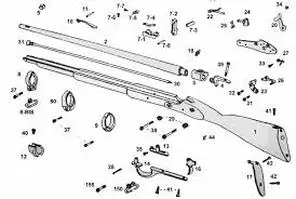
What did Eli Whitney invent that made mass production possible?
Interchangeable Parts
Cotton Gin
Mechanical Reaper
Telegraph

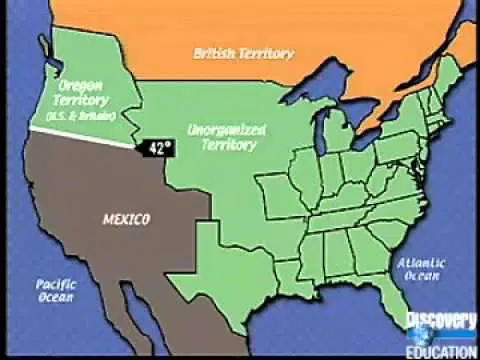
the Mexican War
a purchase from France
the Texan War for Independence
a treaty with Britain
This law required the return of runaway slaves even in free states and affected free African-Americans as well.
Runaway and Return Act
Underground Railroad Act
Fugitive Slave Act
Southern Slave Act
This novel by Harriet Beecher Stowe brought awareness to slavery and helped increase abolition.
The Underground Railroad
The Scarlet Letter
Uncle Tom's Cabin
The Narrative of the Life of Frederick Douglass
What does Sectionalism mean?
A loyalty to a belief in one's section/region of the U.S.
A loyalty to a belief in one's house.
An opposition to a belief in one's section/region of the U.S.
A disagreement to a living in one's section/region of the U.S.
What does the Reconstruction Era consist of?
rebuild the North and readmit the Union states back into the South
rebuild the West and readmit the Confederate states back into the Union
rebuild the West and readmit the Union states back into the Confederacy
rebuild the South and readmit the Confederate states back into the Union

Lincoln was elected president.
the Confederates fired on Fort Sumter in Charleston Harbor
South Carolina seceded from the Union.
Union troops attacked Confederate troops at Bull Run in Virginia.

Which 2 battles of the Civil War took place in Union territory?
Battles of Bull Run and Petersburg
Battles of Vicksburg and Chancellorsville
Battles of Saratoga and Yorktown
Battles of Antietam and Gettysburg
American statesman and politician who served as President of the Confederate States of America for its entire history from 1861 to 1865
James K. Polk
Jefferson Davis
Abraham Lincoln
Thomas “Stonewall” Jackson

Who was the Confederate general that surrendered to General Grant at Appomattox Courthouse in 1865 ending the Civil War?
Stonewall Jackson
Robert E. Lee
Winfield Scott
Abraham Lincoln

This Freedmen's Bureau was created after the Civil War to...
establish churches to provide aid in the Southern states.
reunify the former Confederate States and to craft a plan to readmit them to the Union.
establish schools and provide job training to former slaves in the South.
abolish former Confederate governments and to punish former Confederate leaders.
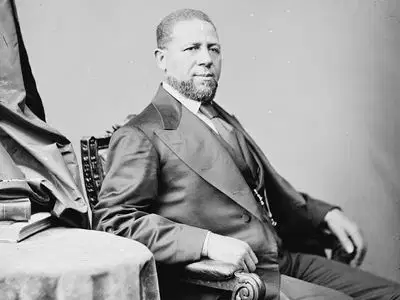
Who was the First African American to become a Senator from Mississippi?
Harriet Tubman
Hiram Rhodes Revels
William Carney
Phillip Bazaar
During the Civil War: factories, larger population, access to the telegraph, and a better navy
Southern advantages
Northern advantages
Reasons for Southern victory
Cause of the battle of Gettysburg
What was the purpose of the Black Codes after the Civil War?
To provide services for newly freed African Americans
To help African Americans exercise their rights
To limit the rights of African Americans
To help white farmers exercise their rights
Which of the following was one of the effects of the Kansas-Nebraska Act?
Kansas and Nebraska were united into one territory
Residents could vote on the issue of slavery
Banned slavery in both Kansas and Nebraska
Allowed slavery in both Kansas and Nebraska
*Popular essayist and author
*Promoted individualism and self-reliance
*Works included "Nature" and "The American Scholar"
Which movement did Emerson lead?

