wayground logo

Free Printable Worksheets

Font size

S
M
L
XL
Worksheets

Biology EOC Review

Total questions: 55

Worksheet time: 1hrs 13mins

Name
Class
Date
1.

The two kinds of cells are Prokaryotes and Eukaryotes. How are they different?

a)

Prokaryotes are plant cells

b)

Eukaryotes have a nucleus

c)

Prokaryotes have a nucleus

d)

There is no difference

2.

Bacteria are a type of...

a)

Prokaryote

b)

Eukaryote

c)

Both

3.

This cell would be classified as a(n) ________________ cell.

a)

Prokaryotic

b)

Eukaryotic

c)

Both

4.

Where photosynthesis occurs; in plant cells only

a)

Chloroplast

b)

Cell Wall

c)

Endoplasmic Reticulum

d)

Mitochondria

5.

builds proteins, each cell contains thousands, found on ER and floating throughout cell

a)

Ribosomes

b)

Nucleus

c)

Vacuole

d)

Golgi Body

6.

moves materials around in the cell, two types: smooth and rough

a)

Cytoplasm

b)

Nucleus

c)

Vacuole

d)

Endoplasmic Reticulum

7.

smallest unit of life

a)

Human

b)

Cell Wall

c)

Cell

d)

Plants

8.

Which two systems work together to maintain homeostasis while transporting oxygen throughout the body and removing carbon dioxide?

a)

circulatory and respiratory

b)

respiratory and excretory

c)

circulatory and digestive

d)

respiratory and digestive

9.

How can bacteria enter the digestive systems?

a)

By breathing it in

b)

By eating it

c)

By urinating

10.

How can bacteria enter the digestive systems?

a)

By breathing it in

b)

By eating it

c)

By urinating

11.
Homeostasis
a)
allows for a wildly fluctuating internal environment
b)
is impossible in vertebrates
c)
is the maintenance of a relatively stable internal environment and often incorporates a form of feedback regulation
d)
is the maintenance of a relatively stable external environment and often incorporates a form of feedback regulation
12.
The maintenance of an organism’s internal environment is called:
a)
compensating
b)
homeostasis
c)
balancing
d)
routine
13.
Name the levels of organization in the human body in order from smallest to largest:
a)
Tissue, organ, organ system
b)
Organ system, tissue, organs, cells
c)
Cells, tissue, organs, organ system
d)
Cells , organs, tissue, organ system
14.
Failure in the production, secretion and intake of insulin by target cells can cause
a)
diabetes insipidus
b)
hypoglaecemia
c)
hyperglaecemia
d)
diabetes mellitus
15.
After nerve impulse is sent to the respiration control centre and cardiovascular centre, nerve impulse is sent to the following target EXCEPT
a)
cardiac muscle
b)
skeletal muscle
c)
diaphragm
d)
intercostal muscle
16.

When you are cold, you shiver and your blood vessels contract, which warms you up. When you are hot, you sweat and your blood vessels expand, which cools you down.

a)

False

b)

True

17.
The maintenance of an organism’s internal environment is called:
a)
compensating
b)
homeostasis
c)
balancing
d)
routine
18.
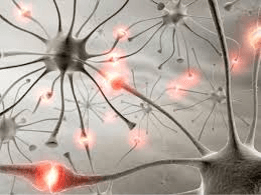
a body system that controls and coordinates all body activities through electric impulses/messages between brain, spinal cord and nerves.
a)
endocrine system 
b)
nervous system
c)
nerve
d)
neuron
19.
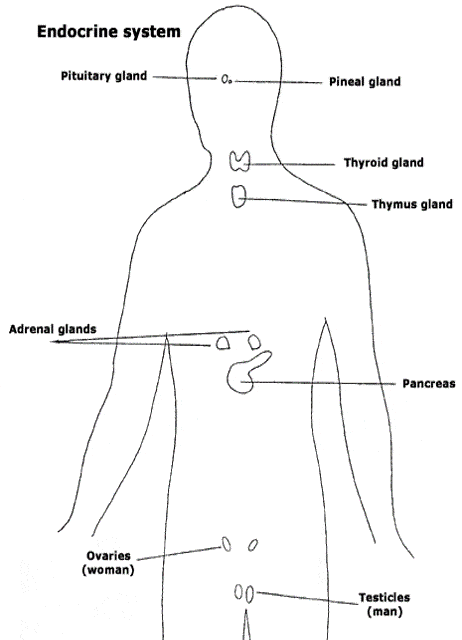
a body system that controls growth and homeostasis by secreting hormones from glands.
a)
skeletal system
b)
nervous system
c)
endocrine sytem
d)
integumentary system
20.
Name the levels of organization in the human body in order from smallest to largest:
a)
Tissue, organ, organ system
b)
Organ system, tissue, organs, cells
c)
Cells, tissue, organs, organ system
d)
Cells , organs, tissue, organ system
21.
Most bacteria that cause sickness in humans grow best at 98.6oF. Sometimes a fever is the body's response to the bacteria. What is the reason for developing a fever?
a)
To lower the temperature of the body to kill the bacteria
b)
The increase the temperature of the body to kill the bacteria
c)
To allow the bacteria to take over
d)
To make you feel miserable
22.

You are growing a tomato plant in your house. Which of the following would the plant probably do to help maintain homeostasis?

a)

Grow away from the light coming from the window

b)

Grow toward the light coming from the window

c)

Growth is not affected by the light coming from the window

23.

Cells of organisms must go through cell division for?

a)

growth

b)

repair of damaged cells

c)

replacement of dying cells.

d)

All of these

24.

DNA is replicated during ______ of the cell cycle.

a)

Gap 1

b)

Synthesis (S phase)

c)

Gap 2

d)

Gap 0

25.
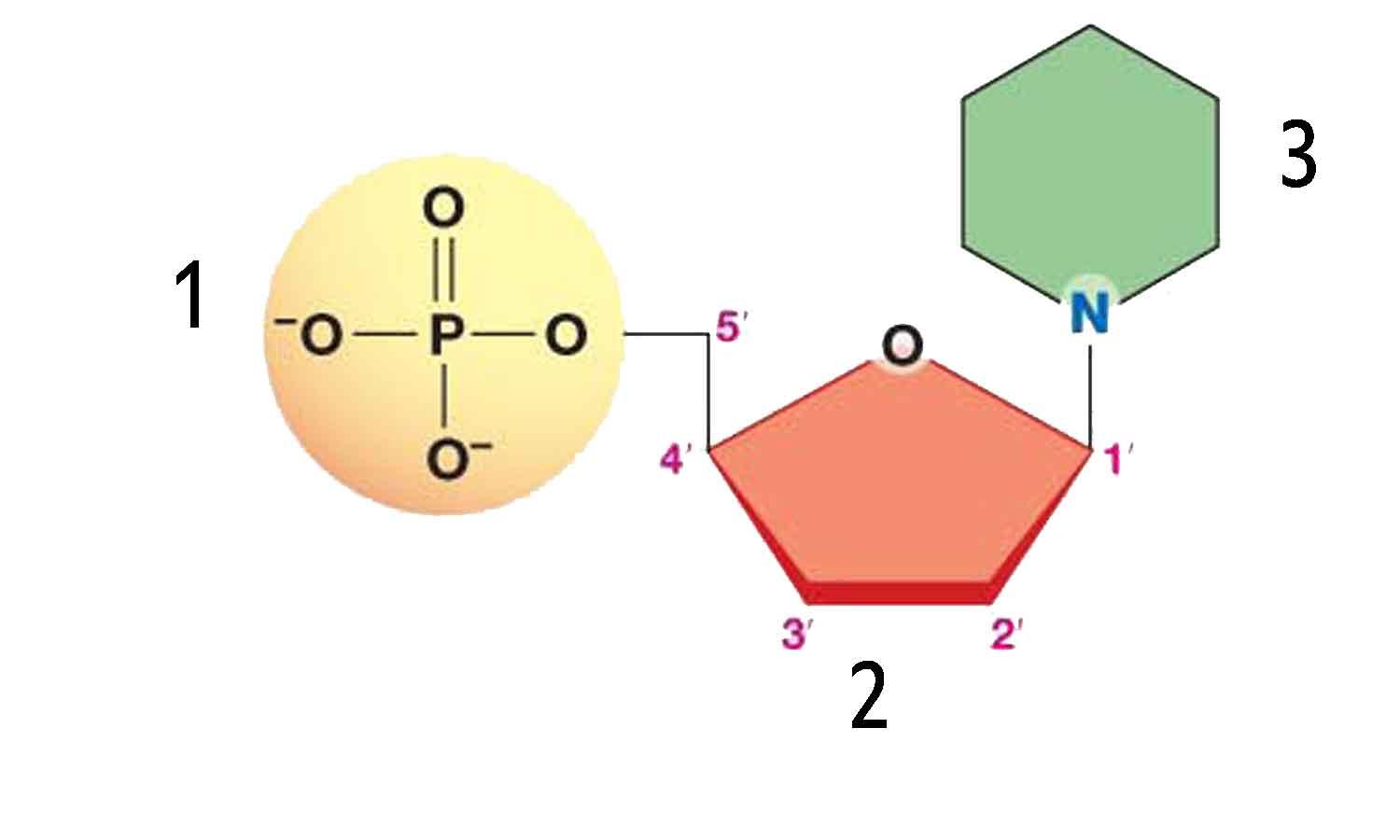
Identify the parts of the nucleotide shown:
a)
1) Ribose Sugar      2) Phosphate 
3)  Nitrogen Base
b)
1) Deoxyribose Sugar
2) Phosphate
3) Nitrogen Base
c)
1) Phosphate
2) Ribose Sugar
3) Nitrogen Base
d)
1)  Phosphate
2) Deoxyribose Sugar
3)  Nitrogen Base
26.

In prophase of mitosis, chromosomes

a)

form and the nuclear envelope disappears.

b)

are pulled toward opposite ends of the cell.

c)

chromosomes line up along the equator of the cell

d)

chromosomes begin to decondense and the two new nuclei begin to form.

27.

In telophase of mitosis, chromosomes

a)

form and the nuclear envelope disappears.

b)

are pulled toward opposite ends of the cell.

c)

chromosomes line up along the equator of the cell

d)

chromosomes begin to decondense and the two new nuclei begin to form.

28.

When cells go through mitosis repeatedly without entering interphase, this results

a)

arthritis

b)

cancer

c)

mutation

d)

diabetes

29.
What phase is this cell in?
a)
Cytokinesis
b)
Mitosis
c)
Prophase
d)
Metaphase
30.
What phase is this cell in?
a)
Mitosis
b)
Cytokinesis
c)
Prophase
d)
Telophase
31.
What phase is this cell in?
a)
Mitosis
b)
Interphase
c)
Anaphase
d)
Telophase
32.
What phase is this cell in?
a)
Mitosis
b)
Interphase
c)
Prophase
d)
Telophase
33.
Which process and type of resulting cells are represented?
a)
mitosis, gametes
b)
mitosis, body cells
c)
meiosis, gametes
d)
meiosis, body cells
34.
A male shark has 40 chromosomes in each of its sex cells. How many would be present in its body cells?
a)
20
b)
40
c)
80
d)
160
35.
What do experts say is the most common form of Down Syndrome?
a)
Trisomy 47
b)
Trisomy 46
c)
Trisomy 21
d)
Trisomy 23
36.
What is this?
a)
Trisomy 13
b)
Monosomy 21
c)
47, XXY
d)
Trisomy 21
37.
How can a person's muscle cells have the same exact DNA sequences as their nerve cells even though the look and perform completely different?
a)
The two different cells become mutated
b)
The proteins expressed in each cell are different
c)
They actually have different DNA in the two types of cells.
d)
The genome of the different cells changes
38.
_______ is to transcription as ________ is to translation.
a)
mRNA / Amino Acid Chain
b)
Amino Acid Chain / mRNA
c)
Ribosome / Nucleus
d)
mRNA / tRNA
39.
____ is the activation of a gene that results in transcription.
a)
Gene expression
b)
Gene technology
c)
Eukaryotic expression
d)
Prokaryotic expression
40.

Translation is a process where:

a)

a polypeptide sequence is produced from a sequence of rRNA codons.

b)

a polypeptide sequence is produced from a sequence of tRNA codons.

c)

a polypeptide sequence is produced from a sequence of mRNA codons.

d)

a DNA nucleotide sequence is used to produce mRNA codon sequence.

41.
Which of the following is the correct equation for PHOTOSYNTHESIS?
a)
CO+ light + H2O --> O+ Sugar
b)
CO+ sugar + H2O --> O+ light
c)
O2 + light + H2O --> CO+ Sugar
d)
CO+ O2 + H2O --> Light+ Sugar
42.
Which organelle performs PHOTOSYNTHESIS?
a)
Chloroplast
b)
Mitochondria
43.
What is the ultimate ORIGINAL source of energy for living things
a)
Sugar
b)
Sun
c)
Moon
d)
Carbon Dioxide
44.
How does carbon dioxide get into the leaves of a plant?
a)
It's absorbed by the roots
b)
It's made in a chemical reaction in the stem
c)
It enters through the stomata
d)
It goes through the flowers
45.
What is the function of NADPH and ATP?
a)
They absorb light
b)
They power the light-dependent reactions
c)
They are light-reflecting pigments
d)
They are short term energy carriers
46.

Which of these are limiting factors for photosynthesis? Choose 3 answers.

a)

Light intensity

b)

CO2 concentration

c)

Temperature

d)

Light

e)

CO2 levels

47.

The term aerobic means

a)

wine-making

b)

with carbon dioxide

c)

without carbon dioxide

d)

with oxygen

e)

without oxygen

48.

Humans use calories they obtain from ____ as their energy source.

a)

food

b)

water

c)

sunlight

d)

minerals

49.
Any change in the sequence of DNA is...
a)
transgenic shift
b)
Single Genotype
c)
Monohybrid Trait
d)
Mutation
50.

What are the building blocks of proteins called?

a)

DNA

b)

RNA

c)

Ribosomes

d)

Amino Acids

51.
Which of the following would result in a frameshift mutation?
a)
Insertions only
b)
Substitution only
c)
Deletion only
d)
Insertions and Deletions
52.
Are all mutations bad?
a)
Yes
b)
No
c)
Maybe?
53.
Mutated DNA sequences that can be passed from parent to offspring --
a)
occur in somatic cells (body cells)
b)
occur in gametic cells (sex cells)
c)
are rejected by meiosis
d)
only occur if the parent is exposed to harmful substances
54.
In a molecule of double-stranded DNA, the amount of Adenine present is always equal to the amount of
a)
cytosine
b)
guanine
c)
thymine
d)
uracil
55.
Why is the order of amino acids so important?
a)
The order of amino acids dictates what shape the protein will fold into.
b)
It is not important. The protein folding chamber will force the protein to fold into the correct shape.