wayground logo

Free Printable Worksheets

NEW

Font size

S
M
L
XL
Worksheets

Atomic Structure

Total questions: 47

Worksheet time: 37mins

Name
Class
Date
1.

What is the smallest unit of matter? It is composed of protons and neutrons, held together in the nucleus, and electrons around the nucleus in different electron orbitals, which form an electron cloud.

a)

cell

b)

nucleus

c)

atom

d)

electron

2.

What is a subatomic particle with a positive charge that is in the nucleus of an atom?

a)

neutron

b)

proton

c)

electron

d)

valence electron

3.

What is a subatomic particle without an electric charge, located in the nucleus of an atom?

a)

neutron

b)

proton

c)

electron

d)

valence electron

4.

What is a subatomic particle with a negative charge? It is found in the electron cloud surrounding the nucleus.

a)

neutron

b)

proton

c)

electron

d)

electron cloud

5.

What is the system of electrons surrounding the nucleus of an atom?

a)

valence electrons

b)

nucleus

c)

electrons

d)

electron cloud

6.

What is the center of an atom containing protons and neutrons?

a)

nucleus

b)

neutron

c)

proton

d)

electron cloud

7.

What is the number of protons in the nucleus of an atom that determines the chemical properties of an atom?

a)

mass number

b)

atomic mass

c)

atomic number

d)

atomic symbol

8.

What is the combined mass of all the protons and neutrons of an atom and is approximately equal to the number of protons and neutrons?

a)

atomic mass

b)

atomic number

c)

subatomic particles

d)

nucleus weight

9.

What is material that has mass and takes up space?

a)

volume

b)

mass

c)

matter

d)

density

10.

The atomic number identifies the number of __________.

a)

electrons

b)

atoms

c)

protons

d)

neutrons

11.

The number 16 for the atomic element sulfur is the

a)

ionic number

b)

isotope

c)

atomic mass

d)

atomic number

12.

How many protons does sulfur have?

a)

32

b)

16

c)

48

d)

12

13.

How many electrons does sulfur have

a)

16

b)

32

c)

48

d)

12

14.

The name of this particle means indivisible and it is the building block of matter

a)

molecule

b)

compound

c)

atom

d)

isotope

15.

The center of an atom is called the ________________.

a)

electron cloud

b)

nucleus

c)

neutrion

d)

nuetron

16.

In what part of an atom can the protons and neutrons be found?

a)

nucleus

b)

neutrine

c)

electron cloud

d)

proton cloud

17.
These will determine what element an atom is. 
a)
number of neutrons
b)
number of electrons
c)
number of atoms 
d)
number of protons 
18.

In an atom, the number of protons is equal to the number of ____________.

a)

energy levels

b)

neutrons

c)

neurons

d)

electrons

19.
What is the atomic mass of "F"
a)
9
b)
18
c)
17
d)
19
20.
An atom of the element with atomic number 6 always has _____.
a)
six protons in its nucleus
b)
an atomic mass of six
c)
more than six neutrons
d)
six electron clouds
21.
What are subatomic particles? 
a)
the nucleus 
b)
electron cloud
c)
positive charge
d)
electrons, protons, and neutrons
22.
How many protons are in this element?
a)
79
b)
196
c)
117
d)
Cannot be determined
23.
How many electrons does potassium K contain? (click to see image)
a)
19
b)
39
c)
20
d)
40
24.

How many neutrons does a Hydrogen atom have?

a)

1

b)

2

c)

3

d)

0

25.

How many electrons does an Iodine atom have?

a)

53

b)

126

c)

73

d)

179

26.

How many electrons does a Copper atom have?

a)

63

b)

29

c)

92

d)

34

27.
How many protons are in Beryllium?
a)
4
b)
9
c)
5
d)
2
28.

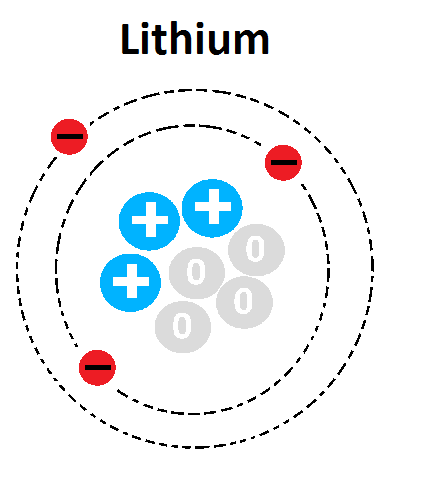
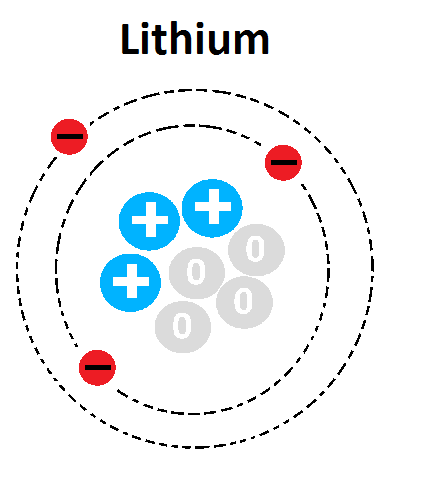
What is the atomic number of this atom?

a)

1

b)

3

c)

4

d)

7

29.

What is the mass number of this atom?

a)

1

b)

3

c)

4

d)

7

30.
Most of the mass in an atom is made up of _____________________?
a)
protons and electrons
b)
protons and neutrons
c)
neutrons and electrons
d)
electrons and quarks
31.
In order for an atom to be neutral what has to be true?
a)
The atom has more protons than neutrons
b)
The atom has more neutrons than protons
c)
The atom has the same number of protons and neutrons
d)
The atom has the same number of protons and electrons
32.
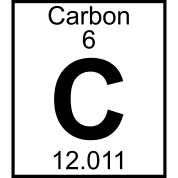
What does the C represent?
a)
atomic mass
b)
atomic number
c)
element name
d)
chemical symbol 
33.

What does the 6 represent?

a)

Atomic mass

b)

atomic number

c)

chemical symbol

d)

element name

34.
How is the number of neutrons in the nucleus of an atom calculated?
a)
Add the number of e- and p+ together
b)
Subtract the number of e- from p+
c)
Subtract the number of p+ from the mass number
d)
Add the mass number to the number of e-
35.
Which subatomic particles contribute the most to the mass of an atom?
a)
Protons, Neutrons, Electrons
b)
Protons only
c)
Protons and Electrons
d)
Protons and Neutrons
36.
If an atom has 12 positively charged subatomic particles, which of the following must it also have to be considered a neutral atom?
a)
12 neutrons
b)
12 electrons
c)
12 protons
d)
24 protons and neutrons
37.

An atom has 10 protons, 15 neutrons and 10 electrons what is its mass number.

a)

20

b)

10

c)

35

d)

25

38.

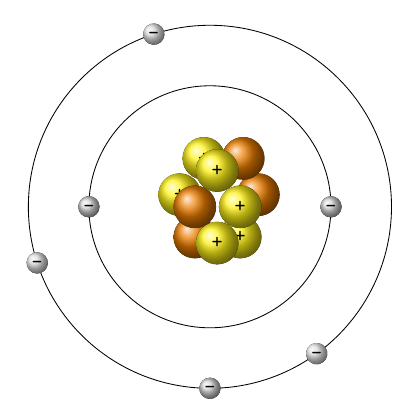
How many electrons does this atom have?

a)

2

b)

4

c)

6

d)

10

39.
The atomic number of an element that has 9 protons, 9 electrons, and 10 neutrons is _____.
a)
9
b)
10
c)
19
d)
28
40.
An element with a mass number of 11 and an atomic number of 5 has how many neutrons?
a)
11
b)
5
c)
6
d)
16
41.
What is the atomic number of the atom pictured? 
a)
9
b)
10
c)
18
d)
19
42.
In the Bohr model of the atom, electrons can only be in certain _____
a)
shells
b)
nuclei
c)
frames
d)
circles
43.
In the Bohr model of the atom, what is the maximum number of electrons in the first shell?
a)
1
b)
2
c)
6
d)
8
44.
In the Bohr model of the atom, what is the maximum number of electrons in the second shell?
a)
2
b)
6
c)
8
d)
18
45.

Isotopes are created by changing the number of ___________ an element has.

a)

electrons

b)

protons

c)

neutrons

46.

Ions are created when metals _______ electrons and nonmetals ________ electrons.

a)

lose, gain

b)

gain, lose

c)

share, lose

47.

An anion is created when an atom _______ electrons and has a _______ charge. A cation is created when an atom _______ electrons and has a _____________ charge.

a)

loses, positive, gains, negative

b)

loses, negative, gains, positive

c)

gains, positive, loses, negative

d)

gains, negative, loses, positive