wayground logo

Free Printable Worksheets

Font size

S
M
L
XL
Worksheets

3rd Nine Weeks Review (6th Advanced)

Total questions: 42

Worksheet time: 29mins

Name
Class
Date
1.
Which system uses hormones to regulate body activities?
a)
Integumentary
b)
Excretory
c)
Endocrine
d)
Nervous
2.
This system carries oxygen, nutrients and waste around the body.
a)
Integumentary
b)
Excretory
c)
Respiratory
d)
Circulatory
3.
I bring oxygen into the body and remove carbon dioxide.
a)
Respiratory System
b)
Skeletal System
c)
Endocrine System
d)
Excretory System
4.

I eliminate waste and extra water from the blood in the form of urine.

a)

Reproductive System

b)

Muscular System

c)

Nervous System

d)

Excretory System

5.
Which of the following correctly lists the levels from most simple to most complex?
a)
cell, tissue, organ, organ system, organism
b)
organism, organ system, organ, tissue, cell
c)
organism, organ system, tissue, organ, cell
d)
cell, tissue, organ, organism, organ system
6.

Which organ system works like cell membrane and protects the body from the environment?

a)

integumentary system

b)

muscular system

c)

skeletal system

d)

nervous system

7.

Which cell part has a similar function to the skeletal system?

a)

cell membrane

b)

cell wall

c)

chloroplast

d)

nucleus

8.
When a threatening situation appears, what is the name of the instinctive mechanism used by animals to protect themselves?
a)
Flight or Run
b)
Hide and Seek
c)
Fight or Flight
d)
Run and Fight
9.

Most bacteria that cause sickness in humans grow best at 98.6oF. Sometimes a fever is the body's response to the bacteria. What is the reason for developing a fever?

a)

To lower the temperature of the body to kill the bacteria

b)

To increase the temperature of the body to slow the spread of bacteria

c)

To allow the bacteria to take over

d)

To make you feel miserable

10.
What is the evaporation of a liquid to cool the body?
a)
Shivering
b)
Sweating
c)
Vasodilation
d)
Vasoconstriction
11.

Which organ system works most like the mitochondria of the cell, which provides energy?

a)

digestive system

b)

respiratory system

c)

endocrine system

d)

muscular system

12.
This organelle is known as the "powerhouse" because it provides energy for the cell.
a)
Cell membrane
b)
Vacuole
c)
Lysosome
d)
Mitochondria
13.

Which of the following is NOT part of cell theory.

a)

All cells can move.

b)

All cells come from pre-existing cells.

c)

Cells are the basic unit of structure and function of all living things.

d)

All living things are made of cells.

14.
Your teacher provides you with a slide of a cell.  Under the microscope, you locate a cell wall, a nucleus, and some chloroplasts.  Which statement is true?
a)
This cell is a plant cell because it has a nucleus.
b)
This cell is an animal cell because it has a cell wall.
c)
This cell is an plant cell because it has a cell wall.
d)
This is an animal cell because it can perform photosynthesis.
15.
Which is not a difference between plant and animal cells?
a)
Plant cells have a cell wall.
b)
Plant cells have a chloroplast.
c)
Plant cells have no vacuole.
d)
Plant cells have a larger vacuole.
16.
What would happen to the plant cell without the chloroplasts?
a)
There wouldn't be an organelle that performs photosynthesis.
b)
There wouldn't be an organelle that serves as the resevoir for water and waste.
c)
There wouldn't be an organelle that regulates what comes in and out of the cell.
d)
They wouldn't be an organelle that makes necesary proteins.
17.
Which is NOT an organelle found in both plant and animal cells?
a)
Vacuole
b)
Mitochondria
c)
Cell wall
d)
Cell membrane
18.
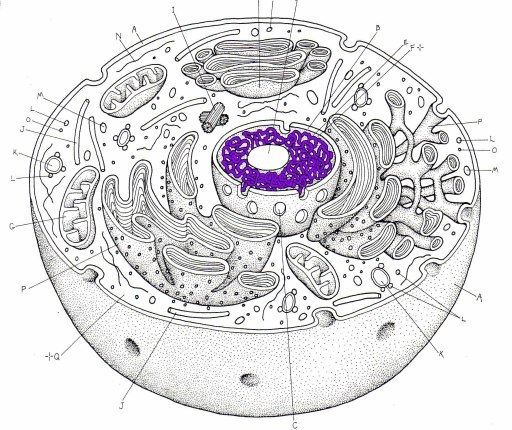
What kind of cell is this?
a)
Eukaryotic
b)
Prokaryotic
19.
What type of cell has a nucleus? 
a)
eukaryotic
b)
prokaryotic 
20.
Jack has a rock. The rock has a mass of 14g and a volume of 2cm3. What is the density of the rock?
a)
7 mL
b)
7 g/cm3
c)
28 g/cm3
d)
1/7 g/cm3
21.

What is the density of the fish with a mass of 2 grams?

a)

3.0 g/cm3

b)

2.0 g/cm3

c)

6.0 g/cm3

d)

12.0 g/cm3

22.
Why do plants wilt?
a)
low turgor pressure
b)
high turgor pressure
c)
too much water
d)
no cell membrane
23.

A houseplant is placed on a window sill that gets direct, bright sunlight every afternoon. The plant starts to grow toward the window. What kind of response is described by this situation?

a)

Gravitropism

b)

A negative response to a stimulus

c)

Gravitropism

d)

Phototropism

24.
Iron is a good conductor, malleable and magnetic. What type of element is Iron? 
a)
Metal
b)
Nonmetal
c)
Metalloid
d)
Pretty
25.
Silicon is a semiconductor and has properties of both metals and nonmetals. What type of element is Silicon? 
a)
Metal
b)
Nonmetal
c)
Metalloid
d)
Pretty
26.

Which of the following is not a compound?

a)

HCl

b)

Cl

c)

NaCl

d)

CO2

27.

At which point of the roller coaster is potential energy the greatest?

a)

W

b)

X

c)

Y

d)

Z

28.

At which point is the potential energy the lowest and the roller coaster is going the fastest?

a)

W

b)

X

c)

Y

d)

Z

29.
What part of the chromosome codes for traits?
a)
Genes
b)
Deoxyribonucleic Acid
c)
Chromosomes
d)
Nucleus
30.
The passing of genetic traits from parent to offspring is
a)
Heredity
b)
Trait
c)
Gene
d)
Allele
31.
What is an advantage of sexual reproduction?
a)
Allows genetic variation
b)
Only needs one parent
c)
Happens very quickly
d)
Offspring are exact copies of parent
32.
What are some of the facts about asexual reproduction?
a)
Takes only one mate to reproduce and takes a longer time to reproduce
b)
Takes a shorter amount of time to reproduce and it takes two mates to reproduce
c)
Reproduces diverse offspring and takes a longer time to reproduce
d)
Takes only one mate to reproduce and takes a shorter time to reproduce
33.
Electrical -> Mechanical -> Sound 
a)
A triple beam balance measuring an object’s mass
b)
A pencil sharpener plugged into a wall outlet
c)
A projector displaying a diagram on the screen
d)
A working flashlight used to light up a dark corner
34.
A hot air balloon has the following energy transformations__________.
a)
Thermal-Chemical-Electrical
b)
Chemical-thermal-mechanical 
c)
Thermal-Mechanical 
d)
Thermal-Chemical
35.
The illustration provided shows a river and four cities on that river. When the water from the river was sampled at location X, it was determined to be polluted with various chemicals. What would be the most likely source for this pollution?
a)
City 1 and City 2
b)
City 2 and City 3
c)
City 3 and City 4
d)
City 1 and City 4
36.

What is the control center or brain of a cell?

a)

Mitochondria

b)

Ribosome

c)

Nucleus

d)

Cell membrane

37.
This organelle stores food and water for the cell.
a)
Cytoplasm
b)
Cell Wall
c)
Vacuole
d)
Nucleus
38.
Which structures are present in both plant and animal cells?
a)
vacuole, chloroplast, cell wall
b)
cell membrane, cell wall, nucleus
c)
ribosome, cell membrane, chloroplast
d)
mitochondria, nucleus, cell membrane
39.
What is a gene?
a)
An entire chromosome that  codes for a trait
b)
a piece of clothing
c)
a piece of a DNA on chromosome that codes for a trait
d)
Chemical messengers in your brain that code for a trait
40.
Which characteristic would a child not inherit from one or both of its parents?
a)
freckles
b)
hair style
c)
eye color
d)
dimples
41.
Sexual or asexual reproduction?
a)
Asexual
b)
Sexual
42.
True or false:  Some plants reproduce sexually.
a)
True.  Through pollination, DNA from two plants can be combined. 
b)
False. Plants can't have sex.